(
(


As a landlord, you have the right to conduct thorough background checks on potential tenants. These checks are crucial to ensure that you are selecting reliable and financially responsible tenants for your rental property. One way you can do this is by asking applicants to provide bank statements as part of the rental application process. But can landlords ask for bank statements?
In this article, I will talk about the rules around requesting bank statements and provide landlords like you with guidance on how to ask for this financial documentation when screening applicants. My goal is to help landlords make well-informed leasing decisions while respecting applicants’ financial privacy. Let’s get started!
Can Landlords Ask for Bank Statements?
Of course yes, landlords can ask for bank statements as part of the rental application process to verify your prospective tenant’s eligibility for occupying the rental units. As long as you are following non-biased tenant screening procedures, most legal experts agree you are within the right to ask for bank statements. Also, get to know about illegal rental application questions that you are not allowed to ask.
Here are the major points regarding the legality of asking for bank statements:
- Banking information provided by a tenant is considered a financial record rather than information collected directly from a financial institution. As long as the landlord has a legitimate reason for the request, such as verifying income or assets, it is allowed.
- The Fair Credit Reporting Act (FCRA) gives landlords permission to request financial records like bank statements for tenant screening purposes. The FCRA considers this a permissible use.
- Discrimination laws do not prohibit landlords from uniformly asking all applicants for bank records. Landlords may make the request, but they can’t use it to illegally discriminate against protected classes.
- Some local laws might place more restrictions on asking for banking data. Landlords need to research applicable laws in their city or state. But in general, simply requesting bank statements upfront is lawful.
[Also Read: Landlords Guide to Renting to Section 8 Tenants]
What Do Landlords Look for in Bank Statements?
This would add practical value. Landlords aren’t looking for a perfect financial history of a tenant. They want to see that a tenant is reliable, financially stable, and able to pay rent on time.
Here are the things landlords typically look for:
- Steady income: Enough regular income to cover rent & daily expenses.
- Account habits: Fewer or no overdrafts, missed payments, or any signs of financial trouble.
- Payment history record: A record of paying rent and bills on time.
- Proof of Tenant Income: Documents showing employment or any other income sources.
- Consistent information: Details that match all the rental applications and other documents.
Sharing accurate data with the property managers from the beginning can make the rental process easier and help applicants stand out. For landlords, reviewing the full application instead of focusing on a single document helps create a fairer & more informed screening process.
Potential Benefits for Landlords to Request Bank Statements
In the world of real estate, you have to play a crucial role in ensuring the smooth operation of rental properties. So, requesting bank statements from potential tenants provides valuable insights that can positively impact your’s business and contribute to long-term success. Though some tenants may find this intrusive, there are several potential benefits to request bank statements for rental application.

Verifying Income and Employment
Bank statement help to verify an applicant’s income and employment status. You need to ensure that tenants have a steady source of income to cover their monthly rent and other expenses associated with the property. The landlord can also run credit checks on tenants and other credit verification documents to verify it.
Legal Compliance and Documentation
In some states, you have legal obligations to assess a tenant’s ability to pay rent. Collecting and reviewing bank statements can be part of this due diligence process, ensuring that the landlord is making informed decisions in compliance with local housing laws.
Improved Tenant Selection
Access to bank statements allows you to make more informed decisions about potential tenants during the tenant screening process. You can verify income, spending habits, and financial management skills, which contributes to a more comprehensive evaluation of the applicant.
Reduced Risk of Non-Payment
By analyzing a tenant’s bank statements, you can identify signs of responsible financial behavior, including regular income deposits, consistent bill payments, and prudent spending. This information helps reduce the risk of renting to tenants who are struggling to meet rental obligations.
[Also Read: Tenant Not Paying Rent? Here’s What To Do As a Landlord]
Strengthening Lease Agreement
The information obtained from bank statements can be valuable when drafting the lease agreement. You can customize lease terms based on the tenant’s financial strengths and weaknesses, potentially leading to more mutually beneficial arrangements.
Minimized Vacancy Rates
Assessing a tenant’s financial stability through bank statements can contribute to the selection of tenants more likely to maintain a stable and long-term occupancy. This benefits landlords by reducing turnover and associated costs, such as advertising, screening, and property turnover expenses. Learn how to minimize vacancy rate for rental property.
Positive Tenant-landlord Relationship
A thorough financial assessment can contribute to a more transparent and trustful tenant-landlord relationship. Clear communication and understanding of each party’s financial expectations can foster a positive rental experience for both the landlord and the tenant.
Best Practices for Requesting Bank Statements
Even after careful consideration, if you still feel bank statements are critical to sufficiently screen applicants, you must explain clearly in the application materials why statements are being requested. Here are the best practices to balance legitimate screening needs and privacy rights:
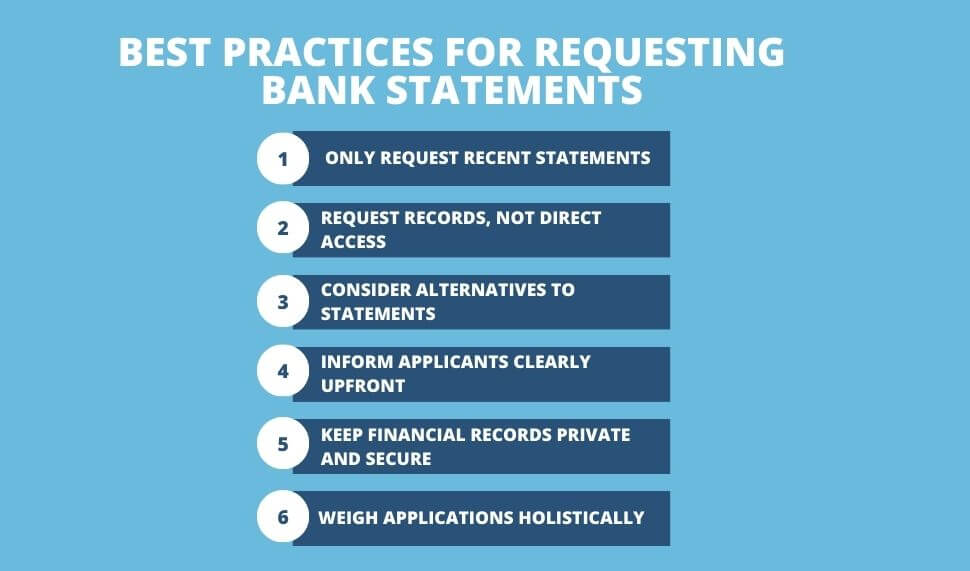
Only Request Recent Statements
Asking for statements from the past 3-6 months is usually sufficient to verify an applicant’s current income sources and payment activity. Requesting indefinitely long bank records can be excessive.
Request Records, Not Direct Access
Ask applicants to provide copies or redacted screenshots of statement pages rather than login credentials or direct access to their bank account. This protects privacy on both sides.
Consider Alternatives to Statements
There are often viable financial verification options besides statements like pay stubs, tax returns, reference letters from employers, or other documents to show their income source. For those applicants with limited financial history, propertyowners may also consider alternatives like requiring a co-signer or rental gurantor. Use a variety of methods.
Inform Applicants Clearly Upfront
State the statement request policy openly as a part of your rental applciation requirements, in advertisements and initial conversations. Do not surprise applicants with extra document demands late in the application stage. Learn legal reasons to reject prospective tenant application
Keep Financial Records Private and Secure
Shred or delete bank statements and any uploaded files containing sensitive information as soon as the screening process is complete. Do not disclose an applicant’s finances to third parties.
Weigh Applications Holistically
View every part of an application – including financials – as one data point among others. Consider the “whole applicant” and use discretion, especially if statements alone do not clearly prove rental ability.
Situations When Landlords Cannot Legally Demand Bank Statements
While landlords normally have wide latitude for deciding who they rent to, there are certain situations protected under fair housing laws where it would be illegal for them to insist on reviewing applicant bank records:
Requesting Only From Protected Classes: You cannot target demands for increased financial documentation like bank statements just for applicants of a particular race, religion, family status, disability, or other attributes covered by fair housing protections. Requiring extra proof only from members of minority groups would constitute unlawful discrimination.
Failure to Apply Standard Consistently: You must use consistent financial screening criteria uniformly across all applicants without respect to protected attributes. Singling out a person in a protected class and imposing stricter requirements like mandatory bank statement disclosures suggests potential illegal bias or intent to discriminate.
Refusal to Consider Alternative Documentation: As covered above, there are reasonable financial verification options you can request that preserve privacy compared to demanding bank statements. Refusing to accept any alternatives from applicants of protected classes hints at unlawful discrimination rather than legitimate tenant screening.
[Also Read: Illegal Property Management Practices You Should Avoid]
The Legal Rules Behind the Landlord Bank Statement Request
When a landlord requests a bank statement, that request isn’t free for all, as it’s governed by both federal and state law. These laws exist for a good reason: without them, sensitive financial information could easily be misused, putting tenant privacy and trust at risk.
The goal is balance: landlords get a fair way to verify a tenant’s finances, while tenants keep control over their sensitive information. This ensures the rental process remains fair and secure for all parties.
What Does Federal Law Say?
The Fair Credit Reporting Act (FCRA) has set some baseline rules. Landlords must get your written consent before requesting or handling any financial files; they can’t log into your bank account or pull statements on their own.
For instance, if a property owner asks for 3 months of bank statements, you provide the copies yourself; your online banking login is never part of the deal. Once submitted, those documents must be stored securely, whether that’s a locked cabinet for paper or encrypted storage for digital files, and are only used for screening.
Afterward, the owner is required to dispose of them properly, following the FTC Disposal Rules by shredding paper documents or deleting digital ones.
How Bank Statements Rule Vary by State
While federal law applies everywhere in the US, individual states often add extra protections. Here’s how things can look different depending on your location.
Can landlords ask for bank statements in Oklahoma? – Yes, Oklahoma landlords can request bank statements as part of financial screening. However, requests must comply with the Oklahoma Landlord-Tenant Act and federal fair housing law. It allows landlords to set reasonable financial criteria, like proof of income or sufficient funds, but that authority comes with limits.
Can landlords request bank statements in California? – Yes, landlords can request, but California Civil Code 1950.6 limits the request to necessary details like account balance & proof of income. They can’t dig through your account to analyze your spending habits.
Can landlords request bank statements in Florida? – Yes, but every request has to comply with fair housing law. A property owner can’t single out one ethnicity or family type for a bank statement request; that’s straightforward discrimination.
Can landlords request bank statements in Texas? – Yes. Under the Texas Property Code (Title 8, Chapter 92), landlords can set financial screening criteria, including proof of funds. But they are required to protect the data under strict privacy standards and apply the same criteria to every applicant.
Can landlords request bank statements in Illinois? – Yes, landlords in Illinois can ask for bank statements as a part of financial screening. However, requests must comply with the Illinois Human Rights Act and fair housing protections, meaning the same financial criteria must be applied consistently to every applicant.
Can landlords request bank statements in New York? – Yes, and it’s common for New York landlords to request bank statements, pay stubs, or tax returns as part of screening. These common requests still have to follow New York housing and consumer protection laws, and criteria must be applied consistently across every applicant
Common Tenant Concerns About Bank Statement Requests
Rental applicants can worry when you request their bank statements, as it involves sharing their sensitive financial information. Thus, it is important to understand those concerns for addressing them appropriately and maintain a positive relationship with potential tenants. Here are common tenant objections addressed respectfully:

“It’s an Invasion of Privacy”
While banking habits are personal, rental history carries greater risks than employment or court records. You have a duty to mitigate those risks. A well-explained, limited request respects both landlord/tenant interests.
“It Could Expose Me to Identity Theft”
You should reassure tenants that any files containing financial data are kept confidential and shredded securely. Requesting statements, rather than full account numbers reduces identity theft risks.
“You Don’t Need to See My Whole Financial Life”
You should ask for only the minimum data required, such as 2-4 most recent statements. This provides sufficient history without excessive private financial exposure.
“What If I Don’t Want to Share That Level of Detail?”
While bank records are not mandatory, you have the right to deny applications missing key verification details. Tenants unwilling to share statements may be better seeking a landlord requiring less financial vetting.
Conclusion
Requesting bank records as part of rental applications is legally valid when done respectfully and for clear screening purposes. As long as you explain the reason for the request, protect tenant privacy, handle data securely and evaluate applicants fairly even without statements, this verification method need not cause undue hardship or privacy worries for qualified renters. With balanced due diligence and respect for tenants’ financial information, bank statements can serve a legitimate role in screening for reliable residents when circumstances warrant a closer look at an applicant’s finances.
FAQs on Landlords Requesting Bank Statements
How Secure is the Handling of Sensitive Financial Information?
Tenants may be concerned about the security of their financial information. Landlords should use a secure/encrypted upload portal when collecting documents & assure applicants that their data will be handled with utmost confidentiality and destroyed or stored securely after application.
Can landlords use bank statements to discriminate against applicants?
No, landlords cannot use bank statements to discriminate against applicants based on protected characteristics such as race, gender, religion, or disability. They must adhere to fair housing laws and treat all applicants equally.
Can landlords share bank statements with third parties?
No. Landlords should not share bank statements or any bank detail with third parties without the tenant’s explicit consent. Doing so may violate privacy laws and regulations.
Can landlords ask for other financial documents besides bank statements?
Yes, landlords can ask for other financial documents besides bank statements. Some common examples include pay stubs, tax returns, employment verification letters, and references from previous landlords. The specific documents landlords request may vary depending on their rental requirements and the local laws and regulations.
Can Tenants Refuse to Provide Bank Statements for rental application?
Yes, tenants can legally refuse to provide bank statement for rental application. However, landlord may decide not to move forward with your rental application if those documents are part of their standard screening process.
When do landlord ask for proof of funds?
Landlords are most likely to ask for proof of funds when they require extra reassurance that you can afford the rent. This often happens if your income isn’t easy to verify through pay stubs or W-2s. For example, a self-employed worker, a freelancer, a retiree, or someone who has just started a new job can be asked to provide other financial documents.
Some landlords may request proof of funds for a higher-priced rental or when an applicant does not meet the usual income documentation.