(
(



Subletting is when a tenant rents all or part of a rental property to another person while the original lease remains active. The new occupant is the subtenant (also called the sublessee), and the original tenant — the sublessor — usually remains responsible to the landlord for rent, property damage, and lease compliance.
If you’re asking “what is subletting” after receiving a request or finding a new occupant, remember it adds another person without replacing your tenant.
Legal Disclaimer: This article provides general information about subletting in Oklahoma and does not constitute legal advice. Legal requirements depend on the lease, tenancy, property, and specific facts. Consult a licensed Oklahoma attorney before approving, denying, terminating, or enforcing a subletting arrangement.
Key Takeaways
- A separate sublease agreement usually exists between the original tenant and subtenant.
- The original tenant generally remains responsible to the property owner.
- Proposed subtenants should meet lawful, consistently applied screening criteria.
- Written consent and attorney-reviewed documents reduce confusion and risk.
- Oklahoma Title 41 §§10, 11, and 14 address written assent, unauthorized transfers, and certain sublessee remedies.
Who Are the Three Parties in a Sublet?
- Landlord or property owner: owns the property and holds the original lease.
- Original tenant or sublessor: signed the lease and rents the property to another person.
- Subtenant, sublessee, or subletter: occupies all or part of the property under a separate agreement.
The owner has a direct lease agreement with the original tenant, while the sublease agreement connects that tenant and the subtenant. Accepting a subtenant does not automatically release the original tenant or create a replacement lease.
Can a Tenant Sublet All or Part of a Rental?
A tenant may propose the whole home or one bedroom. Permission depends on local laws, the rental lease, occupancy rules, and required landlord approval.
How Does Subletting Work?
A controlled sublease process begins with a written request and the owner’s review. The landlord checks the lease agreement and proposed occupant, applies lawful screening, documents the decision, and requires any approved arrangement to end no later than the original lease.
As part of that review, the proposed subtenant should submit a rental application and undergo lawful, consistently applied background and credit checks.
Who Pays Rent to Whom?
Under a typical sublease, the subtenant pays the original tenant, and the original tenant pays the landlord. Document any different rent-collection route — accepting money directly from an unapproved occupant can create disputes about a direct tenancy.
Who Handles Damage, Maintenance, and Lease Violations?
The original tenant is generally responsible to the landlord for rent, property condition, and lease compliance. The sublease should allocate responsibilities and establish a maintenance-reporting route.
After more than 27+ years in Oklahoma City property management, I have found that unknown occupants make screening, clear communication, repairs, responsibility, and lease enforcement harder.
Sublease vs. Sublet: What’s the Difference?
“Subletting” is the act of renting the property again; a “sublease” is the agreement between the original tenant and subtenant. Think of it this way: Subletting is the verb; sublease is the noun; the contract matters more than the label.
A quick example: Sarah signs a 12-month lease on a two-bedroom in Oklahoma City. Six months in, she takes a temporary work assignment out of state for three months. Instead of breaking her lease, she sublets the apartment to Mike for those three months and signs a sublease agreement with him. Sarah sublets the unit. The sublease is the document Sarah and Mike signed to make it official. Sarah, not Mike, is still on the hook to the landlord.
What’s the Difference Between a Sublease, Assignment, and New Lease?
A sublease preserves the original tenant’s lease. An assignment transfers the tenant’s leasehold interest. A replacement lease means the owner contracts directly with a new tenant after properly ending or amending the former arrangement.
| Arrangement | Agreement structure | Original tenant remains responsible? | Owner has direct agreement with new occupant? |
| Sublease | Original lease + tenant–subtenant agreement | Usually yes | Usually no, unless separately documented |
| Lease assignment | Existing leasehold interest transferred | Depends on documents/release | Usually yes, after assignment |
| Replacement lease | Owner signs directly with new renter | Usually no, after valid release/termination | Yes |
| Roommate added to lease | Lease or addendum names another tenant | Usually yes | Yes |
An assignment does not release the tenant automatically. To replace someone, add them to the existing lease or use a replacement lease.
Do Oklahoma Tenants Need Written Permission to Sublet?
Yes, in most ordinary situations. Title 41 §10 covers tenants with terms not exceeding two years, plus tenants at will or sufferance, and bars transferring all or part of their interest without written landlord assent. Related §§11 and 14 address unauthorized transfers and sublessee rights (below). The official 2026 Oklahoma Landlord and Tenant Act compilation contains the current statutory text.
Which Tenancies Does Title 41 §10 Cover?
Section 10 expressly covers three tenancy categories: a term not exceeding two years, a tenancy at will, and a tenancy by sufferance. It bars those tenants from assigning or transferring all or any part of their term or interest without written landlord assent. The substance of the transfer matters more than the document’s label.
What Does Title 41 §11 Say About an Unauthorized Transfer?
Section 11 addresses a transfer made in violation of §10: the landlord may reenter after giving ten days’ notice to quit and dispossess the tenant, subtenant, or undertenant. Residential landlords should not treat this as permission for a self-help lockout — use attorney-reviewed notice and the required court process.
What Remedy Does Title 41 §14 Give a Sublessee?
A sublessee has the same remedy on the original covenant against the principal landlord as against the immediate lessor. Application depends on the covenant, lease, sublease, and facts — have an Oklahoma attorney review before either party relies on it.
How Do the Lease and Statutes Work Together?
The statutes set legal rules; the lease defines the property’s subletting policy and approval process. A lease cannot remove an applicable statutory requirement — when §10 applies, a silent lease does not eliminate the need for written landlord assent.
| Lease position | Practical effect | Owner action |
| Subletting prohibited | No contractual permission; §10 may also require written assent | Enforce consistently; get legal advice before notice |
| Written consent required | Tenant must request approval before transferring | Apply written criteria, document the decision |
| Conditionally permitted | Tenant must meet screening/occupancy/insurance/date terms | Confirm every condition before approval |
| Silent on subletting | No internal process; §10 still controls when applicable | Review tenancy and statute, document assent or refusal |
What Should the Lease Say About Subletting?
The lease agreement should state whether subletting is prohibited, requires written permission and screening, or is conditionally allowed. Address guests, unauthorized occupants, short stays, further transfers, and violations, using attorney-reviewed language.
Why Might a Landlord Approve or Refuse a Sublet?
The decision should follow the lease, applicable law, insurance requirements, and consistent screening criteria — never assumptions about an applicant or any characteristic protected by fair housing law.
Potential benefits: preserves rent, reduces turnover, helps a reliable tenant return, avoids an early lease break. Makes sense when the tenant has a strong payment history, has found a subtenant with reliable income and references, and the arrangement has a clear end date.
Potential risks: incomplete screening, missed rent, property damage, late fees, delayed repairs, insurance/HOA conflicts, occupancy violations, holdover subtenants, and short-stay licensing or zoning issues.
How Should a Landlord Review a Subletting Request?
Use the same controlled process for every comparable request:
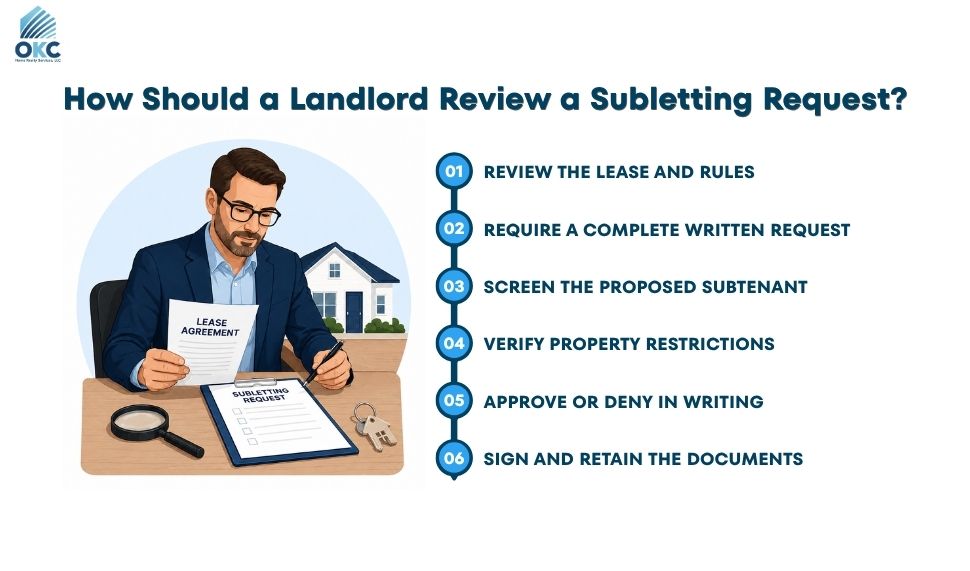
Step 1: Review the Lease and Applicable Rules
Check the lease agreement’s subletting clause, remaining lease term, guest policy, occupancy limits, property rules, insurance, mortgage, and local laws.
Step 2: Require a Complete Written Request
Require the original tenant to submit a formal request for landlord approval that lists the proposed occupant’s name, contact details, dates, reason, and area involved. Avoid protected-class questions.
Step 3: Screen the Proposed Subtenant Consistently
Use the same written standards applied to comparable applicants to identify a suitable subtenant who can pay rent on time. Screen a prospective subtenant instead of relying on the tenant’s recommendation.
The Fair Housing Act applies to rental decisions. If a consumer report influences a negative decision, follow the FCRA guidance for landlords, including permissible purpose and adverse-action duties.
Step 4: Verify Property Restrictions
Confirm that the arrangement will not violate insurance, HOA, occupancy, zoning, mortgage, or short-term-rental restrictions.
Step 5: Approve or Deny the Request in Writing
Identify the applicant, dates, decision, conditions, and documents. Retain supporting records, especially for a denial.
Step 6: Sign and Retain the Documents
The owner may use consent or an addendum and require the sublease. Do not rely on verbal approval involving possession and liability.
Not Sure Whether a Sublet Request Protects Your Rental?
OKC Home Realty Services helps owners maintain consistent applications, professional tenant screening, lease documentation, and resident communication.
Get Your Free Owner Consultation
What Should a Written Sublet Approval or Agreement Include?
- Names and contact details
- Address and area being sublet
- Dates that do not exceed the original lease
- Rent amount, payment schedule, late fees, and collection route
- Security deposit responsibility
- Original lease terms that remain applicable
- Utilities, maintenance, damage, and violations
- Renters-insurance requirements
- Lawful entry procedures
- No further subletting without approval
- Move-out, keys, signatures, and dates
This checklist does not replace an Oklahoma attorney’s review.
What Should a Landlord Do If a Tenant Sublets Without Permission?
- Verify and document the occupancy — not every guest is a subtenant. Determine who lives there, whether rent is paid, what space is possessed, the duration, and whether an agreement exists. Oklahoma law generally requires one day’s notice before nonemergency entry at reasonable times.
- Review the lease before sending notice — the situation may be an unauthorized subtenant, undisclosed roommate, assignment, guest violation, or short-term rental.
- Follow the lawful notice and court process — Title 41 §§10–11 and the Oklahoma Residential Landlord and Tenant Act may interact differently depending on the tenancy and remedy. Never change locks, remove belongings, shut off utilities, or use self-help eviction.
How Can Landlords Prevent Unauthorized Subletting?
- Use clear lease and guest clauses — define what requires approval, how to request it, whether short stays are prohibited, and the required screening.
- Make the request process easy to follow — one contact and a written list of required information.
- Maintain lawful oversight — properly noticed inspections, renewal reviews, and communication; avoid surprise entry, harassment, surveillance, or selective enforcement.
Is Subletting the Same as a Roommate, Guest, Airbnb, or Rental Arbitrage?
No, payment, possession, duration, agreements, lease language, and local rules determine the relationship, not just what the tenant calls the person.
| Situation | Typical feature | Owner response |
| Subtenant | Pays the tenant for possession | Apply the sublet approval/screening process |
| Roommate | Lives in the property, may join the lease | Use an application and addendum or new lease |
| Guest | Temporary visitor, no rental agreement | Apply the lawful guest policy |
| Airbnb guest | Repeated short stays advertised online | Review lease, insurance, HOA, licensing, zoning |
| Rental arbitrage | Tenant earns short-term-rental income | Require express authorization; check all restrictions |
For short stays, review the city’s home-sharing requirements and our rental arbitrage guide.
Conclusion
A sublet adds another occupant and agreement without normally erasing the original tenant’s responsibilities. Oklahoma landlords can reduce risk through written requests, consistent screening, documented approval, attorney-reviewed agreements, and lawful enforcement — while preserving owner control.
Review the lease and law together. Know who occupies the property, owes rent, reports repairs, and returns possession.
Consistent lease management helps owners retain control over screening, documentation, communication, and enforcement. OKC Home Realty Services helps Oklahoma City landlords manage resident requests through a clear process while protecting the property, lease terms, and owner’s interests.
Schedule a Free Owner Consultation
FAQ About Subletting
These answers address common owner questions about permission, responsibility, screening, and enforcement. Because leases and facts differ, Oklahoma landlords should review the current law and obtain legal advice before sending a notice or trying to recover possession.
Is Subletting Legal in Oklahoma?
Subletting can be legal when it complies with Oklahoma law, the lease, and the landlord’s required written consent. Title 41 §10 restricts specified tenants from transferring all or part of their interest without written landlord assent. The exact requirements depend on the tenancy and documents.
Can a Landlord Refuse a Tenant’s Request to Sublet?
A landlord may refuse when the lease prohibits subletting or the request fails lawful, consistently applied requirements. Document the reason and avoid decisions based on protected characteristics. A lease that already grants subletting rights may limit the owner’s options. Keep the review process in writing.
Who Is Responsible for Unpaid Rent or Property Damage?
The original tenant usually remains responsible to the landlord. If the subtenant fails to make rent payments, the original tenant remains responsible for paying rent unless another written agreement changes the relationship. The tenant may have separate rights against the subtenant, which the sublease agreement should address.
Can a Landlord Screen a Proposed Subtenant?
Yes. Landlords can generally require screening when the lease and approval process permit it. Apply relevant written criteria consistently, follow the Fair Housing Act, and comply with the FCRA when using a consumer report. Document the criteria, report use, and final decision in writing consistently.
Can a Tenant Sublet Only One Room?
A tenant may propose subletting one bedroom while remaining in the home. Partial subletting may still require written approval and screening. The owner should review occupancy limits, the guest policy, shared-space responsibilities, insurance restrictions, and the lease. Shared areas also need clear rules in writing.
Can a Subtenant Pay Rent Directly to the Landlord?
The landlord should collect rent directly only when the arrangement is deliberately documented. Accepting money from an unapproved occupant can create confusion about whether the owner recognized a direct tenancy. The agreement should state who pays whom, what the payment means, and whether any tenancy changes.
Is a Roommate Automatically a Subtenant?
No. A roommate might be a named co-tenant, approved occupant, or subtenant depending on the lease, payment arrangement, and rights granted. Review the facts and document whether that person joins the lease or occupies the property in another approved capacity, including their financial responsibilities clearly.
What Happens When the Original Lease Expires?
A sublease should not extend beyond the original tenant’s right to occupy. The subtenant should leave when the original lease ends unless the landlord signs a new agreement or approves another lawful arrangement. The documents should state the end date and possession-return process clearly in writing.
Can a Landlord Evict a Tenant for Unauthorized Subletting?
Unauthorized subletting may support lease termination or eviction depending on the law, lease, facts, notice, and any opportunity to cure. Landlords must use the correct notice and court procedure, preserve documentation, and never attempt a self-help eviction or remove an occupant personally without legal authority.
Is Airbnb Considered Subletting?
Airbnb activity may involve subletting, short-term rental activity, rental arbitrage, or overlapping arrangements. Review the lease, written authorization, insurance, HOA rules, zoning, licensing, taxes, and current Oklahoma City home-sharing requirements rather than treating it as an ordinary residential sublease with the same risks or approval process.