(
(


Finding out your tenant is in jail can leave you wondering who will pay the rent and what to do with the property. In Oklahoma, a tenant going to jail does not automatically end the lease. If the tenant still has months left on the lease, they may still owe rent. If they stop paying, you must follow the legal eviction process to take back the property. This guide explains you know how to deal with it and what to avoid.
What Should You Check Before Deciding What To Do?
- Confirm where the tenant is held. Use an official county jail or Oklahoma Department of Corrections record. Match identifying details rather than relying on a name alone.
- Check the lease and rent balance. Review unpaid rent, the lease end date, and any early-termination terms.
- Find out who remains in the home. Check whether a co-tenant, spouse, or another authorized occupant is still living there.
- Discuss practical arrangements. Ask how the tenant plans to pay rent, receive messages, and authorize anyone who needs to collect belongings.
What If You Cannot Reach the Tenant?
Keep a dated record of your contact attempts. Check the facility’s rules for sending letters or communicating with someone in custody. You can also ask the tenant’s emergency contact to pass along a message.
Before accepting instructions from a family member or representative, verify their authority. Permission to collect belongings is different from authority to end the lease.
If communication remains unsuccessful, ask an Oklahoma attorney how to proceed with the appropriate notices. Do not treat an unanswered call or letter as proof that the tenant has given up the rental.
Does The Lease End When A Tenant Goes To Jail?
No. A tenant’s incarceration does not automatically terminate the lease. The lease agreement will remain in force until it ends in a way the law allows. That means the tenant still owes rent, and you still have duties as the landlord.
Jail alone is not the same as abandonment. Do not consider the unit abandoned just because the tenant is in custody. Review how to determine whether a tenant has abandoned a rental property in Oklahoma before taking back the unit.
This matters because a landlord has limited rights to enter a tenant’s home. You may enter in an emergency. Otherwise, you must give at least one day’s notice and enter at a reasonable time. Outside of those cases, you need a court order, unless the tenant has abandoned or surrendered the premises.
Many landlords are tempted to change the locks and clear out the unit. That is a costly mistake. Lockouts and other self-help evictions are illegal and can expose a landlord to damages. If a landlord wrongfully removes or locks out a tenant, the tenant can recover possession or terminate the lease. The tenant can also collect up to twice the average monthly rent, or twice their actual damages, whichever is greater.
What Are Your Options When A Tenant Goes To Jail?
The best option depends on whether rent is being paid, whether the tenant plans to return, and what the lease allows. Here are four options to consider.
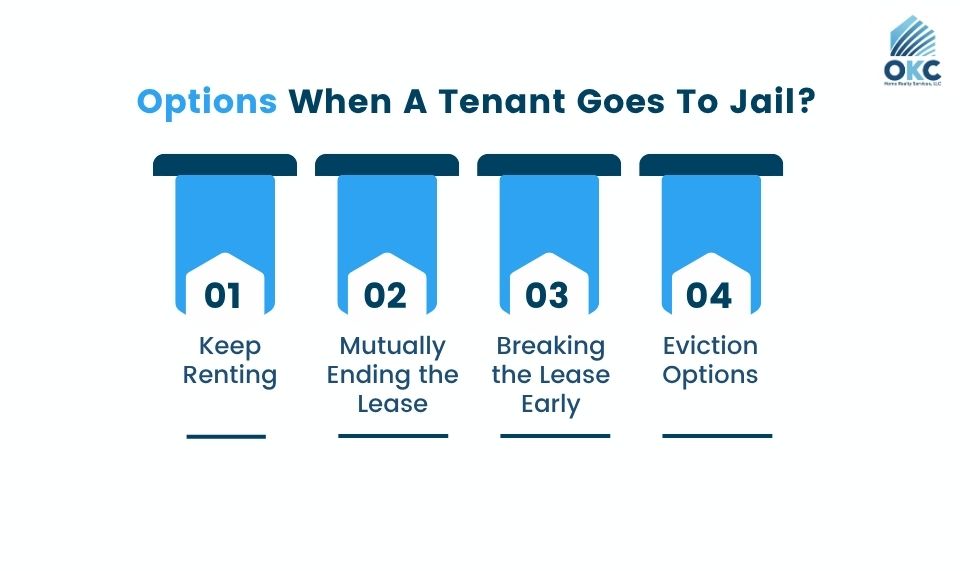
1. Keep Renting
Continuing the tenancy may be practical if the tenant expects a short stay in jail and can arrange rent payments. Discuss how you will communicate and who will handle any urgent issues at the property.
Put any changes to payment arrangements in writing. If someone offers to pay rent for the tenant, clarify that this does not permit them to move into the rental.
2. Mutually Ending the Lease
If the tenant cannot continue renting, discuss ending the lease by agreement, which requires consent from both the landlord and the tenant. A written agreement should clearly explain:
- The date the lease ends and possession returns to you.
- How unpaid rent and any agreed charges will be handled.
- Who will collect the tenant’s belongings and return the keys.
- How the security deposit will be handled.
Get the tenant’s signature or verify that anyone signing for them has legal authority. Do not rely only on a family member’s verbal agreement; if possible, the incarcerated tenant should authorize the arrangement in writing.
3. Breaking the Lease Early
If the tenant requests an early exit, check whether the lease includes an early termination option. Review its notice requirements and any lawful charges.
If the tenant wrongfully abandons the rental, Oklahoma law requires reasonable efforts to rent it again. Under 41 O.S. § 129, the old lease ends when the new tenancy begins. Do not assume the tenant automatically owes every remaining month’s rent.
4. Eviction Options
For unpaid rent, 41 O.S. § 131 generally requires a written demand giving the tenant five days to pay before lease termination. Other qualifying material lease violations generally follow § 132(B), which allows 10 days to correct the violation and termination no earlier than 15 days after receipt of the notice. If payment is not made, you can pursue eviction through court. Eviction can be costly and time-consuming for landlords, so some owners first explore a voluntary move-out or payment arrangement.
Because the tenant is in jail, have an Oklahoma attorney confirm how to serve the required notices and court papers correctly.
What To Do With The Tenant’s Belongings
This is where landlords often get into trouble. You cannot simply throw out the tenant’s belongings because the tenant is in jail.
Oklahoma law lets a landlord take control of a tenant’s personal property only after the tenant has abandoned or surrendered the home, or after the tenant has been lawfully removed through eviction. Until then, leave the tenant’s property alone. Do not box up or toss personal items early.
Once one of those things happens, the law sets these rules:
- Items with no apparent value: You may dispose of them.
- Items with apparent value: Send a written notice by certified mail to the tenant’s last-known address. It must state that the items will be treated as abandoned if they are not removed by a set date.
- Safe storage: Keep the property in a safe place and use reasonable care.
- 30 days: Property left with you for 30 days or longer is treated as abandoned, and you may dispose of it.
- Storage costs: If the tenant wants to claim the items, you may charge for storage.
Take photos and make a written list of everything before you move anything.
Let A Legal Representative Or Family Members Pick Things Up
The cleanest solution is to have the tenant or a legal representative arrange for the belongings to be removed. A tenant can sign a release that names a person who may
collect the tenant’s property, or that lets you dispose of what is left. Having the tenant’s document notarized is preferred when authorizing pickup or disposal. Ask anyone who comes to claim the items to sign a list of what they took.
You can also ask the contacts listed in the lease contract to collect the items, but only with the tenant’s written permission. Do not hand over the tenant’s belongings to family members based on a phone call alone. If you contact those emergency contacts, do not say the tenant is in jail; simply ask them to have the tenant or the tenant’s legal representative contact you.
How To Serve An Eviction Notice To A Tenant In Jail
Serving a notice on a jailed tenant is tricky because you cannot hand it to the tenant at the home. Here is how Oklahoma’s notice rules work.
1. Put the notice in writing.
For unpaid rent, send a written notice that demands payment within five days. State the amount owed. In Oklahoma, a demand for past-due rent also counts as a demand for possession, so you do not need a separate notice to quit.
2. Serve it the right way.
A written notice that ends a tenancy must be given to the tenant in person. If the tenant cannot be located, deliver it to a family member over age 12 who lives with the tenant. If that is not possible, post the notice in a visible place on the rental unit and mail a copy by certified mail.
3. Keep proof.
Save the notice, photos of the posting, mailing receipts, and your notes.
You may know where the tenant is being held, so ask a qualified attorney whether you must serve the tenant in person at the facility. Also count the days carefully. The day you serve the notice does not count. If the last day is a legal holiday, that day is skipped.
4. Send extra copies.
Many landlords also mail a copy to the jailed tenant at the facility. They may send another copy to the tenant’s legal representative. The law does not require these extra copies, but they show that you tried to reach the tenant.
Can You Evict A Tenant For Criminal Activity?
Sometimes. But an arrest alone is not grounds to evict.
Oklahoma law names two kinds of criminal activity that are grounds for ending a lease right away:
- Criminal activity that threatens the health, safety, or peaceful enjoyment of other tenants, or that puts the premises in danger.
- Drug-related criminal activity on or near the premises.
This covers the tenant, members of the tenant’s household, guests, and anyone under the tenant’s control. If the harm to people or the property is serious and cannot be fixed, the landlord may file an eviction case right away.
Even so, you still have to go through the court. An arrest is not a conviction, and it may have happened far from your property. Tread carefully. Talk to a qualified attorney before you evict a tenant for criminal activity. Fair housing rules also limit how landlords use criminal records, so base your decision on documented conduct that meets the applicable legal grounds, rather than the arrest alone.
One Oklahoma law (Section 201) lets owners of certain tax-credit housing accept, decline, or end a lease because of a felony conviction. It does not cover every rental. If you want a felony conviction rule in your lease, ask a qualified attorney to review it first.
When Family Members Or A Co-Tenant Stay In The Home
Often, a partner or family members are living in the home when the tenant goes to jail. This is another place to tread carefully.
- A co-tenant on the lease: If another adult signed the lease, that person has the same rights and duties. The lease obligations do not disappear, and neither does the rent. Check your lease to see whether each adult is responsible for the full amount. If a remaining occupant is not already on the lease but wants to stay and pay, you may require a background check before adding that person.
- The tenant’s spouse: If the tenant’s spouse is on the lease, the spouse must keep paying rent and following the lease. If the spouse or partner is not on the lease but wants to remain and pay, you can decide whether to add that person to the lease agreement.
- People who are not on the lease: An occupant’s absence from the written lease does not automatically make them a trespasser. Section 111(G) applies when there is no rental agreement and the landlord has not consented to creating a tenancy. Have an Oklahoma attorney confirm the person’s status before using this provision. Be careful, though. If you take rent from that person or agree to let them stay, you may be creating a new tenancy.
Do not change the locks on family members. Talk to them, explain the rules, and put your decisions in writing.
When The Arrest Involves Domestic Violence
Some arrests involve domestic violence. In these cases, the person who was hurt, or other family members, may still be living in the home. This is a high-risk area for landlords, so slow down.
Oklahoma law says a landlord cannot deny, refuse to renew, or end a tenancy because a tenant or household member is a victim or alleged victim of domestic violence, sexual violence, or stalking. This is true even when there is no protective order. A victim of domestic violence can also end a lease without penalty by giving written notice and a protective order within 30 days of the incident, unless the landlord waives that time limit.
Federal law adds more protection in some housing. Under the Violence Against Women Act (VAWA), a landlord in federally assisted housing cannot evict a tenant just for being a victim of domestic violence. VAWA also allows “lease bifurcation.” That means a covered housing provider may remove the person who committed the violence from the lease, so the victim and other household members can remain in the home. HUD says any bifurcation must follow federal, state, and local law. The Violence Against Women Act applies only to covered housing programs, so check whether your property is one.
What does this mean for you?
- Do not end a victim’s tenancy because of the violence.
- Do not blame other family members for charges against someone else.
- If you want the person who was arrested off the lease, ask a qualified attorney about your options, including lease bifurcation where it applies.
Final Thoughts
When a tenant goes to jail, stay calm and follow the process. Confirm the situation, reach out, decide on a plan, and put everything in writing. In such a situation, do not change the locks or touch the belongings until the law allows it.
If you would like help with a hard tenant situation, OKC Home Realty Services can walk you through your options for your rental property, including eviction coordination services.
This article is general information, not legal advice. Laws change, so check the current Oklahoma Statutes or ask a qualified attorney about your situation.
FAQ
Can I show or re-rent the unit while the tenant is still in jail and the lease hasn't ended?
Yes, with the usual notice. Oklahoma law lets a landlord enter to show the unit to a prospective tenant, the same as any other showing, as long as you give at least one day’s notice and enter at a reasonable time (41 O.S. § 128). Showing the unit is different from moving someone new in, though you can only do that once the current lease has actually ended, whether by agreement, a wrongful-abandonment finding, or an eviction judgment.
Who takes care of utilities and basic upkeep while the unit sits empty?
Usually, the tenant, under the lease, is still paying rent. If the unit sits vacant with no one paying, check with whoever handles the utility accounts, and check on the property yourself with proper notice so pipes, appliances, and safety systems aren’t neglected in the meantime.
What if the tenant is released and wants the unit back after I've already moved on?
It depends on how things were resolved. If the lease was properly ended, through a signed agreement, a court judgment, or a documented wrongful abandonment, the former tenant has no legal right to the unit and would need to apply like any new applicant. If the lease was never actually ended and rent stayed current, the tenant simply resumes the tenancy as before.
Do I have to tell other tenants or neighbors why someone was arrested?
No, and you generally shouldn’t. Sharing an unconfirmed arrest with neighbors carries the same defamation risk as discussing it with an emergency contact. If there’s an actual safety concern at the property, address that directly rather than announcing the arrest itself.
How is the security deposit handled if the tenant never comes back?
The same way as any other tenant who doesn’t return. Once the lease ends and the belongings are cleared under the rules above, you may apply the deposit to unpaid rent and damage, then send an itemized statement and return any balance within 45 days, as Oklahoma law requires (41 O.S. § 115).