(
(


If a former tenant leaves furniture, clothing, or other items at your rental, you may wonder: how long can someone leave their belongings on your property before you can legally remove them? In Oklahoma, property left with a landlord for 30 days or longer is conclusively considered abandoned under Title 41 O.S. § 130. This rule applies when a tenant abandons or surrenders the rental or is lawfully removed through eviction.
If the belongings have apparent value, the landlord must send written notice by certified mail to the tenant’s last known address and state when the property must be removed. The landlord must also store the belongings safely and exercise reasonable care until they are retrieved or lawfully disposed of.
Determining when personal property left behind by a tenant is considered abandoned is not always straightforward, and mishandling it can expose landlords to disputes or liability. Hence, with over 27+ years of helping landlords navigate such complexities.
I’ll explain everything you need to know about property abandonment laws and what your legal obligations actually are when tenants leave belongings behind, so you can handle the situation confidently and without putting yourself at risk of a lawsuit. I’ll cover the legal timeframes, the exact steps you should take before disposing of someone else’s property, and what to do when the person who left items behind wasn’t a tenant.
Understanding Property Abandonment Laws
Property abandonment laws determine when personal belongings left behind by tenants, guests, or former occupants are legally considered abandoned and what steps the property owner must follow before removing, storing, selling, or disposing of those belongings.
These laws exist to protect both tenants and landlords by preventing tenants from losing their valuable possessions unfairly and giving landlords a clear legal process to deal with cluttered property left behind after a move-out.
According to these laws, personal property is considered abandoned when the tenant leaves items behind that signal no intent to return after:
- Tenant vacates the premises without notice
- Fails to renew a lease
- Completes an eviction process
In most states, including Oklahoma, the law requires landlords to make a reasonable effort to notify the tenant before taking action and allowing a specified waiting period before the property is considered legally abandoned. The timeframes and exact procedures vary from state to state, so understanding the law in your specific jurisdiction is critical before you touch, move, sell, or dispose of anything left behind in your rental property.
How Long Can a Tenant Leave Belongings in Oklahoma?
Abandoned-property rules are established by state law. Under Oklahoma law, personal property left with a landlord for 30 days or longer is conclusively considered abandoned. The law does not define these 30 days as beginning only after the tenant receives notice. Delays in mailing the notice do not push back this absolute 30-day timeline.
If the belongings have apparent value, the landlord must send written notice by certified mail to the tenant’s last-known address and specify the removal deadline. While storing the belongings, the landlord must keep them in a safe place and exercise reasonable care.
How Oklahoma Law Treats Different Types of Property
| Type of property | What the landlord may do |
|---|---|
| Property with no apparent value | The landlord may dispose of it without a duty to account for it. |
| Perishable property | The landlord may dispose of it in any manner the landlord considers appropriate. |
| Property with apparent value | The landlord must send written notice by certified mail to the tenant’s last-known address and store the property safely. |
| Property left for 30 days or longer | The property is conclusively considered abandoned and may be disposed of reasonably and properly. |
Abandoned Property Laws State-By-State Comparison
| State | Time Limit | Statute |
| Oklahoma | 30 days | OK Stat. §41-130 |
| California | 15-18 days | Cal. Civ. Code §1983 |
| Texas | 60 Days | TX Prop Code § 92.0081 |
| Florida | 10 days | Fla. Stat. §715.104 |
| Washington | 45 Days | RCW 59.18.310 |
| New York | Reasonable time | N/A |
| Indiana | 90 Days | IC § 32-31-4-2 |
What Should Landlords Do When Tenants Leave Belongings Behind?

When a tenant leaves belongings behind, landlords cannot immediately remove or discard the items because most property abandonment laws require a structured process before taking action. You need to follow a clear, legally sound process that protects you from liability and ensures you’re acting within the boundaries of your state’s law.
Step 1: Confirm the Unit Is Actually Vacated
Before assuming that a tenant has abandoned the property, you need to confirm that the unit is actually empty and that the tenant does not intend to return. A tenant leaving belongings behind doesn’t automatically mean that they have abandoned the property because they could be in the middle of a move, dealing with an emergency, or temporarily away for reasons they haven’t communicated to you yet.
As a landlord, you should review multiple indicators like unpaid rent, disconnected utilities, returned keys, significantly reduced or removed personal belongings, stopped mail, no response to multiple attempts to contact over several days, or neighbors reporting the tenant has permanently moved out. It’s your responsibility as a landlord to carefully review the lease agreement and any recent communication with the tenant to confirm whether a formal move-out occurred or if the tenant simply left temporarily.
Step 2: Document and Inventory Everything
Once the landlord has reasonably confirmed the tenant has vacated the unit, the next step is to carefully document every item left inside the property to create a clear record of the belongings that remain. This documentation should include photographs, video when possible, and a detailed written inventory describing each item and its condition. To document damage, cleaning needs, and security-deposit issues involving the rental unit itself, follow a complete move-out inspection process. For example, instead of just writing “television,” note “55-inch Samsung Smart TV with no visible screen damage.”
Creating an accurate record of tenant-abandoned belongings is important because it protects landlords from disputes if the former tenant later claims that valuable belongings were lost or improperly handled. Having an objective third-party witness, such as a neighbor, present during this inventory process can further strengthen your case if the situation ever escalates to a small claims court dispute.
Step 3: Assess Whether Items Have Value
After documentation, landlords should evaluate whether the items appear to have monetary value, personal importance, or legal significance before deciding how they should be handled during the abandonment process. Items like furniture, electronics, appliances, clothing, vehicles, and personal documents such as identification, financial records, or family photographs are generally considered personal property with value and must be handled with greater care and formal notice requirements.
On the other hand, items that are clearly broken, unsanitary, perishable, left in a condition that resembles trash, or have no reasonable resale or replacement value may be disposed of immediately, depending on the state’s specific laws. This assessment prevents landlords from wasting money on storing junk while ensuring you don’t accidentally throw away what holds significant financial or personal value.
Step 4: Send Written Notice Via Certified Mail
Landlords are legally required to send a formal written notice to the tenant before taking any further action with the tenant’s personal belongings. The notice should be sent via certified mail to the tenant’s last known address, a forwarding address if provided, or an emergency contact address listed in the original lease agreement. The notice should identify the belongings, explain where they are being stored, and state that they will be considered abandoned if they are not removed by the deadline specified in the notice. Oklahoma law does not establish a general 7-to-30-day notice period; property left with the landlord for 30 days or longer is conclusively considered abandoned.
Mention any applicable storage fees exactly as they are outlined in the original lease agreement, and clearly state what the landlord may do if the tenant fails to comply within that timeframe, such as the eventual sale, donation, or lawful disposal of the unclaimed property. Sending a notice through certified mail creates proof that the communication was delivered, which becomes important documentation if the tenant later disputes the situation.
Step 5: Store Items Safely During the Notice Period
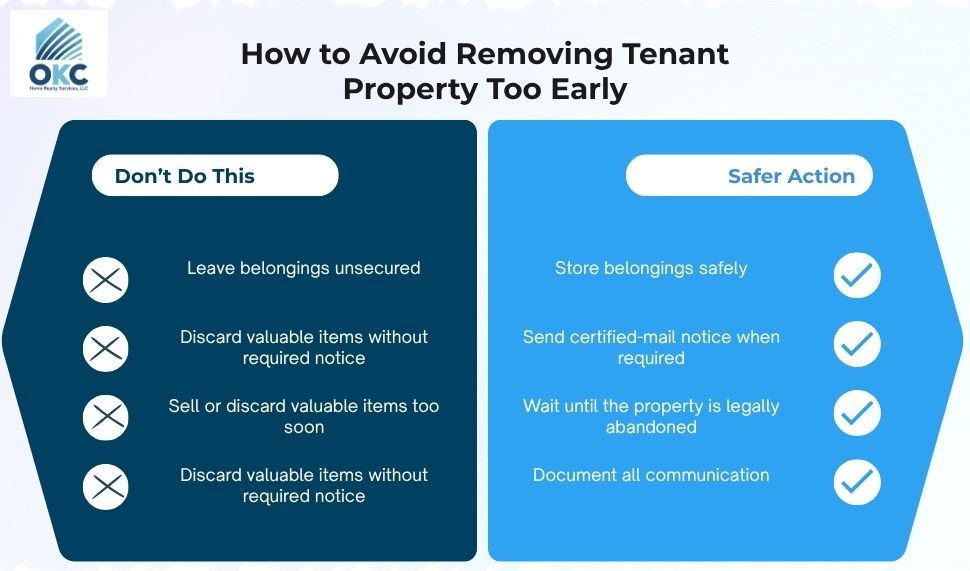
Landlords are legally obligated to store the tenant’s belongings in a safe and secure location where they are protected from damage, theft, or deterioration while the tenant still has the legal right to reclaim them. Store the items inside the rental unit if they are not yet needed for a new tenant, move them to a locked storage room, or place them in a rented storage facility until the notice deadline passes.
In many cases, the landlord can charge reasonable storage or moving fees if a tenant returns to collect their belongings during the notice period, if it is specified in the lease. Throughout the entire storage period, continue to maintain your inventory records and avoid discarding, selling, donating, or moving any items without explicit legal authorization, as any action taken before the notice period has fully expired can be used against you in a legal dispute.
Step 6: Dispose of or Sell Items Lawfully
If the tenant doesn’t respond or retrieve their belongings before the notice period expires, landlords can move forward with legally removing or disposing of the items according to the state’s specific property abandonment laws. If the items have resale value, landlords can sell them through a public sale or auction, donate them to a charitable organization, or discard them entirely if they have no resale or donation value.
When valuable belongings are sold, some states require landlords to apply the proceeds toward unpaid rent, storage costs, or other expenses related to handling the former renter’s abandoned personal property. The landlord may be required to return any remaining balance to the tenants, so it is important to keep detailed financial records of any sale to ensure full compliance before finalizing disposal.
Legal Requirements for Handling Personal Property Left Behind by a Non-Tenant
Dealing with belongings left behind by a non-tenant, such as a guest, roommate, family members, or short-term occupants (ex-partners), can be complicated because the legal protection may differ from that apply to tenants under traditional landlord-tenant laws. Most states’ abandonment laws are written specifically around the landlord-tenant relationship and do not always provide explicit guidance for situations involving guests or informal occupants.
Determining whether someone is a tenant, guest, or other occupant is separate from deciding what to do with their belongings. If the person still occupies the property, review the lawful process for removing someone who is not on the lease before taking action.
Oklahoma’s residential abandoned-property law specifically addresses belongings left by a tenant after abandonment, surrender, or lawful eviction. It does not establish the same procedure for belongings left by a guest, informal roommate, family member, or ex-partner.
If a non-tenant leaves belongings behind, document the items and attempt to contact the owner in writing. Do not assume that the tenant procedure under 41 O.S. § 130 applies. If the person’s occupancy status, ownership of the items, or your right to dispose of valuable property is unclear, consult an Oklahoma attorney before selling, donating, or discarding anything.
What Happens If You Remove Property Too Early?
Removing or disposing of someone’s belongings before the legally required notice period has expired can create serious legal problems for landlords. Abandoned property law requires following the exact steps for notice and waiting period, and skipping them means courts see it as theft, conversion, or wrongful disposal rather than cleanup.
One of the most common consequences of removing items too early is a civil dispute or lawsuit, where the tenant claims compensation for the value of the belongings that were discarded or damaged. Similarly, because the law views a tenant’s possession as their private property until the notice period ends, removing the belongings can be regarded as self-help, illegal eviction, or wrongful removal of property. In such situations, tenants may argue that the landlord interfered with their right to access the property and retrieve their belongings, leading to punitive fines and damaging your reputation as a landlord overall.
Handle Abandoned Belongings with a Professional Property Manager
The answer to how long someone can leave their belongings on your property depends on state law. In Oklahoma, property left with a landlord for 30 days or longer is conclusively considered abandoned. To handle the property left behind, landlords need to confirm the unit is vacated, document the items, send a written notice, and allow a legally required waiting period before disposing of the abandoned belongings.
Dealing with abandoned property requires a legal process that can be complicated to handle for most landlords. Hence, relying on a local professional property management company can save you from legal headaches and lawsuits. OKC Home Realty Services can help manage abandoned property, ensure legal compliance, and make the transition between tenants much smoother. From serving legal notices to coordinating secure storage, our team ensures your investment is protected and your units are turned over quickly without the threat of litigation.
Not sure how to legally clear out personal items left behind by your tenant? Contact us today and let our experts handle legal processes so you can get your property back on the market faster.
FAQs: Handling Tenant’s Abandoned Personal Property
Can I sell or donate items left on my property after a certain time?
In Oklahoma, a landlord may dispose of property that has no apparent value and may handle perishable property in any manner the landlord considers appropriate. If the belongings have apparent value, the landlord must send written notice by certified mail and store them safely. Property left with the landlord for 30 days or longer is conclusively considered abandoned and may then be disposed of reasonably and properly.
Can a landlord charge for storing a tenant's belongings?
Yes. Landlords are typically entitled to be reimbursed for reasonable costs associated with moving and storing abandoned property. In Oklahoma, for example, if you store the items in the rental unit itself, you can charge up to the fair rental value of the space. If you use a commercial storage facility, you can pass the actual costs of the unit and the movers on to the tenant.
What are the abandonment laws in Oklahoma?
Under the Oklahoma Residential Landlord and Tenant Act, property left for 30 days or longer is conclusively determined to be abandoned. Landlords must provide written notice by certified mail to the tenant’s last known address. While waiting, you must exercise reasonable care in storing the items. Once the 30-day window closes without a response, the landlord may dispose of the property in any manner deemed reasonable without further liability.
How long does someone have to come get their stuff?
For a former tenant in Oklahoma, property left with the landlord for 30 days or longer is conclusively considered abandoned. If the belongings have apparent value, the landlord must also send certified mail notice stating the removal deadline and store the property with reasonable care.
What happens to a tenant’s belongings if the tenant dies?
If a tenant who lived alone dies, Oklahoma law provides a separate process under 41 O.S. § 130.1. The landlord may remove and store the belongings but must release them to the tenant’s designated contact or another person legally entitled to them if requested before disposal. Unless the written lease establishes a different process, the landlord may discard the belongings only after sending the designated contact a written request by certified mail, waiting 30 days from the notice’s postmark date, and receiving no claim for the property.
How long does an ex-spouse have to remove belongings?
Oklahoma does not apply one deadline to every ex-spouse situation. The answer depends on whether the ex-spouse was a tenant, who legally owns the belongings, and whether a divorce decree or property-settlement order provides a removal deadline. If the ex-spouse was a tenant, Oklahoma’s abandoned-property rules may apply after the tenancy legally ends. If ownership or occupancy status is disputed, do not sell, donate, or discard the belongings until an Oklahoma attorney or court order confirms what you may do.