(



A rental property appraisal is an independent opinion of an investment property’s value on a specific date. Depending on the assignment, an appraiser may also estimate its market rent, which is the rent the property could reasonably command based on comparable rentals and current market conditions.
If you are buying, refinancing, or selling a rental property in Oklahoma, the appraisal can influence your financing and help you evaluate the investment. However, what a property is worth and what it can rent for are two different questions. A home may appraise at a price that satisfies a lender but still falls short of an investor’s cash-flow goals.
In this guide, you’ll learn. How rental property appraisals work, what appraisers look for, how income affects value, and what Oklahoma landlords can do to prepare.
What Is a Rental Property Appraisal?
A rental property appraisal is a professional valuation of a property used, or intended to be used, to generate rental income. The appraiser analyzes the property and relevant market evidence to develop a supported opinion of value.
Depending on the assignment, that evidence may include:
- Recent sales of comparable properties
- The property’s size, layout, condition, and improvements
- Existing leases and rental income
- Comparable rentals and estimated market rent
- Vacancy and operating expenses
- Local market conditions
A rental property appraisal can cover a single-family home, condominium, duplex, fourplex, apartment building, or another income-producing property. The analysis for a single-family rental may differ substantially from the analysis for a larger apartment building.
An appraisal is an opinion of value, not a guarantee of a sale price. It also does not guarantee that a property will rent for a particular amount or produce a specific return.
Rental Property Appraisal Vs. Rental Market Analysis: What is the Difference?
A rental property appraisal generally estimates the property’s value, while a rental market analysis estimates what the property could rent for. An appraisal can also include a market rent opinion if the assignment requires one.
| Factor | Rental property appraisal | Rental market analysis |
| Main question | What is the property worth? | What monthly rent could the property command? |
| Typical evidence | Comparable sales, condition, property features, and sometimes income | Comparable rentals, property features, competition, and tenant demand |
| Typical provider | A qualified appraiser | A property manager, real estate professional, or appraiser |
| Common use | Purchase financing, refinancing, sale, or estate valuation | Setting an asking rent or evaluating rental potential |
For example, a rental home might have an appraised market value of $225,000 and an estimated market rent of $1,500 per month. The first figure concerns the property’s value; the second concerns potential rental income. Both figures are hypothetical.
Appraised Value Vs. Assessed Value
The appraised value is a professional opinion developed for a particular assignment and date. The assessed value is the value the local assessor assigns under the rules used for property taxation.
These amounts can differ. In Oklahoma, the taxable assessed value is set at 11% to 13.5% of the property’s fair cash value (Okla. Const. art. X, §8), so it will usually be far below an appraised value. A property’s tax assessment should not be assumed to represent its current market value or the amount a lender will accept for a loan.
When Do Landlords Need a Rental Property Appraisal?
Landlords most often encounter appraisals when buying or refinancing an investment property. A formal valuation may also be useful or required for a sale, estate matter, or other financial decision.
Buying an Investment Property
When you finance a rental purchase, the lender may order an appraisal to assess the property’s value as collateral. If the appraised value is lower than the agreed purchase price, the lender may reduce the amount it is willing to finance.
The appraisal is one part of the purchase decision. Investors should also review the lease, inspect the property, estimate repairs, and calculate whether the expected rent supports the ownership costs.
For investors considering a home before making an offer, our rental property analysis in Oklahoma City can help identify rent potential, competing rentals, and operating questions that deserve further investigation.
Refinancing a Rental Property
A lender may require an appraisal when an owner refinances. The value opinion helps the lender evaluate the property’s loan-to-value ratio, or LTV.
For example, a property valued at $250,000 with a $150,000 mortgage balance has a 60% LTV before any new borrowing:
($150,000 loan balance ÷ $250,000 property value) × 100 = 60% LTV
The difference between the property value and the loan balance is approximately $100,000 in equity. However, that does not mean the entire amount is available through a refinance. The lender’s LTV limits, underwriting requirements, loan costs, and other obligations still apply.
Selling a Rental Property
An owner may request an appraisal before listing a rental, especially when the property has unusual features or few closely comparable sales.
The appraisal provides a value opinion that can be considered alongside a real estate professional’s pricing advice. The final asking price may also reflect current competition, the seller’s timeline, property condition, and existing lease terms.
Estate, Divorce, or Tax Matters
A formal appraisal may be requested when a property is involved in an estate, divorce, tax matter, or other proceeding. The assignment may require an opinion of value as of a past date, rather than the current date.
When contacting an appraiser, explain why the report is needed and who will use it. The required scope and effective date can affect the fee and timeline.
How Does a Rental Property Appraisal Work?
A rental property appraisal begins with a defined assignment. The appraiser then gathers property and market information, develops an analysis, and prepares a report.
Step 1: Define the Purpose And Scope
The appraiser identifies the property, intended use, effective date, and type of value needed. A lender may request a market value opinion and rental information, while a private client may need a report for a different purpose.
If you hire an appraiser directly, ask whether the assignment includes an opinion of market rent. Do not assume that every property appraisal includes one.
Step 2: Collect Property and Rental Records
The appraiser may review public records, property details, leases, a rent roll, recent income, and operating expenses. For an occupied duplex or fourplex, information about each unit may be relevant.
Accurate records help explain how the property currently operates. They also help the appraiser compare the existing income with what similar rentals command in the market.
Step 3: Review the Property
Many appraisals involve an on-site visit, although the required method depends on the assignment. The appraiser or another authorized professional may collect information about the interior, exterior, condition, layout, and features.
The visit is one part of the process. The appraiser also researches comparable properties and analyzes the evidence before reaching a value opinion.
Step 4: Analyze Comparable Sales and Rental Income
The appraiser selects comparable sales and considers differences between those properties and the subject property. When rental income is relevant, the appraiser may also review comparable rents, existing leases, expenses, and market-supported income assumptions.
Step 5: Prepare the Appraisal Report
The report describes the property, the evidence considered, the valuation approaches used, and the final opinion of value. It may also state whether the opinion is based on the property’s current condition or is subject to specified repairs or other conditions.
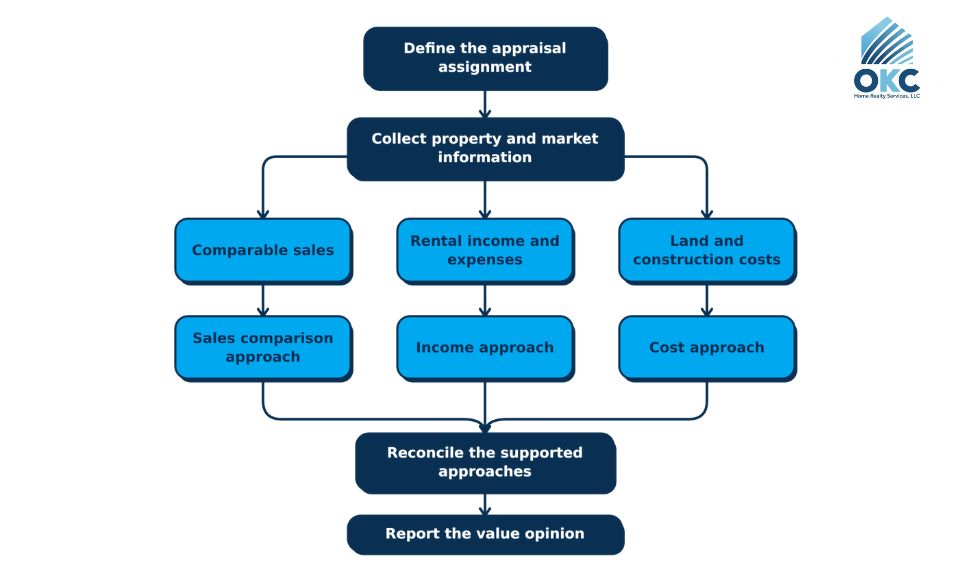
The following diagram shows the main approaches an appraiser may consider. Not every assignment uses all three.
What Do Appraisers Look For in a Rental Property?
Appraisers consider the characteristics and market evidence that affect the property’s value. For income-producing properties, they may also assess the reliability of existing rent and the income the property could reasonably produce.
Location and Comparable Sales
Location influences which properties are suitable comparisons. A three-bedroom home in Edmond may compete with a different group of homes than a similarly sized property in Midwest City or Moore.
The appraiser considers recent comparable sales and the differences between them and the subject property. These differences may include location, condition, square footage, parking, lot size, or renovations. The goal is to understand how the market responds to those differences, not simply to average nearby sale prices.
Property Size, Layout, and Features
Appraisers review the property’s physical characteristics, which may include:
- Living area and lot size
- Number of bedrooms and bathrooms
- Number and configuration of rental units
- Garage and parking space
- Laundry facilities and storage
- Outdoor space
- Construction quality and overall condition
- Layout issues that affect how the property functions
For a duplex, the size and layout of each unit matter as well as the building’s total size. Two properties with similar square footage may appeal to different tenants if their unit configurations differ.
Condition and Deferred Maintenance
A property’s visible condition can affect what buyers are willing to pay. An appraiser may observe damaged flooring, deteriorated exterior materials, signs of water damage, or other conditions that warrant consideration.
An appraisal is not a home inspection. A home inspection provides a more detailed assessment of the property’s condition and systems. Buyers should consider whether they need both services when evaluating a rental purchase (Consumer Financial Protection Bureau).
For existing rentals, regular rental property inspections can help owners document conditions and identify maintenance needs before they become larger problems.
Repairs, Renovations, and Improvements
Appraisers may consider meaningful improvements such as a replaced roof, updated HVAC system, permitted addition, or renovated kitchen. Records can be especially helpful when the work is not readily visible.
The amount spent on an improvement does not automatically equal the value it adds. A renovation’s contribution depends on its quality, the property, and what buyers in that market are willing to pay.
Current Rent and Market Rent
Current rent, sometimes called contract rent, is the amount stated in an existing lease. Market rent is an estimate of what the property could rent for under typical current market conditions.
Suppose a tenant pays $1,250 per month, while comparable rentals suggest a market rent of $1,400. The difference may matter to an investor, but the owner cannot assume the existing rent can be raised immediately. The lease and applicable law determine when and how a change may be made.
Likewise, an unusually high rent in a lease does not automatically mean that income is sustainable. The appraiser or lender may compare it with market evidence and review the lease terms.
Vacancy and Operating Expenses
For an income-producing property, gross rent does not tell the whole story. The appraiser may consider an allowance for vacancy and collection losses, along with expenses such as taxes, insurance, maintenance, management, and owner-paid utilities.
Actual records are useful, but an appraiser may also use market-supported assumptions. For example, an owner who manages a duplex personally may not pay a management company. A buyer’s analysis may still include a management allowance if that is appropriate for the market and valuation method.
How is a Rental Property Appraised?
Appraisers commonly consider the sales comparison approach, income approach, and cost approach. The property type, available evidence, and assignment determine which approaches are developed and how much weight each receives.
1. Sales Comparison Approach
The sales comparison approach uses recent sales of similar properties to develop an indication of value. The appraiser considers differences between the comparable sales and the property being appraised.
This approach is often important for a single-family rental because buyers may include both investors and people planning to live in the home. For a duplex or fourplex, the appraiser may seek comparable sales with similar unit counts, locations, conditions, and income potential.
A comparable sale should be evaluated as a whole. A lower sale price may reflect needed repairs, while a higher price may reflect a larger lot, an additional bathroom, or superior condition.
2. Income Approach
The income approach considers the income a property can reasonably produce. One method uses net operating income, or NOI, and a capitalization rate, or cap rate:
Estimated property value = Annual NOI ÷ Cap rate
NOI generally starts with rental income after an allowance for vacancy and collection losses, then subtracts operating expenses. It does not subtract mortgage principal and interest, income taxes, or accounting depreciation.
The cap rate must be supported by comparable market evidence. It should also be consistent with the income and expense assumptions used. A rate suitable for one property type or market may not be suitable for another.
Fannie Mae describes the income approach as an analysis of the relationship between property value and the market rent or income the property can be expected to produce (Fannie Mae Selling Guide).
3. Cost Approach
The cost approach considers the land’s value plus the estimated cost to construct the improvements, minus applicable depreciation.
It may be useful for a newer property or when comparable sales are limited. However, construction cost alone does not establish market value. Buyers may not pay the full cost of improvements, especially when a property has physical wear, functional limitations, or location-related drawbacks.
4. Gross Rent Multiplier
The gross rent multiplier, or GRM, compares a property’s sale price with its gross rental income:
GRM = Comparable sale price ÷ Comparable gross rental income
Suppose a comparable rental sold for $240,000 and generated $24,000 in annual gross rent:
$240,000 ÷ $24,000 = 10 GRM
If a similar property has annual gross rent of $30,000, applying that illustrative multiplier produces:
$30,000 × 10 = $300,000 indicated value
GRM can help screen and compare properties, but it does not directly account for differences in expenses, vacancy, or condition. The multiplier should come from suitable comparable sales, and the income periods must match: an annual multiplier should be applied to annual rent.
Rental Property Appraisal Example: Estimating Value From Income
Consider a hypothetical duplex with two units renting for $1,500 per month each. Assume the following income and expenses are supported by the market and that comparable properties support a 7% cap rate.
These figures illustrate the calculation. They are not a statement of current Oklahoma City average rents, expenses, or cap rates.
| Annual calculation | Amount |
| Gross scheduled rent: $3,000 × 12 | $36,000 |
| Less vacancy and collection allowance | −$1,800 |
| Effective rental income | $34,200 |
| Property taxes | −$3,600 |
| Insurance | −$1,800 |
| Maintenance and repairs | −$2,400 |
| Property management | −$2,400 |
| Owner-paid utilities and lawn care | −$1,200 |
| Replacement reserve allowance | −$1,800 |
| Estimated annual NOI | $21,000 |
Using the assumed cap rate:
$21,000 ÷ 0.07 = $300,000
The result is an illustrative income-based value indication of $300,000, not a complete appraisal.
The assumptions have a substantial effect on the result. With the same $21,000 NOI, a 6% cap rate produces an indication of $350,000; an 8% cap rate produces $262,500. The appraiser must support the income, expenses, reserve treatment, and cap rate with appropriate evidence.
Is NOI the Same As Cash Flow?
No. NOI is calculated before mortgage principal and interest. Cash flow also considers financing and other cash expenses.
For example, if the hypothetical duplex has $21,000 in annual NOI and $14,400 in annual mortgage payments, the remaining amount is $6,600 per year, or $550 per month, before income taxes and other costs not already included in the example.
That distinction matters when buying a rental. A property can appraise at the purchase price and still produce less cash flow than the investor needs. Our guide to evaluating a rental property investment covers additional measures to review before buying.
How Much Does a Rental Property Appraisal Cost In Oklahoma?
A rental property appraisal in Oklahoma can cost several hundred dollars or more. The fee depends on the property type, location, complexity, report requirements, and whether a market rent opinion is included.
Oklahoma fee sheets published in early 2026 by appraisal management companies ranged from about $715 to $805 for a conventional single-family appraisal and $865 to $925 for a duplex to fourplex, before additional fees (Appraisal MC, PropertyRate, 2026 TRID fee schedule). These are published fee schedules, not a market average or a current quote.
A duplex or fourplex may cost more to appraise than a single-family home because the assignment can require additional unit, lease, and income information. Unusual properties, limited comparable sales, and urgent deadlines can also affect the fee.
Before proceeding, ask the lender or appraiser what the quoted fee includes, whether rental information is part of the assignment, and when the report is expected.
How Long Does a Rental Property Appraisal Take?
A residential appraisal may take several days to a few weeks from scheduling to report delivery. The timeline depends on appraiser availability, property access, the number of units, and the research required.
An occupied duplex or fourplex may take longer to schedule if access must be arranged with several tenants. A property with unusual features or limited comparable sales may also require additional analysis.
In 2026, Oklahoma’s Real Estate Appraiser Board and Real Estate Commission advised that the transition to a redesigned report for applicable Fannie Mae and Freddie Mac loans could affect inspection time and pricing. Ask your lender which report format applies and allow enough time before closing (OREC and OREAB industry alert).
Preparing for the Rental Appraisal Process: A Step-by-Step Guide for Oklahoma Landlords
Landlords can prepare by gathering accurate records, documenting improvements, addressing necessary repairs, and arranging lawful access. Good preparation helps the appraiser understand the property; it does not guarantee a higher value.
1. Gather Leases and Financial Records
Depending on the assignment, the appraiser may request:
- Current leases and amendments
- A rent roll showing each unit’s rent and occupancy
- Recent income and expense records
- Property tax and insurance information
- Details of owner-paid utilities and services
- Information about vacant units or rental concessions
A rent roll should reflect the current lease terms. If a tenant pays less than the stated rent, or if a concession affects the income collected, provide accurate information rather than assuming the scheduled amount tells the whole story.
Consistent rental property financial reporting makes it easier to review income, expenses, and maintenance activity when records are needed.
2. Document Improvements
Prepare a list of significant improvements, including completion dates and available permits or invoices. Examples include roof replacement, HVAC installation, plumbing work, electrical upgrades, and permitted additions.
Describe the work accurately. A repair that restores a home to working condition and a major renovation may affect the market differently.
3. Address Necessary Maintenance
If practical, complete repairs that affect the property’s condition or safe operation. A leaking fixture, damaged handrail, or broken window can raise questions about maintenance.
Avoid assuming that a last-minute renovation will pay for itself in the appraisal. Compare the cost with the likely effect on rent, maintenance, tenant appeal, and resale value before approving major work.
4. Coordinate Access With Tenants
Contact tenants early to arrange a reasonable time for the visit and explain who will attend. Confirm whether the appraiser needs access to each unit, common areas, garages, or exterior equipment.
Under 41 O.S. § 128, Oklahoma landlords generally must give at least one day’s notice of their intent to enter and enter only at reasonable times. The statute provides exceptions for emergencies or when notice is impracticable. Review the lease as well, and do not force entry if a tenant refuses access.
5. Share Relevant Comparable Information
If you know of recent, genuinely comparable sales or rentals, provide the addresses and available details for consideration. Explain what makes each property comparable and identify any known differences.
The appraiser remains responsible for independently evaluating the evidence and reaching a conclusion.
What Should Landlords Review in an Appraisal Report?
When you receive the report, check whether it accurately describes the property and explains the evidence used. A lower value alone does not establish an error, but factual mistakes or overlooked information may deserve review.
Pay particular attention to:
- Property details: Are the unit count, bedrooms, bathrooms, and other characteristics described accurately?
- Condition and improvements: Does the report account for relevant completed work?
- Comparable properties: Are the selected sales reasonably similar, and are material differences explained?
- Rental information: If market rent was part of the assignment, is the rent information consistent with the property and comparable evidence?
- Conditions: Is the value based on the property as it stands, or is it subject to specified repairs or other conditions?
If you find a concern, note the specific item and gather supporting documents. For a lender-ordered appraisal, raise it through the lender’s reconsideration of the value process, explained below.
What Happens If a Rental Property Appraises Below the Purchase Price?
A low appraisal can reduce the amount a lender is willing to finance. The effect depends on the loan terms, the purchase agreement, and the decisions made by the buyer and seller.
Suppose:
- The purchase price is $260,000.
- The appraised value is $240,000.
- The lender allows a loan of up to 75% of the applicable value.
In this example, 75% of the appraised value is $180,000. If the price remains $260,000, the buyer would need to contribute $80,000 toward the purchase price, plus applicable closing costs.
If the loan had been based on the $260,000 purchase price, 75% would have been $195,000. The lower appraisal therefore creates a $15,000 difference in the illustrated loan amount.
Depending on the circumstances, the parties may renegotiate the price, discuss other financing, or rely on the contract’s appraisal and financing provisions. If the report contains factual errors, omitted information, or unsuitable comparable properties, the borrower can ask the lender for a reconsideration of value (Consumer Financial Protection Bureau). A reconsideration is a review of the evidence, not a guaranteed change.
How Does a Rental Market Analysis Help Oklahoma City Landlords?
A rental market analysis helps an owner estimate a competitive asking rent by comparing the property with similar rentals. It considers the property’s features and condition alongside current competition and available market information.
At OKC Home Realty Services, we review comparable homes, location, condition, and demand when recommending a starting rent. We also consider what happens if a property remains vacant while waiting for a higher price.
For example, an additional $50 per month would add $600 over a full year. But one additional month of vacancy at a $1,500 asking rent would cost more than that increase. This is an illustration; the right price and time to lease depend on the individual property and the market response.
If you are deciding how much rent to charge in Oklahoma, use comparable properties as the starting point and adjust for meaningful differences in features and condition.
Make an Informed Decision About Your Oklahoma Rental
An appraisal can help you understand a rental property’s value for a purchase, refinance, sale, or other purpose. To evaluate the investment, combine that value opinion with a review of the property’s lease, condition, expected rent, and operating costs.
At OKC Home Realty Services, we help owners assess rental potential across Oklahoma City and surrounding communities, including Edmond, Moore, Norman, Midwest City, and Yukon. Request a free rental analysis to see how your property compares with the local rental market.
Frequently Asked Questions About Rental Property Appraisals
Who Conducts a Rental Property Appraisal?
A rental property appraisal is conducted by a licensed or certified real estate appraiser, ideally one experienced with income-producing properties. In Oklahoma, appraisers are licensed by the Oklahoma Real Estate Appraiser Board, and lenders generally expect the appraiser to know the local market, including rental trends in Oklahoma City and nearby communities.
Does a Rental Property Appraisal Include a Rent Estimate?
It can, but not every appraisal includes one. A lender may request market rent information as part of an investment property loan. Confirm with the lender or appraiser whether a rent opinion is included in the assignment.
Can a Vacant Rental Property Be Appraised?
Yes. An appraiser can value a vacant property and, when requested, estimate market rent using comparable rentals. The appraiser may also consider the reason for the vacancy and whether the property needs work before it can be rented.
Does a Rental Property Always Appraise Based on Income?
No. The approaches used depend on the property and assignment. Comparable sales can be especially important for a single-family rental, while income may receive closer attention for a property commonly purchased by investors.
Who Chooses the Appraiser for an Investment Property Loan?
The lender generally arranges a lender-required appraisal according to its procedures. An owner can hire an appraiser for a private assignment, but should confirm whether the lender will accept that report before relying on it for financing.
Can an Existing Tenant’s Lease Affect an Appraisal?
Yes. The appraiser may review the lease, including the rent, remaining term, and other relevant conditions. Existing rent can differ from market rent, and the lease may affect when an owner can change the amount charged.
How Long Is a Rental Property Appraisal Valid?
There is no single period that applies to every purpose. A lender may have specific requirements for the age of a report or may request an update. Changes in the property or market can also affect whether an older opinion remains useful.