(




Quick Answer
When landlords ask what is SFR in real estate, they are usually referring to a Single-Family Rental. It describes a single-family home held and leased as a residential rental property. In property listings and real estate data, SFR can also identify a Single-Family Residence, which may be owner-occupied or rented. Single-Family Residential is another use of the term in zoning and land-use classifications, although its precise meaning depends on the local code.
If you own or plan to rent out a single-family home, understanding these terms can help you avoid confusion when reviewing property classifications, listings, insurance information, and zoning requirements. With more than 15 years of property management experience in Oklahoma City, OKC Home Realty Services understands why a property’s classification, permitted use, and rental status matter to landlords.
This guide explains how real estate professionals use the term SFR, which property types may fall under single-family classifications, and how single-family rentals differ from multifamily properties. It also covers SFR zoning and off-market listings so you can better understand these terms when reviewing property information or making decisions about your rental.
How Is SFR Used in Real Estate?
The abbreviation appears in different types of real estate material, so its meaning depends on whether the discussion concerns a rental investment, a property’s classification, or a zoning designation. Checking the context helps you understand what SFR describes in a particular listing, report, or document.
Single-Family Rental
In rental-investment discussions, SFR refers to a single-family home held and leased as a residential rental property. An individual investor may use the term for one house held for rent, while an institutional investor may use it when discussing a larger SFR portfolio.
This usage describes the property’s rental role, not a separate building design. A single-family home can be owner-occupied or rented, but it becomes a single-family rental when the owner holds and leases it as a rental property.
Single-Family Residence and Single-Family Residential
In some multiple listing services (MLS) and property-data systems, SFR identifies a Single-Family Residence. For example, the Real Estate Standards Organization’s (RESO) property-subtype dictionary lists Single Family Residence as a property subtype and includes SFR as a synonym.
A single-family residence may be owner-occupied or rented, so the term alone does not tell you whether the home is currently a rental. Landlords may encounter this classification in property listings and real estate data.
Single-Family Residential, on the other hand, often appears in zoning and land-use terminology. It describes a category of residential use, but its exact definition and permitted uses depend on the local zoning code. This is why a property’s real estate classification should not automatically be treated as its zoning designation.
What Makes a Property an SFR?
When SFR refers to a single-family rental, the property generally has one primary dwelling unit that provides independent living space for one household. Landlords can look for these characteristics:
- One primary dwelling unit: The property contains one main residential unit rather than multiple separately recognized units.
- Self-contained living space: Residents have their own living areas and essential facilities, such as a kitchen, bedrooms, and bathrooms.
- Designed for one household: Its layout supports one household’s residential use.
- Leased as one complete dwelling: In a rental arrangement, the landlord generally leases the home as one residential unit rather than renting separate units to different households.
A property does not automatically qualify as an SFR simply because it looks like a house. Its dwelling-unit configuration and applicable property classification also matter.
What Types of Homes May Be Classified as SFR Properties?
Single-family rental properties can have different physical configurations. Detached houses are a common example, but certain attached homes may also fall under single-family classifications, depending on the applicable property definition and local rules.
Detached Single-Family Houses
A detached single-family house is a standalone residential building designed for one household. It does not share structural walls with neighboring homes and generally occupies its own lot. When a landlord leases the entire house to one household, it fits the common detached single-family rental configuration.
Attached Homes and Townhouses
Attached homes and townhouses can create classification questions because their physical layout does not always determine how they are categorized. Some real estate data systems may classify certain attached homes as single-family properties, while local zoning codes may apply different definitions.
In Oklahoma City, the distinction is important. Under Section 59-8200.14 of the City’s Zoning and Planning Code, the Single-Family Residential use classification describes one dwelling unit in a freestanding, structurally separated building used exclusively for residential purposes. The building must also be on a lot or building site that is not occupied by another dwelling unit or main building.
This means an attached townhouse should not automatically be assumed to qualify under Oklahoma City’s Single-Family Residential use classification. Landlords should check the property’s applicable classification and zoning requirements before relying on the SFR label. You can review the code through the City of Oklahoma City’s Municipal Code.
How Is an SFR Different From a Multifamily Property?
The main difference between a single-family rental (SFR) and a multifamily property is the number and arrangement of independent dwelling units. An SFR generally provides one primary living space for one household, while a multifamily property contains multiple separate residential units within a property or building.
For a common example of a two-unit property, see our guide to what a duplex is.
| Comparison | Single-Family Rental (SFR) | Multifamily Property |
| Dwelling units | Generally one primary unit | Two or more independent units |
| Living spaces | One household’s residential space | Separate spaces for different households |
| Property configuration | Typically one complete home | May contain several units in one building or development |
| Rental arrangement | Usually leased as one complete dwelling | Units may be leased separately |
Classification can vary depending on the definition being used. Attached homes, townhouses, and properties with additional dwelling units may be treated differently under real estate data systems and local zoning codes. Landlords should therefore look beyond a property’s appearance and verify how it is classified for the specific purpose they are considering.
What Does SFR Zoning Mean?
SFR zoning is commonly used as shorthand for a Single-Family Residential zoning designation. It generally refers to land-use rules associated with single-family housing, but the exact district name and permitted uses depend on the local zoning code.
An SFR property and an SFR zoning designation are different. The property describes the home, while zoning establishes the uses and development standards permitted on the land. A property listed as a single-family residence does not automatically establish which uses its zoning district allows.
Does Single-Family Residential Zoning Determine How a Property Can Be Used?
A single-family residential zoning designation may limit the types of residential uses allowed on a property. However, landlords should check the specific zoning district and applicable regulations before assuming what a property permits.
In Oklahoma City, zoning districts and use-unit classifications serve different purposes. The zoning district establishes the applicable development standards and permitted uses, while a use-unit classification identifies a category of land use. Landlords can review Oklahoma City’s zoning information and the applicable provisions of Chapter 59 to understand the rules that apply to a property.
What Should OKC Landlords Verify About SFR Zoning?
Before relying on a property’s SFR zoning designation, check these four details:
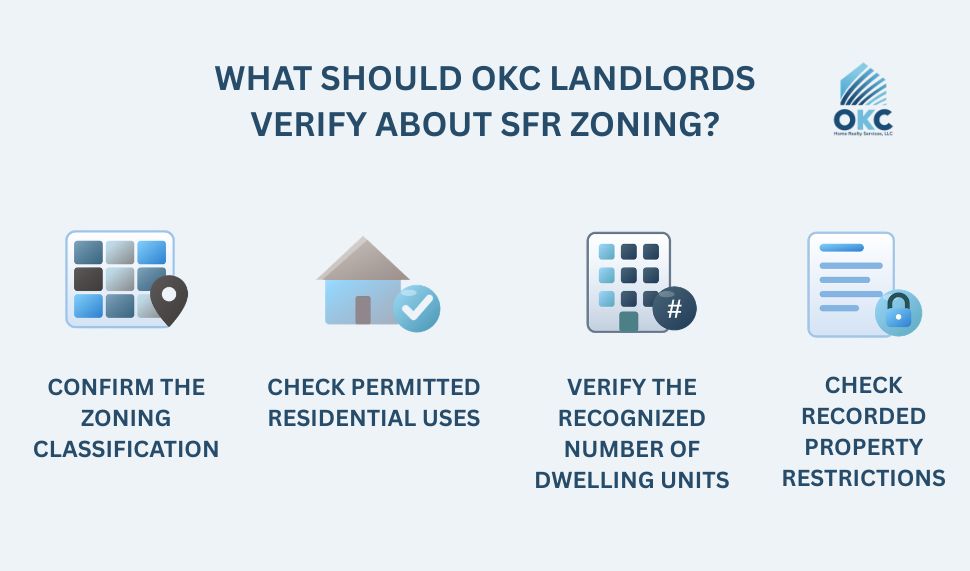
- Confirm the zoning classification. Look up the property’s designation on the official Oklahoma City zoning map.
- Check permitted residential uses. Review the regulations for the property’s specific zoning district.
- Verify the recognized number of dwelling units. Check the applicable zoning records and property information to understand how many residential units are recognized.
- Check recorded property restrictions. Review relevant deed restrictions or other property documents that may affect the property’s use. These restrictions are separate from zoning regulations.
These checks can help landlords avoid assuming that a property’s appearance or listing description establishes its permitted use. When the classification is unclear, confirm the applicable requirements with the city before making plans for the property.
What Does Off-Market SFR Mean?
An off-market SFR is a single-family property being offered for sale without the broad public exposure typically associated with a traditional listing. The term can describe different marketing situations, so it is important to understand the specific arrangement.
One example is an office-exclusive listing. Under the National Association of REALTORS® (NAR) guidance on office-exclusive listings and pre-marketing options, a seller may choose to have a property filed with the MLS without making it publicly available or distributing it to MLS participants and subscribers outside the listing firm.
NAR also describes delayed-marketing options, which may postpone public advertising through IDX and syndication for a period allowed by local MLS rules. However, these listings are filed with the MLS and may still be available to other MLS participants and subscribers. Therefore, delayed marketing should not automatically be treated as an off-market arrangement.
For landlords and investors, the important point is that off-market describes how a property is marketed, not its physical condition, ownership status, or investment quality.
Why Does Correct SFR Classification Matter to Landlords?
Understanding a property’s SFR classification helps landlords distinguish its physical configuration, rental use, and applicable land-use requirements. These details can matter when reviewing property records, listings, financing information, and insurance arrangements.
Occupancy status and the number of dwelling units are separate pieces of information. For example, Fannie Mae’s Single-Family MBS Disclosure Guide lists Occupancy Status and Number of Units as separate categories in its security supplemental records.
Insurance is another area where accurate property information matters. A home occupied by a tenant may require landlord-specific coverage rather than a standard owner-occupied homeowners policy. Landlords should accurately describe the property’s occupancy and intended use when speaking with an insurance provider and confirm that the policy covers the intended rental arrangement. For more information, see what landlord insurance covers.
Conclusion
The meaning of SFR in real estate depends on the context. It can describe a single-family rental, referring to how a home is used, or a single-family residence, referring to its property type. Single-Family Residential may also describe a local land-use classification.
For landlords, understanding these distinctions helps prevent incorrect assumptions about a property’s use, records, and zoning requirements. If you have questions about managing a single-family rental in Oklahoma City, contact OKC Home Realty Services to discuss your property.
Frequently Asked Questions About SFR Real Estate
What Is an SFR Property?
In a property listing, an SFR property usually means a Single-Family Residence. In an investment discussion, it generally means a single-family home held as a rental. The surrounding context tells you which meaning applies.
Can an SFR Have Multiple Tenants?
Yes. Several tenants can rent one SFR together, but sharing one dwelling does not automatically make the property a multifamily building. The lease, occupancy limits, and applicable local requirements still matter.
Is a Townhouse Considered an SFR?
It depends on the classification system. Some real estate systems may include certain attached townhouses in a single-family category. However, Oklahoma City’s Single-Family Residential use classification has a specific freestanding-building requirement. Landlords should verify the applicable classification rather than assume every townhouse qualifies.
What Is the Difference Between SFR and Single-Family Residential Zoning?
SFR commonly describes a single-family rental or a Single-Family Residence in real estate discussions. Single-Family Residential zoning or a related use classification concerns how land may be used under local regulations. The terms are related, but they do not mean the same thing.
What Does SFR Mean on a Property Listing?
On a property listing, SFR usually means Single-Family Residence. It identifies the property subtype, but does not necessarily mean the home is currently rented or occupied by tenants.