(



Quick Answer
If you’re researching how to buy a rental property with no money down, you may be able to use home equity, an investor partnership, seller financing, an assumable mortgage, or private financing. These options can reduce or eliminate a traditional down payment, but they do not necessarily eliminate closing costs, inspections, insurance, or repair expenses.
Putting nearly all your available cash into a property can leave little room to handle unexpected ownership costs. With more than 15 years of property management experience in Oklahoma City, OKC Home Realty Services understands the ongoing costs of rental ownership, including tenant placement, vacancies, and maintenance.
The right approach depends on the resources you can contribute and the financing terms you can qualify for. Here are eight ways to reduce your upfront investment and the considerations that come with each one.
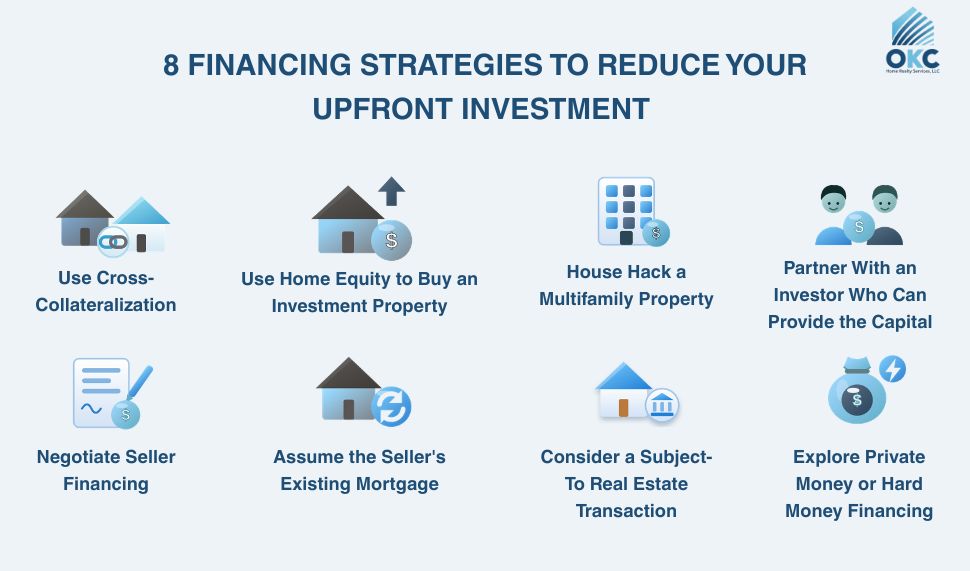
8 Financing Strategies to Reduce Your Upfront Investment
These approaches use existing equity, another investor’s capital, or alternative financing. Some may reduce your down payment, while others require you to contribute time, occupy part of the property, or negotiate directly with the seller.
The following eight strategies explain how each approach works and what you should consider before using it.
1. Use Cross-Collateralization
Cross-collateralization allows a lender to use more than one property as security for a loan. For example, if you own a home with substantial equity, a lender may accept it as additional collateral when financing another property.
This arrangement may reduce the cash you need to contribute at closing, depending on the lender’s requirements. However, you could put both properties at risk if you cannot repay the loan. Review the loan’s cross-collateralization and partial release provisions before agreeing.
2. Use Home Equity to Buy an Investment Property
If your current home has available equity, you may be able to borrow against it to help purchase a rental property. Common options include:
- Home equity loan: Borrow a lump sum against the equity in your current home, typically with a fixed interest rate and repayment schedule.
- HELOC: A home equity line of credit lets you access a revolving credit line and draw funds as needed.
- Cash-out refinance: Replace your existing mortgage with a larger loan and receive the difference.
You could use these funds toward the purchase price or closing costs. However, borrowing against your home creates another debt obligation and may put it at risk if you cannot repay the loan. See our guide to how to finance a rental property for more financing options.
3. House Hack a Multifamily Property
House hacking means buying a multifamily property, living in one unit, and renting out the others. For example, you could occupy one side of a duplex and rent out the other.
Owner-occupied financing may make this approach more affordable than a standard investment property loan:
- FHA loan: Eligible borrowers may qualify for a down payment as low as 3.5%. FHA financing requires owner occupancy, so it is not a zero-down investment loan. Check HUD’s FHA down-payment guidance.
- VA loan: Eligible borrowers may qualify for zero-down financing, subject to VA and lender requirements. They must intend to occupy the property as their home. Review VA purchase loan requirements.
Both programs have eligibility and occupancy rules. You cannot use them simply to purchase a property that you plan to rent out entirely.
4. Partner With an Investor Who Can Provide the Capital
You may have the time or skills to find and evaluate properties but lack the purchase funds. A joint venture with an investor who provides the capital could help you acquire a rental property.
For example, you could contribute property research, renovation coordination, or management skills while another investor funds the purchase. Agree on each partner’s contributions, ownership interests, responsibilities, and exit terms in a written agreement. Our guide to real estate investing partnerships explains these arrangements in more detail.
5. Negotiate Seller Financing
Seller financing allows you to purchase a property directly from its owner, who agrees to finance some or all of the purchase price. You negotiate the down payment, interest rate, and repayment schedule with the seller.
In some transactions, a seller may agree to a low or no down payment. However, the seller may require an upfront contribution or other conditions, such as a balloon payment. Have an Oklahoma real estate attorney review the agreement before signing. Learn more in our guide to how owner financing works.
6. Assume the Seller’s Existing Mortgage
An assumable mortgage allows a qualified buyer to take over the seller’s existing loan, subject to the loan program and servicer’s approval. This may be attractive if the existing loan has a lower interest rate than current financing options.
However, the purchase price may exceed the remaining mortgage balance. You must cover that difference through your own funds, negotiated seller financing, or another acceptable arrangement. Also, confirm whether the seller will receive a release from liability after the assumption is approved.
7. Consider a Subject-To Real Estate Transaction
In a subject-to transaction, you take ownership of the property while the seller’s existing mortgage remains in the seller’s name. You agree to make the mortgage payments, but you do not become the borrower on the original loan.
The lender may invoke a due-on-sale clause and accelerate the loan, depending on the loan terms and applicable legal exceptions. The seller also remains responsible for the original debt to the lender. Have an Oklahoma real estate attorney review the transaction before proceeding. You can read the relevant federal due-on-sale statute.
8. Explore Private Money or Hard Money Financing
Private-money and hard-money lenders offer financing outside the traditional mortgage process. Depending on the lender, they may consider the property’s value and your repayment plan when evaluating a loan.
These options may help when conventional financing does not fit, but they do not guarantee a zero-down purchase. Lenders may require a down payment, charge higher interest rates and fees, or set shorter repayment periods.
Before accepting a loan, understand its interest rate, term, collateral requirements, and repayment deadline. Have a realistic plan to repay or refinance it because failure to do so could put the property securing the loan at risk
What Oklahoma Buyers Should Know Before Buying a Rental Property With No Money Down
Before using a no-down-payment arrangement in Oklahoma, confirm that the lender or seller accepts the specific property and proposed terms. Check the county assessor’s property records and county treasurer’s tax records, then request an insurance quote for the property address. Review what landlord insurance covers before estimating your ongoing ownership costs.
Compare expected rent with similar properties in the same city or neighborhood rather than relying only on OKC metro-wide figures. For a deeper look at rental income and property expenses, see our guide to evaluating a rental property investment. Before closing, ask a title company or Oklahoma real estate attorney to review ownership records, recorded mortgages, liens, and transaction documents.
What Costs Do You Still Need to Cover Without a Down Payment?
A zero-down purchase does not mean a cost-free purchase. You may still need cash to complete the transaction and prepare the property for rental.
Closing Costs and Transaction Fees
Depending on the financing arrangement, you may need to pay for an appraisal, property inspection, title services, lender fees, and recording charges. Some costs may be negotiated with the seller or included in financing when permitted. Confirm who is responsible for each expense before closing.
Repairs, Insurance, and Emergency Reserves
If the property needs work before you can rent it, you may have to pay for those repairs out of pocket. You also need appropriate landlord insurance coverage. Keep accessible funds for urgent expenses rather than committing all your available money to the purchase.
Review our guide to common rental property expenses to understand the ongoing costs you should account for as a rental property owner.
What Are the Risks of Buying a Rental Property With No Money Down?
Buying a rental property with little or no money upfront can help you preserve your savings, but it also leaves less room to absorb financial setbacks. Before choosing this approach, consider these three risks.
1. Higher Debt and Monthly Payments
When you finance nearly the entire purchase, you take on more debt. Large monthly payments can strain your finances if rental income falls short or other property costs rise.
2. Limited Financial Reserves
Insufficient cash reserves can make it difficult to manage an unexpected expense or interruption in rental income while keeping up with your financial obligations.
3. Financing and Ownership Risks
Alternative financing agreements can create complications if responsibilities, repayment terms, or ownership rights are unclear. A poorly structured agreement may expose you to disputes or obligations you did not fully understand before signing.
How to Choose the Right No-Money-Down Financing Strategy
Start with the resources you can actually contribute. Use this table to narrow your options:
| Your situation | Strategy to consider | What to check |
| Equity in another property | Home equity or cross-collateralization | Borrowing costs and collateral at risk |
| Can occupy a unit | House hacking | Occupancy and loan eligibility |
| Can contribute time or expertise | Investor partnership | Contributions, control, and exit terms |
| Seller offers financing | Seller financing | Payment terms and legal documents |
| Seller has an eligible loan | Assumable mortgage | Approval and purchase-price gap |
| Seller’s mortgage stays in place | Subject-to purchase | Loan terms and due-on-sale risks |
| Need short-term funding | Private or hard money | Required cash, fees, term, and repayment plan |
Compare the terms before committing. No strategy guarantees a purchase with zero cash required.
Conclusion
There is more than one way to approach how to buy a rental property with no money down, but each option comes with different financial and ownership commitments. A low upfront payment does not automatically make a property affordable.
If you’re planning to invest in the OKC area and want to understand the property management side before purchasing, contact OKC Home Realty Services. We’re happy to discuss what managing that investment may involve.
Disclaimer: This article is for general informational purposes only and does not constitute financial, tax, mortgage, or legal advice. Financing eligibility, loan terms, and transaction requirements vary by borrower, property, lender, and agreement. Consult a qualified mortgage professional, tax adviser, or Oklahoma real estate attorney before making a purchase decision.
Frequently Asked Questions
Can a co-signer help you qualify for a rental property loan?
Possibly. A lender may consider a co-signer’s income and credit history when reviewing your application. However, approval and down payment requirements still depend on the loan program and lender.
Can you use a personal loan to cover a rental property's down payment?
Possibly, but check with your mortgage lender first. The additional debt may affect your debt-to-income ratio, and some loan programs restrict borrowed down payment funds.
Can you use gift money for a rental property's down payment?
It depends on the loan program. Some lenders accept eligible gift funds, while others restrict their use for investment properties. Confirm the source and documentation requirements with your lender before relying on a gift.