(
(



It is not easy for landlords to deal with difficult tenants. Some tenants pay rent late, while some are careless and damage the property. Most landlords face the trouble of dealing with bad tenants at some point, and it’s uneasy.
When it comes to bad renters, you may think your only choice is to evict them. But you have other options too. Evicting a tenant should be the last action. It’s legally difficult, and tenants have many rights to help them fight against eviction.
So, how to deal with bad tenants? Here we’ve put together a list of options you have. Read on and start developing a plan to deal with demanding tenants!
Note: As homeowners find it difficult to deal with demanding renters, tenants also might face difficulties while dealing with bad property managers. Get to know How to deal with a bad property management company?
Before diving into the article for dealing with terrible tenants, first of all, be aware of what landlords cannot do. Now, let’s go for the main agenda of this article.
Common Signs of a Bad Tenant
Here are some of the common warning signs of bad tenants every landlord should watch out for:
Frequent Late or Missed Payments: One of the biggest signs of a bad tenant is regularly refusing to pay rent or making late payments without a valid reason. While temporary financial issues can happen, consistently missing due dates or ignoring payment reminders may indicate financial problems. Always review rental history to identify payment patterns before endorsing a tenant.
Refuse to Complete the Screening Process: If an applicant refuses to complete a background check, credit check, or reference verification, consider it a warning sign. While there may be a valid reason for their hesitation, it may make it difficult to confirm their rental history & financial background. Always conduct a background check on tenants and the tenant screening process before approving any new applicant.
Property Damage by Tenants: Most of the tenants don’t take proper care of the rental property or make unrelated changes that can lead to costly damage. From broken appliances and damaged walls to plumbing issues, the repair costs of the property may rise. In some cases, the damages caused by tenants may even exceed the security deposit, leaving the landlord responsible for the remaining costs.
Inconsistent or Poor Communication: Good communication is an essential part of a smooth landlord-tenant relationship. If a tenant is difficult to reach, misses appointments, takes a long time to respond, or avoids important questions during the screening process, it can be a warning sign. Poor communication may lead to future problems with rent payments, maintenance, and lease matters.
Unstable Employment History: Frequent or unexplained gaps in a tenant’s employment may indicate income instability, which can increase the risk of late rent payments. Employment gaps do not always mean there is a problem, as there may be some reasons behind it. Always verify an applicant’s income and employment through valid documents like recent pay stubs or proof of income before approving.
Incomplete Rental Application: A rental application with missing or unclear information is a clear warning sign of a bad tenant. Check that the applicants provide all details about their income, rental history, employment, previous address, and references. Review and verify the information before approving the application.
Frequent Moves or Rental History Gap: A tenant who moves frequently or has unknown gaps in their rental history may pose a potential risk. They may indicate previous payment issues, lease violations, or landlord disputes. Ask about the reasons for frequent moves and verify previous owner references before approving.
How to Deal with Difficult Tenants in 7 Steps
As mentioned above, evicting a difficult tenant is the last option a landlord should use. Here are a few preventive measures that can help you deal with problematic tenants.
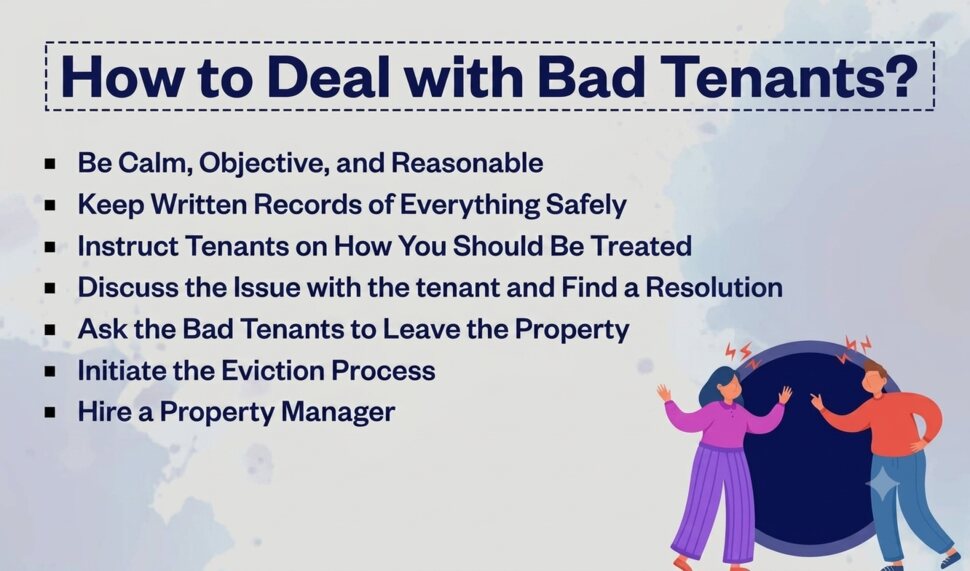
Be Calm, Objective, and Reasonable
It is understandable landlords get angry when tenants cause problems in rental properties. However, you need to stay calm because being angry isn’t going to work. It can worsen the situation. Do not let your thoughts trouble your emotions when you talk to your tenants.
As a landlord, you need to be reasonable. Evaluate the situation carefully from every aspect. Take some time to come to the best approach. Your tenants will be a lot more responsive to what you tell them if you come across as managed and thoughtful.
Keep Written Records of Everything Safely
Keeping a written record of everything can help you avoid disputes with difficult tenants. This increases your workload, but at the same time decreases the possibility of arguments with problem tenants. So, it is deserving the trouble.
Well, During the home inspection, take pictures and videos along with the written records of your findings that feature a timestamp. This is the one way no tenant can argue with necessary security deposit deductions. It will be easy for you to get rid of bad tenants.
Also Read: What are the squatters’ rights in Oklahoma?
Instruct Tenants on How You Should Be Treated
Your actions reflect how you expect to be treated. Unless you will find your tenants taking advantage of you.
For example, if your tenant does not pay their rent on time, and you do not enforce the terms of the lease, they will begin to get away with it. So, if you stand on your own rules, you’ll find yourself dealing with far fewer disputes.
And if you can’t get the result still after all the rules and agreement, keep following. Let your tenant believe that you are not going to drop the argument. This will make them resolve the issue quickly or they will face consequences.
Recommended: Can Landlord Keep Security Deposit For Breaking Lease in OKC?
Discuss the Issue with the tenant and Find a Resolution
If you are having issues with a tenant but still want to make it work, you may want to schedule a time to discuss your concerns. Be patient, listen to their side, and try to find a solution that works for both parties.
Always respond to tenant concerns, handle essential repairs promptly, and keep communication respectful. A positive relationship can make it easier for them to follow the rules.
Be clear about your expectations and enforce the lease agreement properly. If an occupant continuously breaks the rules or pays late rent, address the issue instead of letting it continue.
If the tenant is willing to correct the problem and follow the lease terms, you may be able to keep them as a tenant. If the problem still continues, document the situation and take the appropriate next steps. Hire a property management company as a mediator to help you communicate with tenants and enforce lease terms.
Ask the Bad Tenants to Leave the Property
When you have reached your breaking point, it is time to ask bad tenants to move out of your rental property. While getting terrible tenants to leave your property might be difficult, it is not impossible. You can start by sending them a Written Notice to Vacate your property as per the lease terms, and they will know that you want them to leave the property.
However, you cannot simply force a tenant out of your home. If they refuse to leave freely, your only option is the eviction process.

Initiate the Eviction Process
Eviction is always costly and should be the last resort if you can’t deal with the difficult tenant anymore. It is also important to keep in mind that you can’t evict a tenant without a proper notice and procedure. The eviction laws and requirements are different in the states. However, in many states, you can only evict a tenant for these reasons:
- If the tenant violates the lease agreement.
- If the tenant didn’t move out after the lease expires.
- If the tenant failed to pay rent.
Further read here: Legal Reasons to Evict a Tenant
Hire a Property Manager
A bad tenant is hard to deal with no matter what you do to please them. If you don’t want to get involved with such hassle, then it’s best that you let someone else handle them on your behalf. You can save a lot of time and energy and also avoid stress. That’s why hiring a property manager can be in your best interest. Dealing with bad tenants is an easy task for a property manager. In addition, property management companies also offer routine inspections, thorough tenant screenings, lease agreements, repairs, maintenance, etc.
A Property Manager makes sure that there are no illegal activities going on in your rental property. If you need to evict a tenant, then your property management company will send out an eviction notice on your behalf and carry out the eviction process or at least guide you.
If you’re looking for a property manager but don’t know what to look after, then check out our article on choosing a right property management company.
How to Get Rid of Bad Tenants?

If all else fails, Eviction can be the last option for getting rid of bad tenants. As a landlord, you can begin the process of evicting your problematic tenant. You might wonder how you can deal with problem tenants if it is a tough process. For that, you’ll need to collect evidence about how they are violating your lease agreement. This can make a court in your favor, if necessary.
Talking about the evidence, you can collect any noise complaints, police reports about disturbances, and proof of additional tenants living on the property without a lease agreement. Proofs also include pets that weren’t allowed in the rental property. Also look out for property damage, broken appliances, and signs of illegal activities on the property.
After that, begin the eviction process if you have already served an eviction notice to your tenant, as required by your state and local municipality. Hire legal representation. As mentioned above, eviction is a complicated long process. But, if you are in the right place and can prove that your tenant was breaking the lease terms, you will win the case.
Frequently evicting a tenant can hamper your profit and increase the vacancy rate. Learn more on How to minimize rental property vacancy rates.
Recommendation: Can you Evict a Tenant Without a Lease?
How to Avoid Bad Tenants?
The perfect way to deal with bad tenants is to prevent renting to them in the first place. While no screening process is perfect, taking a few simple steps before renting your property can help you avoid many common tenant problems.
- Conduct Thorough Tenant Screening: A thorough tenant screening process is your first line of defense against bad occupants. Always verify the applicant’s employment, income, credit or rental history, criminal background, and eviction records before approving the lease. Tenant screening is time-consuming, but it helps you identify potential problems before the mistake gets bigger & costlier.
- Contact Previous Landlords: Never rely on the information given by your tenants in the rental application. Contact the previous landlord to ask if the tenant pays the rent on time, takes care of the property, and follows the lease agreement. Their feedback can help you identify problems that may not appear while doing a background check.
- Use a Detailed Lease Agreement: A well-written lease agreement clearly explains the rules and responsibilities for both the landlord and tenants. Clearly outline the rent due date, maintenance responsibilities, pet policies, occupancy limits, and the consequences of lease violations. When expectations are clear from the beginning, tenants are more likely to follow the lease agreement.
- Perform Regular Property Inspections: Routine inspections help you identify lease violations, maintenance concerns, or property damage before they become serious problems. Conduct every inspection with proper notice and document your findings to keep detailed records. Routine inspections also encourage tenants to take proper care of the property.
- Communicate Properly and Enforce Rules: Maintain professional communication with your tenants and address any concerns as they arise. At the same time, enforce your lease consistently for every tenant to reduce disputes, prevent violations, and set clear expectations throughout the tenancy.
- Consider Hiring a Property Management Company: If managing tenants becomes stressful or time-consuming, consider hiring a professional property management company. They can handle tenant screening, lease agreements, inspections, rent collection, maintenance, and legal compliance, enabling you to protect your investment while reducing tenant-related issues.
Get Away From the Bad Tenant’s Problems Today!
Dealing with bad tenants is challenging, but being a landlord is an important responsibility. You can follow the above best practices, which takes away your stress on dealing with them. In short, by establishing strong lease agreements, screening potential tenants carefully, and maintaining open communication, you can minimize problem tenants and protect your investment.
Are you feeling the headache of dealing with difficult tenants? Then, let property management OKC take the burden of dealing with bad tenants off your shoulders. Contact us today!
FAQs on Dealing with Problem Tenants
How do I get rid of bad tenants?
The following are the tips to get rid of bad tenants:
Tip 1: Inspect your property regularly and provide maintenance notices.
Tip 2: Provide short-term leases only.
Tip 3: Raise the rent or don’t renew their leases.
Tip 4: Don’t approve unnecessary requests.
Tip 5: Eviction can be your last option.
How to report a problematic tenant?
1. Stay calm and objective.
2. Review lease agreement.
3. Keep records of everything.
4. Discuss the Issue with the tenant.
5. Consider professional management.
6. Report to local authorities.
7. Get legal help.
How do you deal with an abusive tenant?
Dealing with abusive tenants can be difficult. Take the emotion out of the equation, communicate with your tenant, and know when to stand firm and when to compromise. You can use the rental agreement to back up your arguments.
What happens if tenants don’t leave?
You can take legal action. Acting under a court order for possession is the ONLY legal way you can physically evict problem tenants from a property if they refuse to leave. High Court Sheriffs can help you with the process.
How can I get rid of a tenant without going to court?
Talk to them about the problems and consequences and make them clear why you want them to vacant the property. Offer them a way out. Sometimes, cash for the keys can be the best way to deal with terrible tenants.
Can the landlord force the tenant to leave?
Yes, the landlord can force the tenant to leave. usually, the tenant will have to move. The landlord can bring an application to the tenant to vacate the property. If they deny it, the landlord can act for legal help.
Can a landlord charge you after you move out?
Depends on the situation. If tenants agreed to the fee at the outset, they can’t defend it during move-out. But if the tenant didn’t agree to any exit fees, then landlords have no right to charge you after you move out.
Can I evict a tenant myself?
You can, but it’s not simply banging on the door, and demanding they leave. Depriving someone of their right to a home is an issue taken extremely seriously by the courts. So, a landlord looking to evict a tenant is to do everything following the state and local laws.
Can a landlord evict a tenant without a proper reason?
No, eviction must be based on valid reasons, as specified by your local landlord-tenant laws and lease agreement. Also get to know can a landlord evict one tenant and not the other.