(
(



As a landlord, you may face a situation where you need to give a tenant notice to vacate from your rental property. Knowing how much notice to give a tenant to move out can save you from costly legal mistakes and lengthy eviction delays. The correct type of notice depends on the lease type, the reason for ending the tenancy, and whether the tenant gets a legal chance to fix the issue.
Under the Oklahoma Residential Landlord and Tenant Act (ORLTA), the number of days’ notice you give, whether it’s 30, 15, 5, or as little as 24 hours, depends entirely on your lease type and the reason for ending it. You should give notice to move out based on state-required timelines, and these timelines shape very lawful landlord action.
In my 27+ years of managing Oklahoma rental properties, I’ve handled everything from smooth month-to-month terminations to emergency evictions for illegal activity, and the notice period you choose determines whether your tenant’s departure goes smoothly or becomes a legal nightmare.
Throughout this blog, I’ll share exactly what works based on real experience managing hundreds of tenant move-outs. You’ll learn the exact notice periods Oklahoma law requires and how to deliver them correctly so your eviction, if it comes to that, actually holds up in court.
Key Takeaways
- A 30-day Notice is required for ending month-to-month tenancies under Oklahoma law.
- A 5-day notice to quit applies for non-payment of rent; the tenant must pay or vacate.
- A 15-day cure or quit notice is used for lease violations; the tenant has 10 days to cure or 15 days to move out.
- An unconditional quit notice (24 hours to 5 days) is reserved for serious breaches such as criminal activity.
- Serving proper notice protects your case in court, avoids delays, lost rent, or dismissed filings.
Why Giving Sufficient Notice to Tenants Matters for Landlords?
Giving proper notice isn’t just a courtesy; it’s the law. Working with hundreds of landlords, I’ve seen many lose hundreds of dollars just because they gave the wrong notice period to tenants.
Oklahoma landlords are governed by the Oklahoma Residential Landlord and Tenant Act (ORLTA), which outlines rules for lease termination, eviction, and tenant rights. According to ORLTA, improper notice voids your eviction filing entirely. This means starting over, losing weeks or months of rent, and potentially paying attorney fees. In Oklahoma specifically, 40% of eviction cases were dismissed before trial by the landlord; indicating disputes were resolved outside of court. This demonstrates that proper notice combined with adequate time can actually save landlords money by avoiding court altogether.
Under Oklahoma Statute 41 O.S. § 111, specific timelines determine when you can legally file for eviction. Your properly delivered notice becomes crucial evidence that protects you from tenant defenses and Fair Housing complaints. When you understand notice requirements, you can better coordinate your property management operations and minimize costly vacancy periods.
What are the Types of Notices to Vacate in Oklahoma?
Oklahoma law has established five distinct notice types, each with specific timelines and purposes. Choosing the right type of notice and serving proper written notice helps landlords avoid delays, dismissed filings, and disputes over whether the tenant received the notice correctly. Let’s break down each notice so you know exactly when and how to use them to protect your investment.
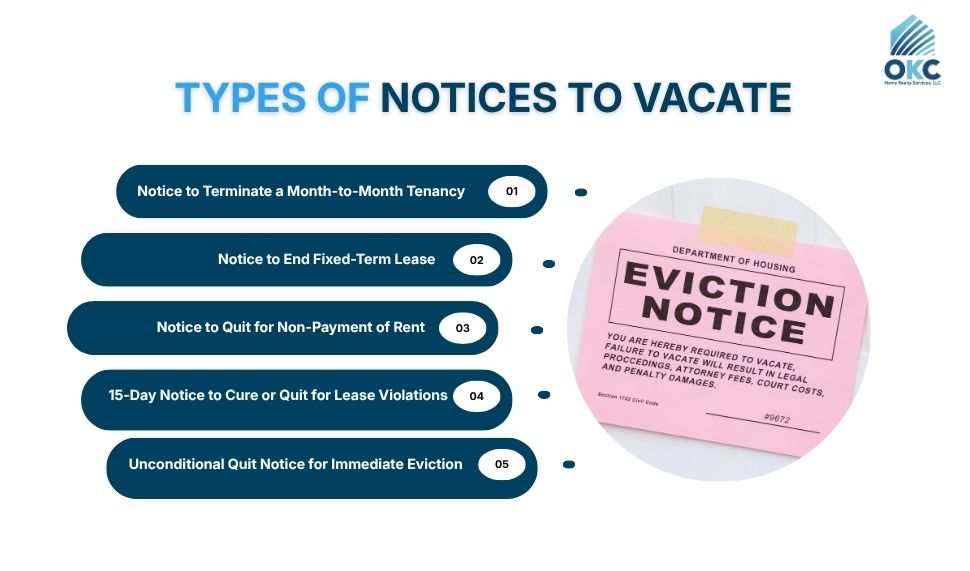
1. Notice to Terminate a Month-to-Month Tenancy
For a month-to-month lease, Oklahoma law requires you to provide 30 days’ written notice before terminating the tenancy. This notice to vacate does not require a specific reason as long as you are not discriminating or retaliating. The 30-day period begins the day after you deliver the notice, not when you write it.
- Legal basis: 41 OK Stat § 41-111(A)
Notice Period: 30 days
Who can use it: Either the landlord or the tenant - Key requirement: Must be in writing, delivered before the rental period ends
2. Notice to End Fixed-Term Lease
If the tenant is on a fixed-term lease (e.g., one year), review the rental agreement first; you generally do not need to give notice if you plan to end the lease at its natural expiration date, unless the lease itself requires notice (41 O.S. §103). However, if you or the tenant wants to end the lease early, that’s a different story. If you’re ending the agreement before the original end date, say in 8 months, you may need to issue a lease termination notice.
3. Notice to Quit for Non-Payment of Rent
When tenants fail to pay rent on time, Oklahoma law allows landlords to issue a 5-day notice to quit. This written notice should state the overdue amount, the deadline to pay rent, and that the tenant must pay or vacate before the landlord files for eviction.
- Legal basis: 41 OK Stat § 41-131 (B)
- Notice Period: 5 days
- Most common eviction notice in Oklahoma
- The 5-day countdown begins the day after proper delivery.
4. 15-Day Notice to Cure or Quit for Lease Violations
If a tenant commits rental agreement violations, such as having unauthorized pets, causing property damage, or other breaches, you must give them a 15-day notice to cure or quit. This notice gives the tenant a chance to fix the violation before eviction moves forward. Industry statistics show that approximately 20% of landlords have experienced property damage exceeding $5,000. If the tenant doesn’t resolve the issue in time, you can proceed with eviction.
- Legal basis: 41 OK Stat § 41-132 (B)
- Notice Period: 15 days
- Key Requirement: Proof of the violation
- The tenant has 10 days to fix the problem, or they must move out within 15 days.
5. Unconditional Quit Notice for Immediate Eviction
Oklahoma law allows landlords to issue an unconditional quit notice for the most serious lease violations, circumstances where the tenant has no opportunity to cure the problem and must vacate immediately. These situations typically involve:
- Illegal activity on property (drug manufacturing, gang activity)
- Substantial property damage, threatening safety
- Creating health or safety hazards for other tenants
- Repeated violations after previous cure notices failed
Unlike the 15-day cure notice, an unconditional quit notice does not offer the tenant a chance to fix the problem. This type of notice should only be used for serious violations where Oklahoma law allows faster action.
- Legal basis: 41 OK Stat § 41-132(C)
- Notice period: 24 hours to 5 days, depending upon the severity (no option to cure)
- Requirement: Strong evidence (police reports, witness statements, photos, official citations)
- Used only for extreme conduct
- Tenant must leave immediately
Oklahoma Move-Out Notice Timeline Table
Different situations require different notice periods, depending on the reason for lease termination or eviction. The table below helps landlords choose the correct type of notice, whether the issue involves unpaid rent, a lease violation, a month-to-month tenancy, or another reason for a notice to vacate.
| Reason for Notice | Notice Period | Type of Lease |
| Ending month-to-month tenancy | 30 days | Month-to-month |
| Ending a fixed-term lease early | Varies (30–60 days or per lease) | Fixed-term |
| Non-payment of rent | 5 days | Any |
| Lease violation (curable) | 15 days (10 to cure) | Any |
| Unconditional quit (serious breach) | 24 hrs – 5 days | Any |
What are Valid Reasons for a Landlord to Ask a Tenant to Move Out?
You can ask a tenant to move out when Oklahoma law recognizes a lawful cause or when the tenancy structure allows a no-cause termination, such as a month-to-month agreement. Valid reasons align with the ORLTA, and courts require the correct type of notice for each situation. Using the wrong written notice can delay the case or force the landlord to restart the process. Below are practical landlord scenarios with legally supported actions.
Scenario 1: You Want to Sell the Property
If your tenant is on a month-to-month lease, you can give 30 days’ notice to vacate. If it’s a fixed-term lease, you cannot terminate early without cause unless your lease includes an early termination clause.
Scenario 2: Tenant Hasn’t Paid Rent
Issue a 5-day notice to quit when the tenant does not pay rent. If they still don’t pay, you can file for eviction. Understand what happens after you accept partial rent payments, if you decide to do so.
Scenario 3: Tenant Is Breaking Lease Rules
Use the 15-day notice to cure or quit. They get 10 days to fix the issue or move out within 15 days.
Scenario 4: You Want to Move In Yourself
In a month-to-month situation, a 30-day notice is valid. If the lease is still active, you can’t evict just to occupy the unit. You’d need to wait for the lease to end or consider negotiation or legal guidance if a landlord can break a lease early.
Scenario 5: Major Renovations or Property Conversion
You can provide 30 days’ notice to month-to-month tenants. Fixed-term leaseholders cannot be removed unless the lease contains a renovation clause or you negotiate an early exit. Consider offering relocation assistance to maintain goodwill.
How to Properly Deliver A Tenant Notice to Quit?
Serving a written notice properly is just as important as the content of the notice itself. Oklahoma law is specific about the acceptable delivery methods, and you must follow them exactly.
- In-person delivery: Hand-deliver the notice to the tenant. The tenant doesn’t have to accept willingly; if they refuse, leave it in their presence.
- Substitute service: If the tenant isn’t home, deliver the notice to another adult resident in the property (spouse or roommate) and mail a copy to the tenant.
- Posting and mailing: If the personal and substitute services fail, post the notice directly at the tenant’s door and mail a copy via certified mail with return receipt.
Remember: An electronic notice via email, text message, voicemails, etc., is not legally valid unless the lease agreement specifically allows it.
What Happens After the Notice Period Ends?
The notice expiration doesn’t automatically mean that the tenant must leave or that you can forcefully remove them.
If the tenant complies and moves out:
Schedule a move-out inspection within 24-48 hours after their departure. Document the property’s condition with photos.
Request the tenant’s new address to ensure you return the security deposit. You have 45 days to return the security deposit, minus any deductions for damages or unpaid rent, or lease-related charges allowed under the rental agreement.
If the tenant refuses to leave:
- You must file for eviction, called Forcible Entry and Detainer” in Oklahoma, with the appropriate court.
- Attend the court hearing
- If the judge rules in your favor, the tenant will be ordered to vacate.
- If they still don’t leave, a sheriff will enforce the order.
Never attempt “self-help” eviction tactics, considered illegal eviction:
- Never change the locks while the tenant is in possession
- Never shut off utilities to force them out
- Never remove their belongings
- Never physically threaten or intimidate
Landlord Obligations for Tenant Move-Out Notice
While issuing a move-out notice, you have legal obligations beyond just delivering it.
- Provide written notice in all cases with specific information. Verbal notice has no legal standing.
- Include all the required information like property address, tenant name(s), exact reason for notice, specific amounts owed (for non-payment), deadline to comply or vacate, and your contact information for questions or payment.
- Deliver notice properly using acceptable delivery methods.
- Allow tenants to cure violations if applicable. For a 15-day cure or quit notice, you should give a chance to fix the problem before proceeding with the eviction process.
- Maintain property access to tenants during the notice period.
- Your notice cannot be based on discriminatory reasons or retaliation for tenants exercising legal rights like requesting repairs.
How OKC Home Realty Services Manages Tenant Notices
Knowing how much notice to give tenants to move out in Oklahoma requires choosing the right type of notice for different scenarios: 30 days for month-to-month terminations, 5 days when tenants fail to pay rent, 15 days for lease violations, and immediate notices for serious violations.
If you’re a landlord in Oklahoma, navigating tenant notices can be stressful and time-consuming. OKC Home Realty Services simplifies this process by handling all tenant communications, including move-out notices, the eviction process, and legal compliance, so you don’t have to. Our team is well-versed in Oklahoma landlord-tenant law, ensuring every notice is delivered correctly and on time, minimizing legal risks and avoiding tenant disputes. From initial notice to final eviction, we provide step-by-step support and documentation, making property management seamless for you.
Need professional property management support in Oklahoma? Contact OKC Home Realty Services today and let us handle tenant notices and move-outs, saving you money, stress, and legal complications.
FAQ
How much notice must a landlord give a tenant who has no written lease in Oklahoma?
Without a written agreement setting a definite term, the tenancy is generally month-to-month. Either party must give at least 30 days’ written notice to end it. A roomer or boarder who pays weekly rent is an exception: that tenancy is week-to-week and generally requires at least seven days’ written notice.
What is a 48-hour eviction notice in Oklahoma?
The 48-hour notice comes after a court judgment and a writ of execution. It tells the tenant when the person executing the writ will return to restore possession to the landlord. It is not the initial notice used to end a tenancy or demand unpaid rent.
Is an Oklahoma notice to vacate the same as a court eviction form?
No. A notice to vacate is given to the tenant. If an eviction case becomes necessary, the landlord starts that separate court process by filing an affidavit for eviction with the court clerk. Oklahoma law calls for public access to the court affidavit through the Oklahoma State Courts Network.
What if the last day of an Oklahoma move-out notice falls on a weekend or holiday?
For a deadline under Oklahoma’s landlord and tenant law, exclude the first day when counting. If the last day falls on a legal holiday, exclude that day too; Oklahoma defines Saturdays and Sundays as legal holidays. Weekends that fall between the first and last days still count.
What happens if a landlord lets a tenant stay after a fixed-term lease expires?
If the landlord consents to the tenant staying, a month-to-month tenancy is created unless both parties agree otherwise. Ending that new tenancy generally requires at least 30 days’ written notice.
Do Section 8 or other assisted rentals have different notice rules?
They can. For a Housing Choice Voucher tenancy, federal rules require an owner ending the tenancy during the lease term to state the grounds in writing and give the housing authority a copy of an eviction notice. Certain public housing and project-based assisted rentals currently require at least 30 days’ notice for nonpayment of rent. Identify the specific housing program and check its requirements before using an ordinary Oklahoma notice.
What if the last day of the notice period falls on a weekend or holiday?
Do not count the day the notice is served. Count the following days, including weekends within the period. If the last day falls on a Saturday, Sunday, or other Oklahoma legal holiday, exclude that day and use the next applicable day. Giving a little extra time can help avoid a deadline dispute.