(
(



If you’re wondering what happens if someone gets hurt on your rental property? The first question you’re asking is: Am I going to be held liable for this? The truth is, it depends on the cause of the injury, where it occurred, and whether you failed to address a known hazard.
Landlord liability arises when you can be held responsible under premises liability law for injuries caused by unsafe conditions they knew about ( or should have repaired), which leads to someone getting hurt, but that doesn’t mean every accident is automatically your fault. Often, liability is shared among the landlord, the tenant, or the injured guest, depending on the circumstances.
In this blog, I discuss what typically happens when somebody is injured on your rental property, when a landlord might be legally responsible, how landlord insurance comes into play, and the steps a property owner should take immediately after an incident. I’ll also cover practical tips to reduce your risk, including documentation, inspections, and communication with tenants, so landowners are better prepared if an accident ever happens on your property.
Understanding Premises Liability
Premises liability is a legal concept that holds property owners responsible for injuries arising from unsafe or neglected conditions on their property. In rental housing, this means you must maintain reasonably safe living conditions in areas under your control, especially common areas such as stairways, parking lots, sidewalks, and hallways. If you knew or reasonably should have known about a hazard and failed to fix it under landlord’s duty of care, you could be held liable for any resulting injuries. This applies to your tenants, their guests, and in some cases, even strangers who enter your property.
Under standard premises liability, tenants must prove four elements:
- Landlord owed a duty of care (e.g., warranty of habitability)
- Breach of duty (failed to fix after notice)
- The breach caused the injury
- Damages resulted (medical bills or pain)
Common Types of Injuries in Rental Properties
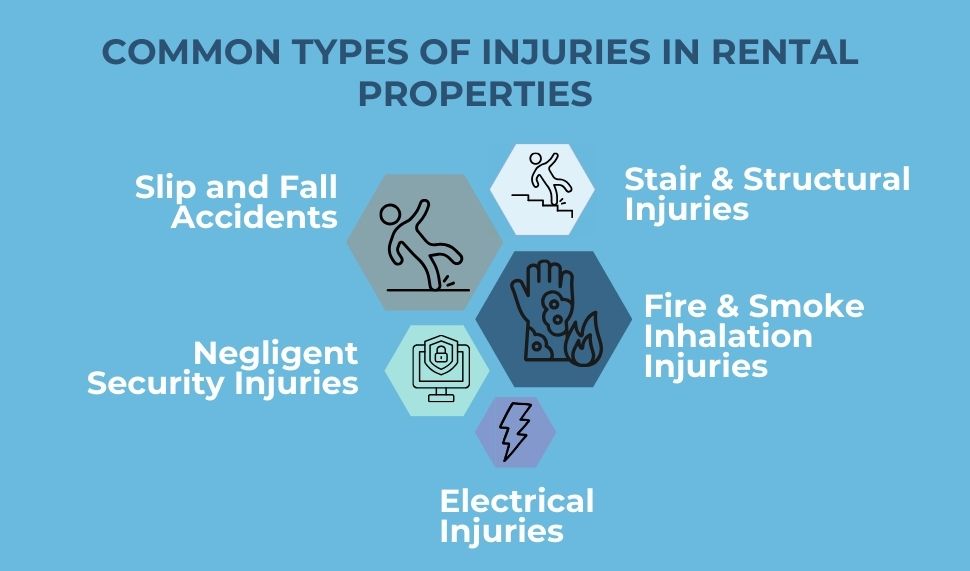
Rental property injuries usually result from preventable hazards linked to maintenance gaps, code violations, or delayed repairs. Below are the most common injury categories landlords face, along with risk factors and liability triggers.
Slip and Fall Accidents
Slip and fall injuries are the most common cause of personal injury claim against landlords. Slip and fall on rental property are mainly caused by wet floors, icy walkways, uneven pavement, or loose rugs, where tenants or guests can easily lose footing. 20% of these accidents result in severe consequences like fractured bones, sprained ankles, or traumatic head injuries that require extensive medical treatment and recovery time. Liability risk increases significantly when the dangerous condition exists in a common area under the landlord’s direct control.
Stair and Structural Injuries
Injury from unsafe stairs often occur when property components deteriorate due to age, weather exposure, or deferred maintenance. Broken handrails, loose stair treads, inconsistent step height, unstable balconies, and inadequate lighting create serious fall risks that can lead to fractures or head injuries. When a defect remains unrepaired after notice or when inspections should have identified the issue, courts may determine that the landlord breached their duty of care.
Electrical Injuries
Electrical injuries occur when rental properties contain faulty wiring, outdated breaker panels, overloaded circuits, exposed outlets, or non-compliant installations that fail to meet modern safety codes. These hazards can cause electric shocks, burns, appliance fires, or widespread structural damage. If a known defect remains unresolved or if outdated systems create foreseeable risk, it becomes your liability under negligence.
Fire and Smoke Inhalation Injuries
Fire-related injuries result from missing or malfunctioning smoke detectors, neglected heating systems, faulty wiring, blocked exits, or failure to comply with safety codes. These accidents cause not only immediate physical harm but also property destruction and displacement for residents. Most states, including Oklahoma, legally require operational smoke detectors in specific locations, and failure to install or maintain them increases liability exposure.
Negligent Security Injuries
Negligent security claims arise when inadequate safety measures contribute to foreseeable criminal activity on the property. Broken locks, poor exterior lighting, damaged gates, unsecured entry points, and malfunctioning surveillance systems create environments where assaults, robberies, or other crimes occur. While you, as a landlord is not automatically a guarantor of tenant safety, the court assesses whether prior incidents or neighborhood crime patterns made additional precautions reasonably necessary.
Exposure to Toxic substances
Toxic exposures like asbestos, lead paint, mold, and pet allergens can cause significant health problems for tenants, including brain damage, breathing issues, and even chronic illness. Exposure to these toxic substances can be vulnerable for tenants, who can be the most affected.
Landlords must identify and repair toxic hazards in a timely manner and can be held liable if they fail to do so.
When Is a Landlord Legally Responsible for an Injury?
Landlords are not automatically liable every time someone gets hurt on a rental property, but legal responsibility arises under premises liability laws when landlord’s negligence directly contributes to the harm, such as failing to repair a known hazard or maintain common areas in a habitable condition. However, if the injury is due to the tenant’s reckless behavior or a hazardous condition created by them, the landlord’s liability is significantly reduced or eliminated.
Below are the primary circumstances that create landlord liability when a tenant is injured on property and seeks to hold you accountable:
Negligent Maintenance & Repairs
One of the most direct ways a landlord becomes legally responsible is through negligent maintenance. If you’ve failed to repair structural defects like broken steps, deteriorating flooring, or unstable handrails, you are breaching your duty of care. Furthermore, if you do attempt a repair but do it incompetently, you are often more liable than if you had done nothing at all, as you created a false sense of security for the tenant.
Hazardous Conditions in Common Areas
You, as a landlord, have control over common areas like hallways, sidewalks, parking lots, laundry rooms, and shared amenities. You need to keep all shared areas in a safe and sanitary condition. When injuries occur in these locations, the court often assigns responsibility to the property owner because tenants don’t maintain or repair these spaces. Courts’ emphasis on reasonable care here, and if a tenant, guest, or visitor is injured because of a hazardous condition you knew about and failed to address, leads to personal injury claims.
Building Code or Habitability Violations
If your rental property has known building code and implied warranty of habitability violations and injuries occur as a direct result of those violations, you face direct liability. Non-compliance, like missing smoke detectors or inadequate heating, is often considered negligence per se. This means the court assumes you were negligent simply because you broke the law, making it nearly impossible to defend yourself in a civil suit.
Security Failures
If your rental property has broken locks, inoperable security cameras, or inadequate lighting that creates opportunities for criminal activity, and a tenant or guest is harmed as a result, you can be held liable for those injuries, too. If a prior criminal incident occurred on or near your property and you failed to improve security measures afterward, that prior knowledge can be used against you in court.
What to Do Immediately After an Accident at a Rental Property?
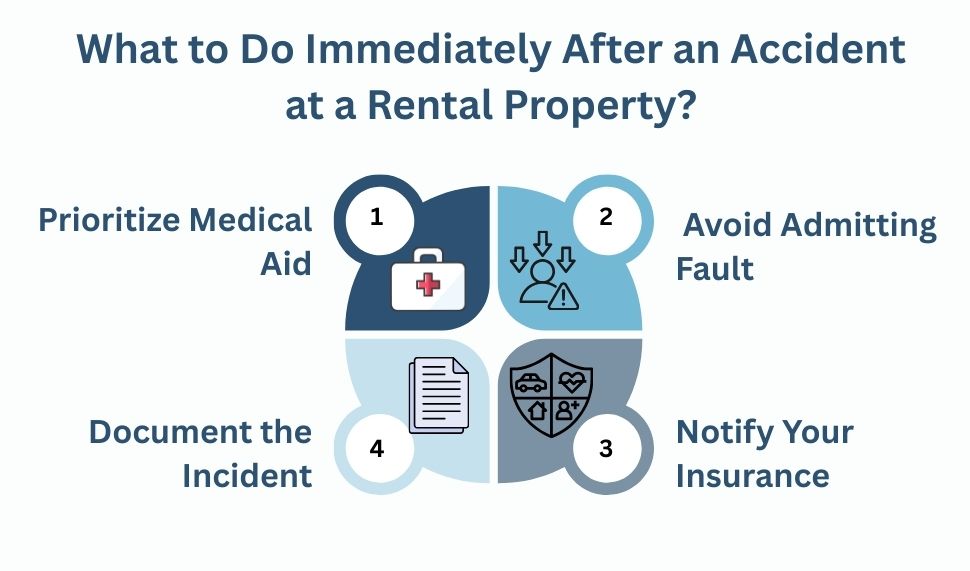
Accidents on a rental property require fast and careful actions to protect everyone involved and limit your legal exposure as a landlord. You need to act quickly, stay calm, and follow a structured process. Courts and insurance providers often review what you did immediately after the incident, including how you handled medical care, documentation, and communication.
Here is exactly how you should immediately respond to injuries in your rental property:
Step 1: Prioritize Medical Aid
Your first responsibility is to ensure the injured person receives proper medical attention as quickly as possible. Call 911 immediately if the injury looks serious, such as a fall causing unconsciousness, heavy bleeding, or broken bones, and stay with the person. In the meantime, offer basic first aid like stopping bleeding to keeping them comfortable without moving them further, but do not attempt to provide medical treatment beyond basic assistance unless you are qualified. Even if the injury seems minor, strongly encourage the injured party to get checked out by a medical professional, since some injuries, like concussions and internal trauma, don’t show symptoms right away.
Showing genuine concern for the injured person’s well-being also reflects positively on you as a responsible landlord if the situation escalates to a legal claim.
Step 2: Document the Incident
Once the injured person has received medical attention, your next priority is to thoroughly document everything about the accident scene before anything is moved, cleaned up, or repaired. Take clear photos of the exact location, surrounding conditions, lighting, weather factors, and any visible hazards, and write down a detailed account of what happened, including the date and time. Collect witness names, contact information, and written statements from anyone who saw the event, asking them to describe exactly what happened without leading questions.
Save maintenance records, prior repair requests, and inspection logs related to that area. These documents are crucial evidence if a landlord negligence claim or lawsuit is filed against you.
Step 3: Notify Your Insurance
Contact your homeowners insurance provider as soon as possible, ideally within 24 hours, and report the incident accurately without speculation. Most insurance policies have specific reporting requirements, and waiting too long to notify them can complicate coverage. Provide factual details, photos, witness information, and maintenance records if requested.
Ask for a claim number, assigned adjuster, and next steps, such as submitting forms or allowing site visits, and keep all correspondence organized. Your insurance provider will handle the investigation and provide legal counsel if a claim for compensatory damages is eventually filed against you.
Step 4: Avoid Admitting Fault
Remain professional and compassionate, but avoid admitting fault or making statements that assign blame before a full investigation occurs. Do not say or write anything that accepts blame, such as apologizing with phrases like “sorry this happened because of me” or agreeing that the property caused the injury, as these statements can be used against you in court or insurance disputes.
Politely decline to discuss details beyond basic facts with the injured party, their family, or personal injury attorney until your insurer or attorney advises. Let your insurer and legal professionals evaluate who is legally at fault for the injury based on documented facts.
Does Landlord Insurance Cover Tenant Injuries?
Yes, in most cases, landlord insurance covers tenant injuries, but the extent of that coverage depends on the type of policy you have and the specific circumstances surrounding the injury. Standard landlord insurance policies typically include liability coverage, which is the portion of your policy designed to protect you financially if a tenant, guest, or visitor is injured on your property and you are found legally responsible for that injury. The liability coverage generally helps you pay for the injured party’s medical expenses, legal defense costs if a lawsuit is filed against you, and any settlement or court-ordered damages up to your policy’s coverage limit.
However, coverage excludes intentional acts, tenant-caused messes inside units, or injuries from tenant pets unless specified. It rarely covers injuries caused by a tenant’s own personal property or negligence; for those instances, the tenant’s own renters insurance would be the primary coverage.
Likewise, it is crucial to understand that standard landlord insurance is not the same as a homeowner’s insurance policy. If landlords try to file tenant injury-related claims under a basic homeowner’s policy, those claims are denied because the property is being used as a rental.
Compensatory Damages in Rental Injury Claims
If a landlord is found liable for a tenant or guest’s injury, the court may order them to pay compensatory damages. These are financial compensations designed to cover the losses the injured party suffered as a direct result of the accident. Here is how these damages are typically broken down in a rental injury case:
Medical Expenses
This covers the total cost of healthcare related to the injury. It includes immediate expenses like ambulance rides, ER visits, and surgeries, as well as ongoing costs like physical therapy, medications, and medical equipment. If the injury requires long-term care, the landlord may also be liable for the estimated medical expenses.
Lost Wages and Future Earning Capacity
If an injury prevents a tenant from working, they can seek compensation for the income lost during their recovery. If the injury results in a permanent disability that prevents them from returning to their career or limits their ability to earn a living in the future, the court may award damages for loss of earning capacity.
Pain and Suffering
These are non-economic damages designed to compensate the victim for physical pain, emotional distress, anxiety, depression, and overall reduction in quality of life they have experienced due to the accident. The amount is often determined by a jury, subjectively based on the injury severity and life impact.
Property damage
If the accident that caused the injury also destroyed the tenant’s personal belongings, the landlord might be responsible for replacement or repair costs. For example, if a ceiling collapses, injuring a tenant, and also smashes their laptop and furniture, the value of these items would be included in the total compensatory claim.
Alternative Accommodation
If the incident that caused the injury also made the rental unit unlivable, such as a major fire caused by faulty wiring, the landlord may be responsible for the tenant’s relocation costs. This includes paying for hotel stays or the rent for a temporary apartment while the property is being repaired and cleared for safety.
Situations like these often raise questions about a landlord’s legal obligations during major repairs, including whether a landlord must provide alternative accommodation during repairs. Understanding these responsibilities can help both landlords and tenants handle emergency situations more clearly and avoid disputes.
Landlord’s Legal Defense Against Injury Claim
When a tenant or guest files a rental injury claim, your defense depends on documentation compliance and evidence you collected reasonably. Here are several powerful legal defenses that can reduce or even eliminate your liability:
No Notice of Hazard
Landlords avoid liability when no prior report or complaints about the hazard existed before the injury. If you can demonstrate that through maintenance logs, inspection reports, and communication records, the hazard was unknown to you before the accident, it becomes much harder for the injured party to prove negligence on your part.
Comparative Negligence
In most states, like Oklahoma, if the tenant or guest was partially at fault, like ignoring repair offers, creating a mess, wearing improper footwear, or being distracted by their phone, their compensation is reduced by their percentage of fault. For example, 70% tenant blame means you pay only 30% of the damages.
Assumption of Risk
Claims can get dismissed under the assumption of risk if the injured parties knew about dangers like posted wet floor signs, noted defects at move-in, or on-going work zones, and chose to proceed anyway voluntarily. This is common when the risk is generally understood, and the injured party made a conscious choice to participate despite that known risk.
The Open and Obvious Doctrine
It is a legal defense that says a landlord isn’t responsible for an injury if the hazard was so plain to see that a reasonable person would have noticed it and avoided it. No duty exists to warn or protect against dangers that reasonable visitors should notice for themselves, like a large pothole in daylight that a person could easily step around.
Landlords’ Liability for Guest Injury
Landlords can face liability for guest injuries on rental property when negligence occurs in areas under their control, such as common spaces where visitors have a right to safe passage. In the U.S, your liability extends beyond just the tenant to include “licensees” and “invitees” such as social guests, delivery drivers, or repair workers.
However, for areas that are entirely under the tenant’s control, such as the interior of their private unit, your liability as a landlord is generally more limited, unless you knew about a hazard and failed to fix it. Tenants share some duty to warn guests about unit-specific risks they create, like spills or clutter, but your oversight in shared zones remains primary.
How to Protect Yourself as a Landlord Before an Injury Happens
The best way to protect yourself from a rental property injury claim is through preventive measures to avoid such accidents completely. Here are the most effective proactive steps you can take as a landlord to reduce your liability exposure and keep your property and your finances protected:
Schedule Routine Property Inspection
Schedule and document regular property inspections of common areas, structural components, lighting, stairways, sidewalks, and safety devices. Document findings with dated photos, rental inspection checklists, and repair timelines, then fix problems within 48 hours of discovery to create verifiable records.
Use a Strong Lease Agreement
Draft a strong lease or rental agreement that clearly defines responsibilities, such as your duty for common areas, tenant upkeep inside units, including clauses requiring renters insurance and guest rules.
The rental agreement should specify timelines for reporting and addressing hazards, along with consequences for non-compliance, such as eviction.
Respond to Maintenance Requests Promptly
Create a clear system for tenants to submit repair requests and respond within a reasonable timeframe, especially for safety-related issues. Encourage tenants to report repairs promptly and prioritize electrical hazards, structural defects, water leaks, and broken handrails. Fast response times reduce injury risk and show compliance with habitability standards.
Maintain Detailed Records
Keep thorough, organized written records of all maintenance requests, repair work, inspection reports, and tenant communication. Include before/after photos, vendor invoices, and notice timelines to demonstrate prompt action on reported defects. These records are your primary defense, helping dismiss disputes by proving no negligence occurred.
Invest in Proper Insurance Coverage
Review your landlord insurance policy regularly to make sure your liability coverage limits are sufficient for the size and type of property you own. Verify that your policy covers medical payments, legal defense costs, and settlements. Consider umbrella policies for additional protection against high-value injury claims.
How Property Managers Reduce Injury Liability Risk
If someone gets hurt on your rental property, you may be legally responsible if negligence caused the unsafe condition. Courts examine whether you controlled the area, knew about the hazard, and failed to repair it within a reasonable timeframe. Landlords can be held liable for tenant and guest injuries through premises liability law, and the financial consequences can be severe. The strongest protection against landlord liability is proactive risk management that prevents hazards before injuries occur, supported by routine inspections and professional property management team.
At OKC Home Realty Services, we’ve helped countless Oklahoma landlords reduce liability risk by enforcing routine inspection, tracking maintenance requests, coordinating licensed vendors, and documenting every repair with clear timelines and invoices. We monitor housing code compliance, verify safety device installation, oversee lighting and structural integrity, and respond quickly to urgent hazards so you can enjoy your rental income without the constant fear of a lawsuit.
Are you worried your rental property might have hidden liabilities? Contact us today for a free consultation, and let us show you how the right property management partnership can reduce your legal liability.
FAQs about Injury in a Rental Property
Who is responsible if someone gets hurt on your property?
Responsibility depends on the circumstances surrounding the injury. Generally, the landlord is responsible if an apartment injury was caused by a hazardous condition they knew about and failed to fix promptly. If the tenant created the hazard or acted recklessly, responsibility can shift to them. In many cases, fault is shared between both parties depending on the specific details of the incident.
Can a tenant sue a landlord for injury?
Yes. If a tenant can prove the landlord was negligent, meaning the landlord had a duty of care, breached that duty by ignoring a hazard, and that breach directly caused the injury, they can sue for compensatory damages like medical bills and lost wages.
Who is liable if a trespasser gets hurt on my rental property?
Usually, you, as a landlord, are not liable for trespasser injuries because you owe them a very low duty of care. However, there are two exceptions: you cannot intentionally harm them (like setting traps), and you may be liable for injured children if you have an attractive nuisance like an unfenced swimming pool.
Does an umbrella policy cover tenant injury lawsuits?
Yes, in most cases, an umbrella insurance policy does extend coverage to tenant injury lawsuits by providing additional liability protection beyond the limits of your standard landlord insurance policy. This can be especially valuable in serious injury cases where medical expenses, lost wages, and pain and suffering damages exceed your base policy limits.
Who is responsible if a guest trips and falls at a rental house?
If a guest trips and falls in a common area or due to a structural defect that falls under the landlord’s responsibility to maintain, the landlord can be held liable for that injury. If the fall occurred inside the tenant’s private unit due to a condition the tenant created or controlled, responsibility is more likely to fall on the tenant.
Can you get in trouble if someone gets hurt on your property?
Yes, you can face serious legal and financial consequences if someone gets hurt on your rental property, and negligence on your part can be established. This can include civil lawsuits, court-ordered damages covering medical bills, lost wages, property damages, and pain and suffering.
Does renters insurance cover if someone gets hurt on your property?
Yes, for the tenant. Renters insurance includes personal liability coverage that protects the tenant if they are sued for an injury that happened inside their unit. This also benefits the landlord by providing a primary source of insurance that shields the landlord’s policy from tenant-caused accidents.
Is a landlord responsible for tenant injury?
Yes, but only if the landlord’s negligence caused the injury. If the landlord fails to fix a known hazard, ignores safety issues, or does not make necessary repairs according to safety codes, they may be held responsible for a tenant’s injury.