(
(



A tenant calls and says, “Hey, I need to move for work, can I sublet my apartment?”
Simple question. Not always a simple answer.
Here’s the confusion most landlords run into: sublease and sublet get used interchangeably online, but they’re not quite the same thing, and mixing them up in your lease language or your response to a tenant can create real liability. One is a document. The other is an action. Knowing the difference, and knowing what your lease actually allows, is what keeps a tenant’s temporary absence from turning into a landlord’s long-term headache.
This guide breaks down what each term actually means, when landlords should say yes, when to say no, and how to protect yourself either way.
Key Takeaways
- Sublet is the act of a tenant renting out all or part of their unit to someone else. A sublease is the document that makes it official.
- The original tenant stays legally responsible to the landlord; the subtenant answers to the original tenant, not to you.
- Most leases either prohibit subletting outright or require written landlord approval first.
- A poorly handled sublet can leave a landlord with an unscreened stranger in the unit and no direct legal relationship to enforce rules against them.
- Clear lease language, a written approval process, and a formal sublease agreement protect everyone involved.
Sublease vs. Sublet: What’s Actually Different
Think of it this way: subletting is the verb, sublease is the noun.
- To sublet means the original tenant (now acting as a “sub-landlord”) rents out the unit, or part of it, to a new person, called the subtenant, while remaining on the original lease.
- A sublease is the written agreement between the original tenant and the subtenant that spells out the terms: rent, duration, responsibilities.
So a tenant sublets their apartment by using a sublease agreement. One describes the action; the other is the paperwork behind it. In casual conversation, almost nobody distinguishes them, and that’s fine, until it’s time to write the actual lease clause or a legal document, where precision matters.
A quick example: Sarah signs a 12-month lease on a two-bedroom in Oklahoma City. Six months in, she takes a temporary work assignment out of state for three months. Instead of breaking her lease, she sublets the apartment to Mike for those three months and signs a sublease agreement with him. Sarah sublet the unit. The sublease is the document Sarah and Mike signed to make it official. Sarah, not Mike, is still on the hook to the landlord.
Who’s Actually Responsible? (This Is the Part Landlords Care About)
This is the single most important thing to understand: subletting does not transfer legal responsibility to the landlord.
- The original tenant remains fully responsible for rent, damages, and lease compliance to you, the landlord.
- The subtenant is responsible to the original tenant, not to you, unless your lease or a separate agreement says otherwise.
That means if the subtenant stops paying rent, trashes the unit, or breaks a house rule, your legal recourse is against your original tenant, the person whose name is on your lease, not the subtenant living there. Some landlords are surprised by this the first time it comes up. It’s also exactly why vetting the sublet arrangement matters as much as vetting the original tenant did.
Do You Have to Allow Subletting?
Generally, no, not unless your lease is silent on the issue or state law says otherwise. Most residential leases fall into one of three categories:
| Lease Language | What It Means |
| Subletting prohibited | Tenant cannot sublet under any circumstances without violating the lease |
| Landlord consent required | Tenant must get written approval before subletting, the most common and flexible approach |
| Silent on subletting | Ambiguous, and often defaults to tenant-friendly interpretations depending on your state |
The takeaway for landlords: don’t leave this to chance. A lease that’s silent on subletting is a lease that’s inviting a dispute. Spell it out, either “subletting is not permitted” or “subletting requires prior written landlord approval,” with a clear process for how that approval works.
Why Landlords Should Care: Even When It Feels Like a Minor Request
A sublet might seem like a small, temporary favor. It rarely stays that simple. Here’s what’s actually at stake:
Unscreened occupants. You ran a background check, verified income, and checked references on your original tenant. A subtenant who moves in without your review has had none of that scrutiny, and they’re the one actually living in your property.
Insurance and liability gaps. Many landlord insurance policies are written around the tenants named on the lease. An unapproved subtenant can complicate a claim if something goes wrong- an injury, a fire, property damage- because that person isn’t a party to any agreement with you.
Property condition and rule compliance. House rules, pet policies, occupancy limits, noise restrictions- none of that transfers automatically to a subtenant who never saw your lease.
Harder-to-untangle disputes. If a subtenant refuses to leave when the original tenant wants their unit back, or refuses to pay the original tenant, you can get pulled into a dispute involving two people, only one of whom has any legal relationship with you.
A real-world stat worth knowing: according to rental industry surveys, roughly one in five renters has sublet a unit at some point, often without formally notifying their landlord. That gap between “how often it happens” and “how often landlords actually know about it” is exactly why airtight lease language matters more than most owners assume.
When Landlords Might Reasonably Say Yes
Subletting isn’t automatically bad for landlords. There are legitimate, low-risk situations where approving one makes sense:
- A tenant with a strong payment history needs to relocate temporarily for work, military deployment, or a family situation
- The tenant has found a subtenant with solid income and references and is willing to put it in writing
- You’d rather have a vetted subtenant than risk the unit sitting vacant or the tenant breaking the lease outright
- The arrangement is short-term with a clear end date, and the original tenant is returning
In these cases, a documented sublet, done through your approval process, can actually reduce your risk compared to the alternative (an early lease break, a vacancy, or a tenant quietly letting someone move in without telling you at all).
How to Handle a Sublet Request the Right Way
If a tenant comes to you wanting to sublet, don’t just say yes or no on the spot. Walk through this process:
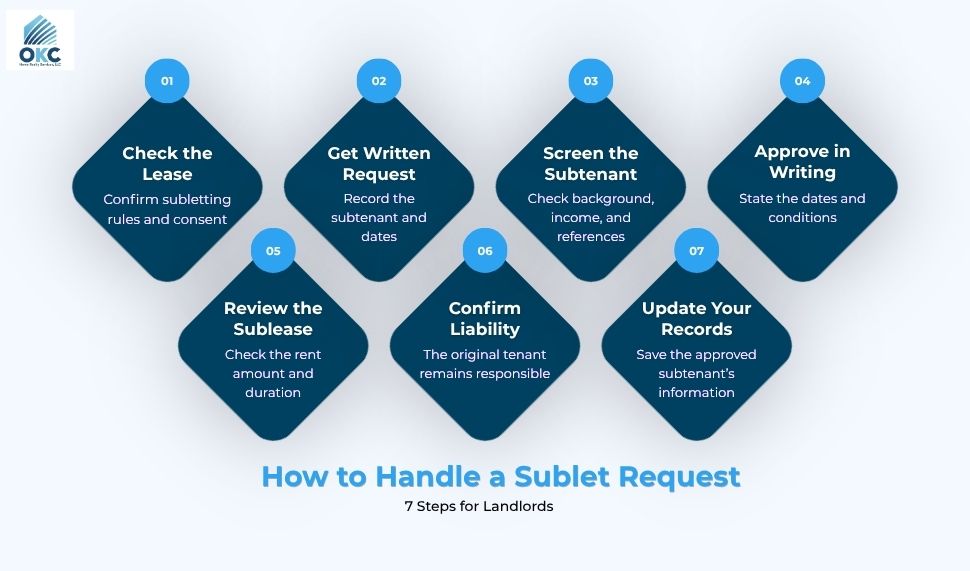
- Check the lease first. Confirm exactly what it says about subletting and whether written consent is required.
- Require a written request. Get the tenant’s request in writing, including who the proposed subtenant is and the proposed dates.
- Screen the subtenant like you would any applicant. Background check, income verification, references- the same standard you’d apply to a new tenant, because in practice, that’s what this person is.
- Put your approval in writing. Don’t rely on a verbal “sure, that’s fine.” Document the approval, the dates, and any conditions.
- Require a copy of the sublease agreement. You want to see the terms the original tenant and subtenant agreed to, particularly the rent amount and duration.
- Clarify who remains liable. Make sure everyone understands, in writing, that the original tenant is still responsible to you for rent and lease compliance.
- Update your records. Note the approved subtenant’s information for your own files, even though they’re not on your lease.
Skipping any of these steps is how a “quick favor for a tenant” turns into a legal gray area six months later.
What Happens If a Tenant Sublets Without Permission?
If your lease requires consent and a tenant sublets anyway, that’s generally a lease violation, treated the same as any other breach. Depending on your lease terms and applicable state law, your options may include requiring the subtenant to vacate, pursuing standard lease-violation remedies against the original tenant, or, in serious cases, moving toward eviction. Exactly what’s available to you depends heavily on your state’s landlord-tenant statutes, so this is a good moment to get legal guidance rather than guess.
Oklahoma Landlords: A Few Notes
Subletting isn’t a topic Oklahoma law addresses with a detailed statutory framework the way it handles security deposits or notice periods, which means your lease language is doing most of the work. The Oklahoma Residential Landlord and Tenant Act governs the broader landlord-tenant relationship, but whether subletting is allowed, restricted, or requires consent comes down to what’s actually written in your lease.
That makes it especially important for Oklahoma landlords to include clear, specific subletting language rather than relying on assumptions about what state law “probably” says. If your current lease is silent on the issue, that’s worth fixing before it becomes a live issue with a tenant rather than a theoretical one.
Sublease vs. Assignment: Don’t Confuse These Either
While we’re clearing things up, a sublease is not the same as an assignment. In a sublease, the original tenant keeps their lease and stays responsible; in an assignment, the original tenant transfers the entire lease to a new tenant and typically exits the relationship completely. Some leases allow one but not the other, so if a tenant says they want to “hand off” their apartment entirely, confirm which one they actually mean; the liability implications are very different.
Quick Checklist for Landlords
- Lease clearly states whether subletting is allowed and under what conditions
- Written tenant request required before any sublet is approved
- Subtenant screened to the same standard as a new applicant
- Written landlord approval on file
- Copy of the sublease agreement collected
- Original tenant’s continued liability confirmed in writing
Final Thoughts
“Sublease” and “sublet” aren’t interchangeable once you’re the one writing lease clauses or responding to a tenant’s request; one’s the action, one’s the paperwork, and both come with a legal relationship that stays firmly between you and your original tenant, not the person who ends up moving in.
The fix isn’t complicated: clear lease language up front, a real approval process, and screening every subtenant like you would any new applicant. Get that right, and a sublet request becomes a manageable, documented process instead of a liability question you’re figuring out after the fact.
At OKC Home Realty Services, we’ve spent over 15+ years managing rental homes throughout the Oklahoma City metro, including drafting lease language and handling sublet requests so owners aren’t left untangling disputes between tenants and subtenants on their own.
FAQ
What's the difference between a sublease and a sublet?
Subletting is the act of a tenant renting their unit to someone else; a sublease is the written agreement that documents that arrangement.
Is the landlord responsible for the subtenant?
No. The original tenant remains responsible to the landlord for rent and lease compliance, regardless of who’s actually living there.
Can a landlord refuse to allow subletting?
Generally, yes, if the lease prohibits it or requires consent that the landlord chooses not to give, subject to state and local law.
Do landlords have to screen subtenants?
There’s typically no legal requirement to, but it’s strongly recommended, since the subtenant will be living in your property even though they’re not on your lease.
What happens if a tenant sublets without permission?
It’s usually treated as a lease violation, with remedies depending on your lease terms and state law, legal guidance is recommended before taking action.
Is subletting the same as lease assignment?
No. Subletting keeps the original tenant on the lease and responsible; an assignment transfers the lease entirely to a new tenant.