(
(


You’re selling a rental property. You’ve handed the buyer the lease, the rent ledger, the security deposit records, the maintenance history; everything checks out.
Then the buyer asks one more question:
“Can the tenant confirm this is actually the deal?”
That’s a tenant estoppel certificate.
In short: it’s a signed statement from your tenant confirming the real terms of their tenancy, rent, lease dates, deposit, and any disputes or side deals, as of a specific date. Buyers and lenders use it to check the landlord’s paperwork against the person actually living in the unit.
If you own rental property in Oklahoma, here’s the one thing to keep in mind before we go further: an estoppel certificate is a verification tool. It doesn’t replace your lease, and it doesn’t override Oklahoma’s landlord-tenant law. Treat it as a snapshot, not a substitute.
Key Takeaways
- A tenant estoppel certificate confirms the facts of a lease, as of a specific date, directly from the tenant.
- Buyers and lenders request them during due diligence on tenant-occupied properties.
- They typically cover rent, lease dates, deposits, amendments, concessions, defaults, and any tenant claims.
- Landlords should cross-check the certificate against the lease, rent ledger, and amendments before sending it anywhere.
- In Oklahoma, the certificate confirms facts; it doesn’t change the tenant’s rights under the Oklahoma Residential Landlord and Tenant Act.
What Is a Tenant Estoppel Certificate, Really?
Think of the lease as the original contract, signed once. The estoppel certificate is the current status report, because a lot can shift in two years that never makes it back into that original document. Rent gets adjusted. A concession gets granted verbally or by email. An amendment gets signed and filed away somewhere. A roommate moves in.
The lease alone can’t tell a buyer what’s actually happening today. The tenant can.
A typical certificate asks the tenant to confirm:
- The property and unit
- Lease start and end dates
- Current monthly rent
- Security deposit amount
- Whether rent is prepaid
- Any amendments or renewal/purchase options
- Any outstanding landlord obligations
- Any tenant claims, credits, or disputes
- Whether they’re currently occupying and the lease is active
Why Landlords End Up Needing One
Nobody wakes up wanting an estoppel certificate. There’s always a transaction driving it.
Selling an occupied property. Say you own a rental in Oklahoma City renting for $1,850/month with a year left on the lease. You tell the buyer that. The buyer doesn’t just want your word; they want the tenant to confirm rent, deposit, lease expiration, and whether any side agreements exist that aren’t in the paperwork.
Refinancing. Lenders evaluate income-producing property based on the rent roll. If your financials assume a certain rent number, a lender may want the tenant to confirm it independently before funding.
Buying a tenant-occupied property. This is where estoppels earn their keep. Picture buying a small portfolio of rental homes. The leases look clean, until, after closing, one tenant mentions a verbal deal for two months of reduced rent, another has an extension that never made it into the file, and a third says the landlord still owes a repair credit. An estoppel process is designed to surface exactly that kind of surprise before you close, not after.
Quick math example: A 4-unit property rents for $1,400, $1,450, $1,500, and $1,550/month, projected annual rent of about $70,800. If the estoppel comes back showing Unit 3 is actually paying $1,350 due to an undocumented concession, that’s an $1,800/year gap the buyer just caught before signing, not after.
What’s Actually in the Tenant Estoppel Certificate
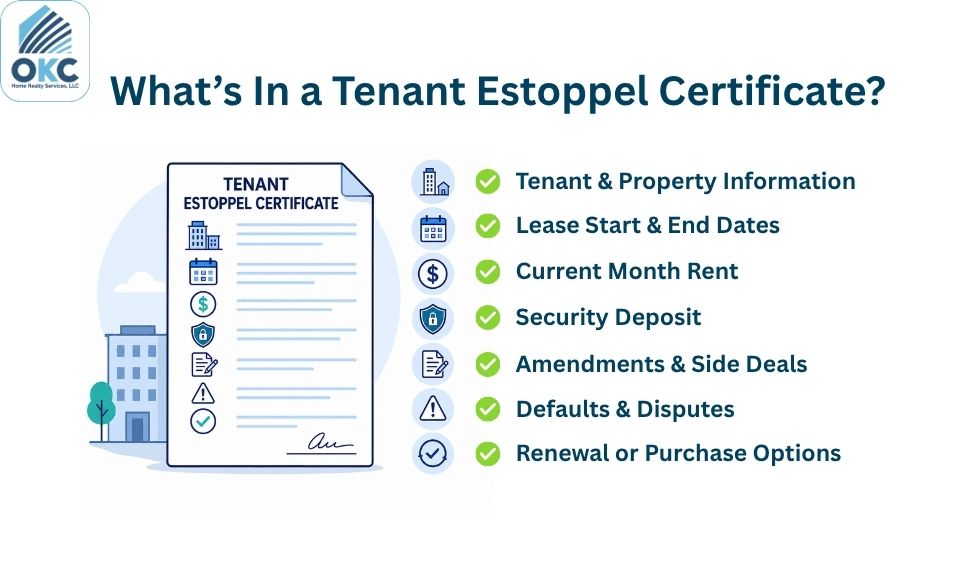
There’s no single universal form; it’s shaped by the lease and what the buyer or lender needs, but most cover the same ground:
| Category | What It Confirms |
| Tenant & property info | Names, address, unit, lease reference |
| Lease dates | Start, expiration, renewals, extensions |
| Current rent | Monthly amount, rent paid through date |
| Security deposit | Amount, and whether any was applied/returned |
| Amendments & side deals | Anything that changed the original lease terms |
| Defaults & disputes | Claims, credits, offsets, unresolved issues |
| Options | Renewal, purchase, expansion, or termination rights |
Before You Send an Estoppel to Your Tenant
Don’t forward the form and hope for the best. Check your own records first against:
- The original lease: Dates, rent, deposit, special provisions
- Amendments: Rent changes, extensions, added occupants, concessions
- The rent ledger: Current rent, payment history, credits, balances
- Property management records: Open maintenance issues, complaints, disputes
- Email and other written communication: An agreement made by email still counts, even if it never made it into the lease
When the Tenant’s Answer Doesn’t Match Yours
Your records say $1,800/month. The tenant’s certificate says $1,700. Don’t just tell them to change their answer, find out why.
Maybe rent really was reduced. Maybe a concession or amendment exists that your books never caught. Maybe it’s a genuine misunderstanding, or a real dispute. Either way, resolve it before that number gets represented to a buyer or lender as fact. This is exactly where organized property management pays off: if leases, ledgers, and tenant communications are already well-kept, you’re not reconstructing two years of history from scattered emails when a deal is on the clock.
Can a Tenant Refuse to Sign the Estoppel Certificate?
Maybe; it depends on the lease. Some leases include an estoppel clause requiring the tenant to provide one on request, sometimes with a deadline. Others don’t say anything about it. If a tenant refuses, don’t assume you can force the issue: review the lease and get legal advice before taking any action.
And if a tenant thinks something on the certificate is wrong- the deposit amount, the rent, an expiration date- they should flag it rather than sign an inaccurate document. The goal isn’t agreement for agreement’s sake; it’s accuracy.
Oklahoma Landlords: Where This Fits With State Law
Oklahoma governs residential landlord-tenant relationships through the Oklahoma Residential Landlord and Tenant Act, and the Oklahoma Real Estate Commission publishes the Act along with standard residential lease forms.
Here’s the key distinction: an estoppel certificate confirms facts for a third party. It does not replace the lease, and it does not change your obligations under Oklahoma law. If something on the certificate conflicts with the lease or with state requirements, that’s a flag to investigate, not something to paper over.
One area where this matters in practice: Oklahoma law addresses what happens when a tenant stays past a lease’s expiration; the tenancy can become a tenancy at will, and periodic tenancies of three months or less generally require 30 days’ written notice to terminate. Before selling an occupied property, know exactly where your tenant stands: still in the original term, on a renewal, holding over, or month-to-month. The estoppel can confirm the tenant’s understanding, but the underlying lease and Oklahoma statute are still what govern.
Is an estoppel certificate legally required in Oklahoma? No, there’s no blanket requirement that every residential tenant sign one. Whether it’s needed comes down to the lease terms and what the buyer, lender, or transaction requires.
A Practical Example: Tenant Estoppel Certificate
An out-of-state investor owns three rental homes in Oklahoma City, managed hands-off by a local property manager. When they decide to sell one, the buyer wants the tenant to stay in place, and the buyer’s lender asks for confirmation.
The property manager pulls together the lease, renewal, rent ledger, deposit records, maintenance history, and tenant correspondence. The tenant signs off confirming: occupancy, $1,850/month rent, eight months left on the lease, a $1,850 deposit, and no side agreements or outstanding claims.
That’s the whole point of the exercise: the buyer now knows exactly what they’re stepping into, with no surprises waiting on the other side of closing.
Estoppel Certificate vs. Lease vs. Rent Ledger
| Lease | Estoppel Certificate | Rent Ledger | |
| Purpose | Creates the tenancy | Confirms current status | Tracks payment history |
| Signed | At move-in | Later, during a transaction | Continuously |
| Shows | Original terms | Verified terms as of today | What was paid, when |
| Catches | — | Undisclosed amendments, disputes, claims | — |
A rent ledger can show a tenant paid $1,800 every month like clockwork, but it won’t tell a buyer whether there’s a renewal option on file, a verbal rent credit, or a claim the tenant believes the landlord owes them. That’s why serious buyers want both documents, not just one.
Why This Gets Harder at Scale
Verifying one estoppel request for one property is manageable. Now imagine a 50- or 100-property portfolio, each with its own rent, deposit, amendments, renewals, and open maintenance items. One missing document in that stack can stall a deal.
This is the unglamorous side of property management, but it’s the part that determines whether a sale, refinance, or portfolio expansion goes smoothly or turns into a scramble.
Estoppel Checklist for Oklahoma Landlords
- Original lease, start/end dates, renewal terms, amendments
- Current rent, security deposit, payment history, credits/concessions
- Current occupants and contact info
- Outstanding maintenance requests or disputes
- Any tenant claims or alleged landlord defaults
- The buyer/lender’s required form and deadline
If anything doesn’t line up, investigate before you sign or submit.
How OKC Home Realty Services Helps
We’ve managed rental properties throughout the Oklahoma City metro for more than 15+ years, overseeing 1,000+ rental homes for owners across the country. Good property management isn’t just collecting rent; it’s keeping leases, ledgers, maintenance records, and tenant communication organized before you need them for a sale, refinance, or estoppel request.
For out-of-state investors especially, that means not having to fly to Oklahoma every time a buyer, lender, or tenant needs answers about your property.
Final Thoughts
A tenant estoppel certificate can look like just another form in a stack of closing documents. It isn’t; it’s often the last checkpoint standing between a buyer’s assumptions and reality.
For Oklahoma landlords, the fix is simple: keep your lease, ledger, and amendments organized as you go, so an estoppel request is a five-minute confirmation instead of a scramble through old emails.
At OKC Home Realty Services, we’ve spent over two decades managing rental homes across the Oklahoma City metro, handling leasing, maintenance, rent collection, and recordkeeping so owners have accurate answers ready whenever a transaction demands them.
FAQs
What is a tenant estoppel certificate?
A signed document where a tenant confirms current lease facts, rent, dates, deposit, amendments, disputes, commonly used when a landlord sells or refinances a tenant-occupied property.
Why do buyers ask for one?
To independently verify the seller’s claims about rental income and lease terms before closing, rather than relying on the seller’s word alone.
Is it the same as the lease?
No. The lease creates the tenancy; the estoppel confirms its current status as of a specific date.
Does every rental need one?
No. It’s requested during specific transactions, sales, refinancing, due diligence, not required by default.
Can a tenant refuse to sign?
It depends on whether the lease has an estoppel clause. If a tenant refuses, review the lease and get legal advice before acting.
What if the certificate has wrong information?
Investigate before it’s finalized. Compare it against the lease, amendments, and rent ledger, don’t let inaccurate information go to a buyer or lender.
Does Oklahoma require estoppel certificates?
No universal requirement exists. It depends on the lease and the transaction; Oklahoma’s landlord-tenant law and the lease itself still govern the tenancy.
Should a lawyer review it?
Worth it when there’s disputed information, unusual lease terms, or significant claims involved. Property managers can organize the underlying records; legal questions go to a qualified Oklahoma attorney.