(
(

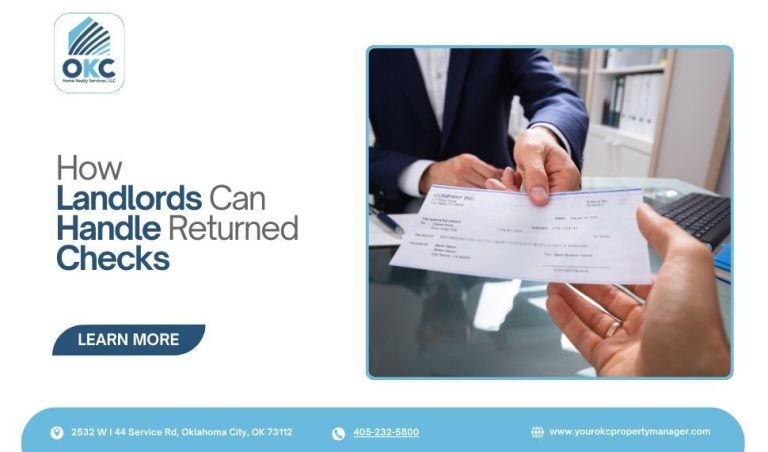

Returned rent checks are frustrating. You did everything right: you provided housing, followed the lease, and waited for rent. You open your bank statement and see those dreaded letters: NSF. Non-sufficient funds. Your tenant’s rent check just bounced. Now the rent is unpaid, bank fees may apply, and you’re stuck figuring out what to do next without making a legal mistake.
The good news?
Returned checks are common, predictable, and manageable when you handle them the right way.
If you’re a landlord in Oklahoma or anywhere in the U.S., this scenario happens more often than you’d think. According to the Federal Reserve, approximately 3-5% of all checks written in the United States bounce each year. For property owners collecting rent from multiple units, that translates to real financial headaches.
Let me walk you through exactly how to handle returned checks, from the moment you discover the bounced payment to collecting what you’re owed, all while staying within the law.
Key Takeaways for Property Owners
Let me summarize the essential points every landlord should remember about bounced checks:
- Act immediately – The moment you discover a returned check, contact your tenant and begin documentation.
- Know your state laws – Returned check fees, notice requirements, and legal remedies vary significantly by state.
- Always document – Keep copies of everything: checks, bank statements, letters, emails, text messages.
- Require guaranteed funds – After one bounced check, insist on certified checks, money orders, or electronic payments.
- Use your lease agreement – Your lease should clearly spell out returned check fees and consequences.
- Consider legal action when necessary – Don’t let unpaid rent accumulate. Small claims court and eviction are valid tools.
- Prevent future issues – Strong tenant screening and alternative payment methods dramatically reduce bounced checks.
- Stay professional – Even when frustrated, maintain professional communication and follow legal procedures.
What Happens When a Tenant’s Check Bounces?
A returned check (also called a bounced check, dishonored check, or NSF check) occurs when your tenant’s bank refuses to process their payment. This happens for several reasons:
Insufficient Funds: The most common reason. Your tenant doesn’t have enough money in their checking account to cover the rent amount.
Closed Account: The tenant wrote a check from an account they already closed.
Stop payment Order: Your tenant called their bank and stopped the check from processing.
Account Frozen: The bank froze the account due to suspicious activity or legal issues.
Signature Mismatch: The signature on the check doesn’t match the bank’s records.
When a check bounces, your bank typically charges you a fee (usually $25-$35) for processing the returned item. You’re out of the rent money and hit with this unexpected charge.
Your Legal Rights as a Landlord
Here’s what most property owners don’t realize: landlord-tenant laws in every state give you specific rights when dealing with bounced checks. You’re not powerless in this situation.
Fee Collection Rights
Bank fees: You can charge your tenant for the NSF fee your bank charged you. This is recoverable in all 50 states.
Returned check fees: Most states let you charge an additional administrative fee for handling the bounced check. These fees typically range from $20 to $50, depending on your state law and lease agreement.
Late fees: Once the check bounces, your tenant hasn’t paid rent on time. You can now charge late fees according to your lease terms.
For example, in California, landlords can charge up to $25 for the first bounced check and $35 for subsequent returned checks within 12 months. In Texas, you can charge the greater of $30 or the amount authorized by your lease agreement.
Lease Violation Consequences
A bounced check violates your lease agreement. This violation gives you grounds to:
- Issue a pay-or-quit notice (demanding payment within a specific timeframe)
- Begin eviction proceedings if payment isn’t made
- Report the incident to the tenant screening services
- Require future payments in certified funds only
Step-by-Step: What to Do When You Receive a Returned Check
Let me break this down into actionable steps you can take immediately.
Step 1: Document Everything (Within 24 Hours)
The moment you discover the bounced check, create a paper trail:
- Save your bank statement showing the returned check
- Make copies of the original check (front and back)
- Note the date you received the NSF notification
- Calculate all fees: bank charges, your returned check fee, and applicable late fees
- Take photos or scans of all documents
This documentation becomes critical if you end up in small claims court or eviction proceedings.
Step 2: Review Your Lease Agreement
Pull out your lease and look for these specific clauses:
- Returned check fee amounts
- Acceptable payment methods after a bounced check
- Consequences for NSF payments
- Grace period language
- Late fee structure
Your lease agreement dictates what you can and cannot do. If your lease doesn’t mention returned check fees, you might still charge them based on state law, but having it in writing makes enforcement easier.
Step 3: Contact Your Tenant Immediately
Call your tenant as soon as possible, don’t wait. Many times, a bounced check is an honest mistake. Your tenant might have:
- Made a deposit that didn’t clear in time
- Miscalculated their account balance
- Experienced a bank error
Keep this conversation professional and factual
“Hi [Tenant Name], I’m calling because your rent check for $[amount] was returned by your bank on [date]. The check bounced due to insufficient funds. You now owe the rent amount plus a $[amount] bank fee and $[amount] returned check fee, totalling $[total]. I need to collect this amount immediately.”
Step 4: Send Written Notice
Follow up your phone call with a written notice. This letter should include:
- Date of the bounced check
- Original check amount
- Reason for return (NSF, closed account, etc.)
- Breakdown of all fees owed
- Total amount due
- Payment deadline (Typically 3-5 business days)
- Acceptable payment methods (usually certified check, money order, or cashier’s check)
- Consequences of non-payment
Send this notice via certified mail with a return receipt requested. This proves your tenant received the notice, important evidence if you need to pursue eviction.
Step 5: Specify Payment Methods
After a bounced check, you should require guaranteed funds:
- Certified check: The bank verifies funds exist before issuing the check
- Money order: Prepaid, so the funds are guaranteed
- Cashier’s check: Drawn on the bank’s account, not your tenant’s
- Cash (with proper receipt): Immediate, but always provide a written receipt
- Electronic payment: Bank transfer or payment apps like Zelle, though these can sometimes fail too.
Many landlords make future rent payments contingent on certified funds for 6-12 months after a bounced check. Your lease should specify this policy.
When to Redeposit the Check vs. Request New Payment
You have two options when a check bounces: try depositing it again or demand a new payment.
Redepositing the Check
Some landlords attempt to redeposit the returned check, hoping funds are now available. This approach:
Pros:
Saves time if the issue was temporary
Might work if your tenant just made a deposit
Avoids confrontation
Cons:
- Delays resolution by 2-3 more days
- Costs another bank fee if it bounces again (around $30)
- Signals to your tenant that bounced checks aren’t serious
Best Practice: Only redeposit if your tenant confirms they’ve added sufficient funds and provides proof (like a deposit receipt or bank statement). Even then, charge the first NSF fee.
Requesting New Payment
Most property management experts recommend requiring immediate payment in guaranteed funds rather than redepositing. This approach:
- Resolves the issue within days, not weeks
- Establishes clear boundaries about payment expectations
- Protects you from additional bank fees
- Creates accountability
Understanding State-Specific Laws on Bounced Rent Checks
Bounced check laws vary significantly by state. Here’s what you need to know for the most common landlord situations:
Criminal vs. Civil Penalties
In most states, writing a bad check is both a civil and criminal matter.
Civil penalties let you recover your money plus fees through small claims court or eviction proceedings.
Criminal penalties kick in when someone knowingly writes a bad check with the intent to defraud. This becomes check fraud or theft by deception—a misdemeanor or felony depending on the amount.
As a landlord, you typically pursue civil remedies. However, if your tenant has a pattern of bounced checks or you suspect fraud, you can file a police report.
State-by-State Fee Limits
Each state caps returned check fees differently:
- Oklahoma: $25 maximum according to state statute (OK Stat §40-3-307)
- California: $25 first offense, $35 for subsequent checks within 12 months
- Florida: $25 for checks under $50, $30 for checks $50-$299, $40 for checks $300+, or 5% of check amount (whichever is greater)
- Texas: Greater of $30 or the amount stated in the lease
- New York: $20 maximum
- Illinois: $25 maximum
Check your state’s landlord-tenant statutes or consult with a local property attorney to verify current limits in your area.
Demand Letter Requirements
Many states require you to send a formal demand letter before taking legal action. This letter must:
- State the exact amount owed
- Provide a specific timeframe for payment (usually 10-30 days)
- Warn of legal consequences if payment isn’t received
- Include specific language required by state law
In California, for example, you must wait 30 days after sending a demand letter before filing a lawsuit for a bounced check. The demand letter must include specific statutory language warning of treble damages (three times the check amount).
How to Pursue Legal Action for Unpaid Rent
When your tenant won’t pay after multiple notices, you have legal options.
Small Claims Court
For amounts typically under $5,000-$10,000 (varies by state), small claims court offers a fast, affordable way to recover:
- Unpaid rent
Returned check fees
Bank charges
Court filing fees - In some states, treble damages (3x the check amount)
The process takes 30-60 days from filing to judgment. You don’t need an attorney, and filing fees run $30-$100.
When to use small claims: Your tenant moved out, or you want to collect money without evicting them.
Eviction Proceedings
If your tenant still lives in your property and won’t pay, eviction becomes necessary. The typical timeline:
1. Pay-or-quit notice (3-5 days in most states)
2. File an eviction lawsuit if they don’t pay or move
3. Court hearing (2-3 weeks after filing)
4. Judgment and writ of possession (immediate to 10 days)
5. Sheriff removes tenant (1-2 weeks after judgment)
Total time: 4-8 weeks in most states, though some jurisdictions take longer.
Important: Never try a self-help eviction by changing locks, shutting off utilities, or removing the tenant’s belongings. These actions are illegal and can result in you owing your tenant damages.
Working with Collection Agencies
After obtaining a judgment, you can hire a collection agency to pursue the debt. Collection agencies typically charge 25-50% of what they recover.
Pros:
- Someone else does the work
- May recover money you otherwise wouldn’t
- Affects tenant’s credit
Cons:
- You only receive 50-75% of the collected amounts
- No guarantee of recovery
- Takes months or years
Prevention Strategies: Avoiding Bounced Checks
The best way to handle returned checks? Prevent them in the first place.
Tenant Screening Best Practices
Strong tenant screening reduces bounced check risk by 60-70%, according to property management industry data.
Credit checks reveal:
- Payment history patterns
- Current debts
- Previous evictions
- Bankruptcy filings
Look for credit scores above 650 and no recent delinquencies on rent or utilities.
Income verification ensures your tenant earns enough to afford rent. The standard: monthly income should be 3x the rent amount. Require:
- Recent pay stubs (last 2-3 months)
- Bank statements showing consistent deposits
- Employment verification letter
- Tax returns for self-employed tenants
Rental history from previous landlords tells you if they’ve had payment issues before. Ask specifically about:
- Late payments
- Bounced checks
- Lease violations
- Property damage
Payment Method Alternatives
Many landlords now skip checks entirely, using payment methods with lower failure rates:
Online rent payment platforms (Rentec Direct, Buildium, Cozy) offer:
- Automatic payments
- Bank account verification
- Lower NSF rates (around 1-2%)
- Built-in late fee calculations
- Digital payment records
ACH transfers pull money directly from tenant bank accounts. Benefits:
- Verify the account has funds before processing
- Lower processing fees ($0.50-$2.00)
- Automatic recurring payments
- Less likely to fail than checks
Credit card payments (through services like PayRent or Rentdrop):
- Near-zero bounced payment risk
- Instant processing
- Tenants can use rewards cards
The downside? Processing fees of 2.5-3.5%, though many landlords pass these to tenants.
Lease Clauses That Protect You
Your lease agreement should include specific language about returned checks:
Returned Check Fee Clause: “Tenant agrees to pay a $[amount] fee for any returned check, plus all bank charges incurred by the Landlord.”
Payment Method Restrictions: “After one returned check, the landlord reserves the right to require all future payments in certified funds, money order, or cashier’s check.”
Multiple NSF Consequences: “Two or more returned checks within a 12-month period constitute a material breach of this lease agreement and grounds for immediate termination.”
Collection Costs: “Tenant shall pay all costs of collection, including attorney fees, court costs, and collection agency charges, for any unpaid rent or fees.”
Real-World Scenarios and Solutions
Let me share some common situations landlords face and how to handle them:
Scenario 1: First-Time Bounced Check, Cooperative Tenant
Your tenant of 18 months has never been late before. Their check bounces due to a banking error they immediately explain.
Solution: Call the tenant, explain the fees, and allow them 2-3 business days to provide payment via money order or certified check. Charge the returned check fee as stated in your lease, but consider waiving it if they’ve been model tenants and provide immediate payment. Document everything and note that future checks must be cleared, or you’ll require certified funds.
Scenario 2: Multiple Bounced Checks, Unresponsive Tenant
This is the tenant’s third bounced check in six months. They won’t return your calls or respond to notices.
Solution: Send a pay-or-quit notice via certified mail immediately. Give them 3-5 days (as required by your state) to pay the full amount due, including all fees. If they don’t respond, file for eviction. Document all attempted communications. Consider filing a police report if you believe the tenant intentionally wrote bad checks.
Scenario 3: Tenant Claims Financial Hardship
Your tenant’s check bounces, and they explain they lost their job and can’t pay rent.
Solution: While you may empathize, you’re running a business. Offer options: a payment plan (in writing), allowing them to break the lease early without penalty, or helping them apply for rental assistance programs. Set a firm deadline (like 10 days) for them to provide partial payment or move out. If they can’t meet these terms, proceed with eviction. Continuing to let them stay without payment hurts both of you.
Legal Notice Templates
Note: These templates are for informational purposes only and not legal advice. Always confirm with a local attorney.
TEMPLATE 1: Notice of Returned Rent Check (Informal)
Subject: Returned Rent Check, Immediate Action Required
Date:
Tenant Name:
Property Address:
Dear __,
This notice is to inform you that the rent check submitted for the above property has been returned by the bank due to insufficient funds.
Amount Due: $_
Returned Check Fee: $_____ (per lease agreement)
Total Due: $_____
Please submit payment using a cashier’s check, money order, or approved electronic method no later than [date].
Failure to cure this issue may result in further legal action as allowed by Oklahoma law.
Sincerely,
Landlord/Agent Name
Contact Information
TEMPLATE 2: 5-Day Notice to Pay or Quit (Returned Check)
Notice To Pay Rent Or Quit
Date:
Tenant Name:
Property Address:
You are hereby notified that you are in default of rent payment due to a returned check.
Amount Due: $_____
Returned Check Fee: $_____
Total Due: $_____
You have five (5) days from receipt of this notice to pay the full amount owed or vacate the premises.
Failure to comply will result in legal action for eviction under Oklahoma law.
Landlord/Agent Name
Signature
TEMPLATE 3: Payment Method Restriction Notice
Subject: Change in Accepted Rent Payment Method
Effective immediately, due to a returned payment, future rent payments must be made by cashier’s check, money order, or approved electronic payment method.
Personal checks will no longer be accepted.
All future rent must be paid via:
- Cashier’s check
- Money order
- Approved electronic payment
This policy is permitted under the lease agreement and Oklahoma law.
Thank you for your cooperation.
Working with Property Management Companies
If you hire a property management company (typically charging 8-12% of monthly rent), they handle bounced checks for you.
What property managers do:
- Notice and document returned checks immediately
- Contact tenants and demand payment
- Send required legal notices
- Charge all applicable fees
- Initiate eviction if necessary
- Appear in court on your behalf
Why this matters: Property managers process hundreds of rent payments monthly. They know local laws, have systems in place, and handle returned checks efficiently. If you own multiple properties or lack time to deal with tenant issues, professional management saves money in the long run.
Tax Implications of Unpaid Rent
Here’s something many landlords miss: you can deduct bad debt from rental income on your taxes.
If a tenant’s bounced check results in unpaid rent you can’t collect, this becomes a bad debt expense.
Requirements:
- You previously reported the rent as income
- You attempted to collect the debt
- The debt is now uncollectible
Document all collection efforts: demand letters, court filings, and collection agency contracts. Consult with a CPA who specializes in rental property taxation to properly claim this deduction.
Building Better Tenant Relationships
While this article focuses on handling problems, preventing bounced checks starts with good tenant relationships.
Clear communication about payment expectations from day one reduces issues. Include in your move-in packet:
- When rent is due
- Where to send payment
- Accepted payment methods
- Late fee policy
- Returned check consequences
Prompt responses to maintenance requests and tenant concerns build goodwill. Tenants who feel respected are more likely to communicate openly about financial difficulties before checks bounce.
Regular check-ins (quarterly or semi-annually) help you spot potential problems early. A casual “How’s everything going?” conversation might reveal job loss or financial stress before it affects rent payment.
Moving Forward with Confidence
Dealing with bounced checks ranks among the most frustrating aspects of being a landlord. You depend on rent income to pay your mortgage, property taxes, insurance, and maintenance costs. When a tenant’s check bounces, it disrupts your entire financial plan.
But here’s the reality: bounced checks happen. According to data from the National Apartment Association, approximately 2-4% of all rent payments involve some form of payment issue, including returned checks. If you own rental property long enough, you’ll face this situation.
The difference between landlords who successfully manage this problem and those who don’t? Preparation, documentation, and decisive action.
Set up systems now, before you receive a bounced check. Include strong lease language, establish relationships with a local attorney and property management resources, and implement reliable payment methods.
When a check does bounce, follow the steps outlined in this guide. Don’t wait, don’t make exceptions that undermine your policies, and don’t handle the situation emotionally. Treat it as the business matter it is: your tenant owes you money, and you have legal rights to collect it.
The rental property business comes with challenges, but you’re not helpless against bounced checks. With the right knowledge and approach, you can handle returned checks effectively, protect your income, and maintain successful rental operations.
Your rental property represents a significant investment. Protect it by enforcing payment standards that respect both your business needs and your tenants’ obligations. That’s not being harsh; it’s being a professional landlord.
Whether you manage one rental or several, having clear systems in place protects your investment. If you ever need help reviewing lease terms, handling nonpayment, or improving rent collection, working with a qualified property management professional (OKC Home Realty Services) is a smart next step.
FAQs
Is a returned check considered unpaid rent in Oklahoma?
Yes. In Oklahoma, a returned rent check is legally treated as unpaid rent because the landlord never actually received funds. This means the tenant is considered in nonpayment, and the landlord may charge allowed fees and issue a proper pay-or-quit notice under Oklahoma law.
Is a returned check the same as late rent?
Yes, in most cases. A returned check is treated as unpaid rent, which means the rent is considered late as of the original due date, not the day the check bounced. As a result, landlords may apply late fees (if allowed in the lease) and begin the proper legal notice process.
Can a landlord evict for a bounced check in Oklahoma?
Yes. In Oklahoma, a bounced rent check is considered nonpayment of rent, which allows a landlord to serve a 5-Day Pay or Quit Notice. If the tenant does not pay the full amount owed within that time, the landlord may proceed with an eviction through the court system.
Can tenants dispute a returned check fee?
They can, but courts usually side with landlords if fees are disclosed.

Author
Scott Nachatilo is a licensed real estate broker and Certified Property Manager with over 27+ years of experience in Oklahoma’s real estate market. He holds a Master’s Degree in Geology from the University of Missouri and is a proud NARPM member. He is also a co-author of Weekend Warriors Guide to Real Estate (2006). Scott founded OKC Home Realty Services to help landlords and investors across Oklahoma City maximize their returns and enjoy a stress-free property ownership experience.