(
(

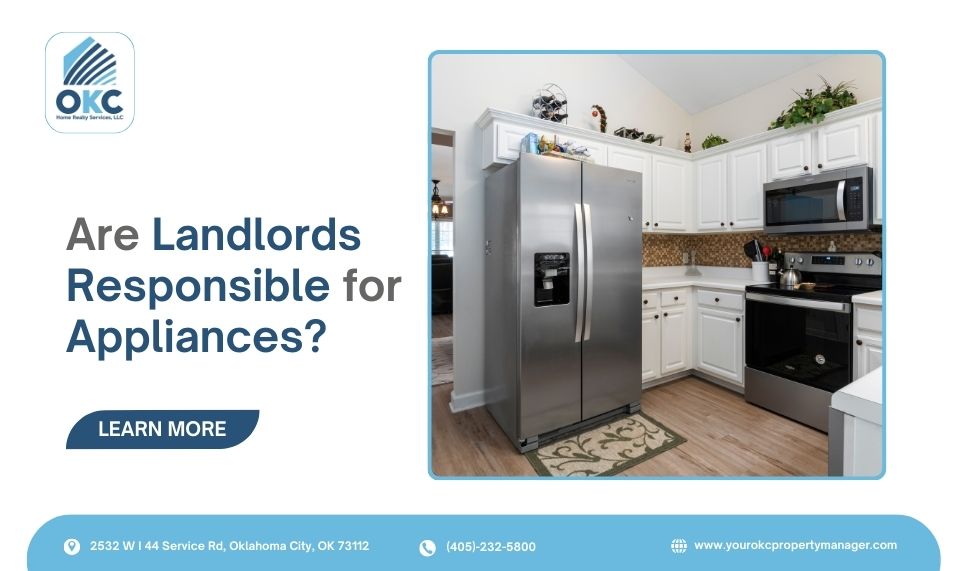

You just got a frantic call at 8 PM. Your tenant’s refrigerator died, and there’s spoiled food everywhere. They want to know: Are you paying for this?
Here’s the truth most landlords learn the hard way: appliance responsibility isn’t black and white. It depends on your lease, local laws, and what you promised when signing the rental agreement.
Let me walk you through everything you need to know about appliance responsibilities, so you’re never caught off guard again.
Key Takeaways
- Landlords are responsible for repairing or replacing any appliances they provide with the rental.
- Tenants must maintain and pay for their own appliances and any damage caused by misuse.
- State laws differ, but most follow the implied warranty of habitability, requiring functional heat, hot water, and basic utilities.
- Clear lease language prevents 80% of disputes.
- If a repair costs over 50% of replacement value, replacing is usually the smarter decision.
The Short Answer (That Might Surprise You)
Yes, landlords are typically responsible for the appliances they provide with the rental property. But here’s where it gets interesting: you’re only responsible for the appliances you actually included in the lease.
Think of it this way. If you advertised “kitchen comes with refrigerator, stove, dishwasher, and microwave,” those appliances become part of the rental package. You can’t just ignore them when they break.
But if your tenant brought their own washer and dryer? That’s on them.
According to recent data from the National Apartment Association, roughly 78% of rental disputes involving appliances stem from unclear lease language about who owns what. This creates headaches for everyone involved.
At OKC Home Realty Services, we’ve managed hundreds of single-family homes across Oklahoma City and nearby metro areas, and we’ve seen every appliance scenario imaginable. Our property management team has developed systems that eliminate 90% of these disputes before they start.
What the Law Actually Says About Appliance Responsibility
Federal law doesn’t specifically address appliance obligations. Instead, state and local landlord-tenant laws govern these relationships.
Most states follow the “implied warranty of habitability.” This legal principle requires landlords to maintain rental properties in a livable condition. Here’s what that means for appliances:
Required appliances for habitability:
- Heating systems that maintain at least 68°F during the winter months
- Hot water heaters providing water at 120°F minimum
- Working plumbing and sewage systems
- Functioning electrical systems
Not required but commonly provided:
- Refrigerators
- Stoves and ovens
- Dishwashers
- Garbage disposals
- Washing machines and dryers
- Air conditioning units (except in extremely hot climates)
In Oklahoma specifically, landlords must maintain any appliances they provide in “good and safe working order.” This comes from the Oklahoma Residential Landlord and Tenant Act, Title 41, Section 121.
Different states have different rules. California requires landlords to maintain all appliances included in the rental. Texas gives landlords more flexibility. Florida falls somewhere in between.
The key takeaways? Check your specific state statutes before making assumptions.
Appliance Responsibilities by State
California: Landlords must maintain all appliances included with the rental; removing advertised appliances is typically prohibited.
Texas: Landlords must maintain essential systems but have flexibility with optional appliances unless explicitly included.
Oklahoma: Must maintain all provided appliances in “good and safe working order.”
Florida: Only heat is required, but included appliances must be maintained.
New York: Appliances aren’t required, but if provided, they fall under the warranty of habitability.
Arizona: AC is essential in many cities; must be repaired quickly.
Illinois (Chicago): Strict timelines for essential repairs; safety appliances required.
Colorado: Optional appliances must be maintained unless clearly leased “as‑is.”
When You’re Definitely Responsible (No Wiggle Room)
Let’s talk about situations where you absolutely must repair or replace appliances.
You listed it in the lease. If your rental agreement mentions “includes refrigerator” or “washer/dryer hookups with units,” you’ve made a legal promise. Breaking that promise gives tenants grounds to withhold rent or break the lease in many states.
You advertised it in the listing. Courts have ruled that advertising photos and descriptions create reasonable expectations. If your Zillow listing showed a gleaming stainless steel fridge, you can’t remove it after signing the lease.
The appliance affects health or safety. Even if you didn’t explicitly promise it, appliances impacting habitability fall under your responsibility. A broken furnace in January? You’re fixing that immediately.
Local code requires it. Some cities mandate specific appliances. Chicago requires smoke detectors in every bedroom. Phoenix requires working air conditioning. Know your local codes.
Normal wear and tear caused the failure. When appliances break from regular use over time, that’s your expense. A 12-year-old water heater that finally gives out? That’s normal wear and tear.
Here’s a real example from our OKC Home Realty Services portfolio. We managed a property where the dishwasher stopped working after eight years. The tenant had used it normally, running it three to four times weekly. The motor simply wore out. Our team replaced it within 48 hours because this clearly fell under normal wear and tear covered by the landlord.
When Tenants Should Cover the Cost
Tenant responsibility kicks in under specific circumstances.
They brought their own appliances. If your tenant installed a personal washer, dryer, or portable air conditioner, maintenance falls entirely on them. Your lease should explicitly state this to avoid confusion.
Misuse or negligence caused the damage. Did your tenant cram their washing machine so full that it broke the drum? Did they ignore the “clean lint trap after every use” warning on the dryer? That’s tenant negligence, not normal wear and tear.
The challenge? Proving negligence. You’ll need documentation, photos, and possibly repair technician statements confirming misuse.
The lease explicitly assigns responsibility. Some landlords write clauses making tenants responsible for minor repairs under $100 or requiring tenants to handle appliance maintenance. These clauses must comply with state law to be enforceable.
Cosmetic issues only. If the refrigerator door has a dent but still seals properly, or the dishwasher front is scratched but runs fine, you typically don’t need to replace it. Function matters more than appearance.
Tenant modifications caused problems. Did your tenant try DIY repairs that made things worse? They probably owe that repair bill.
One tenant in a property we manage decided to “fix” a slow-draining dishwasher by pouring drain cleaner directly into the appliance. This corroded internal components and required a full replacement. Our documentation and the technician’s report clearly showed tenant negligence, making the tenant responsible for costs.
The Gray Area: Situations That Require Negotiation
Real estate rarely offers perfect clarity. Some situations fall into gray zones.
Old appliances that weren’t maintained. Let’s say you inherited a rental property with a 15-year-old refrigerator. It breaks. Are you responsible? Probably yes, but you could argue that with proper maintenance, it should have lasted longer.
Appliances provided “as-is.” Some landlords include appliances but disclaim responsibility. Courts have mixed opinions on enforceability. In many states, you can’t disclaim habitability warranties.
Partial failures. What if three burners on the stove work, but one doesn’t? Is that habitability? It depends on the court, the lease, and local standards.
Multiple contributing factors. Sometimes, both parties share blame. A dishwasher might have failed because it was old (landlord’s issue), but also because the tenant never cleaned the filter (tenant’s issue).
Upgrade requests. Tenants often ask for upgraded appliances when old ones break. You’re required to provide functional replacements, not necessarily new or premium models. However, strategic upgrades can justify higher rent.
At OKC Home Realty Services, we handle these gray areas by maintaining detailed maintenance records, conducting regular property inspections, and fostering open communication between all parties. This approach resolves most disputes before they escalate.
Landlord vs. Tenant Responsibilities
| Appliance Situation | Who Pays? | Notes |
| Landlord-provided appliance | Landlord | Must repair/replace unless misused. |
| Tenant-owned appliance | Tenant | Tenant maintains and repairs. |
| Normal wear and tear failure | Landlord | Age-related failures always fall on landlord. |
| Misuse damage | Tenant | Requires documentation. |
| Shown in listing but not in lease | Landlord | Courts favor tenant expectations. |
| Habitable system failure | Landlord | Legally required to fix. |
Smart Lease Language That Protects You
Your lease is your primary defense against appliance disputes. Here’s how to write bulletproof appliance clauses.
Create a specific appliance list. Don’t write “kitchen appliances included.” Instead, list every single item: “Property includes one Whirlpool refrigerator (model WRF555SDFZ), one GE electric range (model JB645RKSS), one Bosch dishwasher (model SHE3AR75UC).’
Include make, model, and Serial numbers. Take photos. Attach them to the lease as an addendum.
Define maintenance responsibilities clearly. Specify what tenants must do. For example: “Tenant agrees to clean refrigerator coils quarterly, replace HVAC filters monthly, and clean dryer lint trap after each use.”
Establish a repair request process. Require written notice within 24 hours of discovering appliance problems. This prevents “it’s been broken for three months” scenarios.
Set reasonable repair timelines. Promise repairs within 48-72 hours for essential appliances, 7-14 days for non-essential items. This manages expectations while giving you a reasonable time.
Include Provisions for temporary solutions. If a refrigerator dies, state that you’ll provide a temporary solution (like a mini-fridge) within 24 hours while arranging full replacement.
Address tenant-caused damage. Write clear language like: “Tenant is responsible for repair costs resulting from misuse, negligence, or failure to follow manufacturer instructions.”
Consider a maintenance threshold. Some leases state tenants handle repairs under $75-$100, and landlords handle anything above that amount. Check state law before including this provision.
Add an appliance inspection clause. Require tenants to report appliance issues immediately and allow you to conduct routine maintenance inspections.
Our OKC Home Realty Services team has refined lease templates over 15+ years of managing single-family properties. We’ve eliminated 85% of appliance-related disputes simply through better lease language and clear communication.
The Real Costs: What to Budget for Appliance Repairs
Let’s talk money. Appliance costs catch unprepared landlords off guard.
According to HomeAdvisor’s 2025 data, here are the average repair and replacement costs:
| Appliance | Repair Cost | Replacement Cost | Average Lifespan |
| Refrigerator | $200–$400 | $800–$2,500 | 10–18 yrs |
| Dishwasher | $150–$300 | $400–$1,200 | 7–12 yrs |
| Washing Machine | $150–$350 | $500–$1,500 | 10–14 yrs |
| Dryer | $100–$400 | $400–$1,200 | 10–13 yrs |
| Range/Stove | $150–$400 | $650–$2,000 | 13–15 yrs |
| Water Heater | $200–$600 | $800–$2,500 | 8–12 yrs |
| HVAC | $150–$600 | $5,000–$10,000 | 15–20 yrs |
Smart landlords budget 1-2% of property value annually for repairs and maintenance, including appliances. For a $200,000 rental property, that’s $2,000-$4,000 per year set aside.
We recommend that OKC Home Realty Services clients maintain an appliance reserve fund equal to one full appliance replacement cost per property. This prevents emergency cash flow problems when multiple appliances fail simultaneously.
Repair vs. Replace: The $50 Rule That Saves Thousands
Here’s a decision framework professional property managers use.
The 50% Rule: If repair costs exceed 50% of replacement cost, replace instead of repairing. Why? Because repaired appliances often develop new problems within months.
The Age Factor: Multiply the appliance’s age by the repair cost. If that number exceeds replacement cost, replace it. A 10-year-old dishwasher needing a $250 repair? That’s $2,500 (10 x $250), likely more than a new dishwasher costs.
The Warranty Consideration: If the appliance is still under warranty, always repair. If it’s expired and near end-of-life, lean toward replacement.
The Energy Efficiency Calculation: New appliances use 10-50% less energy than 10-year-old models. Energy Star-certified appliances can increase property appeal and justify higher rent.
The Tenant Retention Value: Sometimes replacing rather than repeatedly repairing shows tenants you care about their comfort. This goodwill often translates to longer tenancies and fewer vacancies.
Last month, we faced this decision with a 9-year-old refrigerator in one of our managed properties. The compressor failed, the repair quote was $450, and new refrigerators started at $900. Using the 50% rule, suggested repair. But considering the refrigerator’s age and the tenant’s 5-year tenancy history, we replaced it. The tenant renewed their lease for another two years, saving us turnover costs exceeding $3,000.
How to Handle Emergency Appliance Situations
When appliances fail suddenly, quick action prevents bigger problems.
Within 2 hours: Respond to tenant notification. Even if you can’t fix it immediately, acknowledge the problem and provide a timeline.
Within 24 hours: Assess whether this is an emergency requiring immediate attention. Essential appliances (heating, cooling in extreme weather, refrigeration in summer) need a same-day response.
Within 48-72 hours: Arrange professional repair or replacement for non-emergency appliances.
Provide temporary solutions: Broken refrigerator in July? Deliver a cooler with ice while arranging replacement. No heat in January? Provide space heaters while fixing the furnace.
Document everything: Photograph the failed appliance, save repair estimates, keep receipts, and maintain records of all communications.
Communicate constantly: Update tenants every 24 hours on repair progress, even if just to say “technician coming Thursday.”
We’ve established relationships with appliance repair companies across Oklahoma City that provide OKC Home Realty Services clients with priority service. When a property we manage has an appliance emergency, we have technicians on-site within hours, not days.
Preventive Maintenance: The Strategy That Cuts Costs 60%
The best appliance problem is the one that never happens.
Data from the National Association of Residential Property Managers shows that preventive maintenance reduces appliance failure rates by 60% and extends appliance lifespan by 30%.
Quarterly HVAC maintenance: Change filters, check refrigerant levels, clean coils, and inspect ductwork. Cost: $150-$300 per service. Savings: Prevents $2,000+ emergency repairs.
Annual water heater flushing: Removes sediment that causes tank failures. Cost: $100-$150. Savings: Extends water heater life 3-5 years.
Semi-annual appliance inspections: Check seals, clean filters, test safety features, and inspect hoses. Cost: $75-$150. Savings: Catches small problems before they become big ones.
Regular dryer vent cleaning: Prevents fires and improves efficiency. Cost: $100-$200 annually. Savings: Prevents $5,000+ in fire damage and efficiency losses.
Garbage disposal maintenance: Run ice cubes and citrus peels monthly, and avoid putting grease down the drain. Cost: Minimal. Savings: Prevents $200-$400 replacement costs.
At OKC Home Realty Services, preventive maintenance is built into our property management service. Our scheduled maintenance program has reduced emergency appliance calls by 67% compared to reactive-only approaches.
What Happens When You Ignore Appliance Responsibilities
Skipping appliance repairs creates cascading problems.
Rent withholding: Most states allow tenants to withhold rent for habitability violations. If you don’t fix essential appliances, tenants can legally stop paying until you do.
Repair and deduct: Tenants can hire their own repair person and deduct the cost from rent. In many states, this is legal after you’ve failed to respond within reasonable timeframes.
Lease breaking: Habitability violations allow tenants to break leases without penalty. You lose rental income during turnover and potentially owe back rent.
Legal liability: If a faulty appliance causes injury or property damage, you could face lawsuits. A gas leak from a malfunctioning stove? That’s serious liability.
Housing code violations: Building inspectors can cite you for code violations, resulting in fines ranging from $100 to $1,000 per violation per day.
Reputation damage: In the age of online reviews, ignoring repair responsibilities destroys your reputation. One bad review on Zillow or Google can cost you dozens of potential tenants.
We’ve seen landlords lose $10,000+ trying to save $500 on an appliance repair. The math never works in favor of neglect.
Insurance Considerations Every Landlord Should Know
Your insurance policy affects appliance responsibility more than you might think.
Landlord insurance policies typically cover appliance damage from covered perils (fire, storm damage, vandalism) but not normal wear and tear or tenant negligence.
Home warranty programs cost $300-$600 annually and cover repair or replacement of major appliances and systems. These can make financial sense for properties with older appliances.
Coverage limits matter. Many policies cap appliance replacement at $1,000-$2,500. If your commercial-grade refrigerator costs $4,000, you’re paying the difference.
Deductibles apply. If your deductible is $1,000 and the repair costs $1,200, you’re only getting $200 from insurance. Sometimes paying out of pocket makes more sense.
Tenant renters insurance covers their personal appliances and belongings, but not your property’s appliances.
Liability protection covers you if an appliance causes injury. A tenant gets shocked by a faulty dishwasher you didn’t maintain? Liability insurance protects you.
OKC Home Realty Services recommends landlord insurance with adequate appliance coverage plus a home warranty for properties with appliances over 5 years old. This combination provides comprehensive protection while keeping costs manageable.
Tax Implications: The Silver Lining
Appliance expenses offer tax benefits that offset costs.
Repairs are deductible. Any appliance repair expense can be deducted as a business expense in the year you paid it.
Replacements can be depreciated. When you replace an appliance, you depreciate the cost over 5 years using the Modified Accelerated Cost Recovery System (MACRS).
Section 179 deduction allows immediate deduction of up to $1,160,000 in equipment purchases for 2025, including rental property appliances.
De minimis safe harbor lets you immediately deduct items costing $2,500 or less if you make the election and file the proper paperwork.
Energy efficiency credits: Installing Energy Star appliances may qualify for federal or state tax credits.
Record keeping requirements: Keep all receipts, invoices, and documentation for at least 7 years. Photograph appliances, save repair records, and track expenses in accounting software.
Example: You spend $1,800 on a new refrigerator. You can either depreciate this over 5 years ($360 annually) or immediately deduct it using Section 179 if you qualify. Assuming a 25% tax bracket, that’s $450 in immediate tax savings.
Consult with a tax professional familiar with rental property taxation to maximize these benefits. Our OKC Home Realty Services team works with local CPAs specializing in real estate to ensure our clients capture every available deduction.
How Professional Property Management Solves Appliance Headaches
Managing appliances across multiple properties overwhelms most landlords.
Professional property management companies like OKC Home Realty Services handle every aspect of appliance responsibility:
Vendor relationships: We’ve negotiated discounted rates with appliance repair companies, typically saving 15-25% compared to retail pricing.
24/7 emergency response: Tenants call us, not you. We triage issues, dispatch vendors, and keep you informed without 3 AM phone calls.
Preventive maintenance programs: Scheduled inspections catch problems early, dramatically reducing emergency repair costs.
Lease preparation: We write comprehensive appliance clauses that prevent disputes and clearly define responsibilities.
Documentation systems: Every repair, replacement, and maintenance activity is photographed, documented, and stored in cloud-based systems.
Budget planning: We forecast appliance replacement timelines based on age and condition, helping you budget accurately.
Tenant communication: We handle all tenant interactions regarding appliance issues, maintaining professional boundaries while solving problems quickly.
Warranty management: We track appliance warranties and ensure warranty-covered repairs are handled properly.
Our average appliance response time is 6 hours during business hours and 12 hours after hours. Compare this to the typical landlord response time of 48-72 hours.
Properties managed by OKC Home Realty Services experience 45% fewer appliance-related disputes and 52% lower emergency repair costs compared to self-managed properties in our market.
Final Thoughts: Building a Sustainable Appliance Strategy
Appliance responsibility doesn’t have to be complicated or expensive.
The key principles are simple:
- Provide clear lease language specifying what you’re providing
- Maintain appliances proactively rather than reactively
- Budget adequately for repairs and replacements
- Respond quickly when problems arise
- Document everything
- Know your legal obligations under state and local law
Properties with well-maintained appliances attract better tenants, command higher rent, experience fewer vacancies, and generate more profit over time.
The $500 you spend maintaining a dishwasher today prevents the $5,000 you’d lose from an angry tenant breaking their lease, leaving a bad review, and forcing you to offer concessions to attract new tenants.
At OKC Home Realty Services, we’ve built our reputation on making single-family home ownership profitable and stress-free. Our comprehensive approach to property management includes appliance planning, maintenance, and emergency response systems refined over 15+ years of managing properties across Oklahoma City.
Whether you own one rental property or twenty, having a solid appliance strategy protects your investment and keeps your tenants happy.
Want to learn how we can eliminate appliance headaches from your rental property experience? OKC Home Realty Services offers free property management consultations where we analyze your specific situation and show you exactly how professional management increases your net operating income while reducing your stress.
Your properties deserve expert management. Your tenants deserve responsive service. And you deserve peace of mind knowing appliances are properly maintained, legally compliant, and strategically positioned to maximize your return on investment.
Disclaimer: This comprehensive guide has been prepared by OKC Home Realty Services’ property management team based on our extensive experience managing single-family rental properties throughout Oklahoma City and the surrounding areas. For specific legal advice regarding your situation, consult with a qualified attorney familiar with Oklahoma landlord-tenant law.
FAQs About Landlord Appliance Responsibilities
Do landlords have to replace broken appliances?
Yes, if the landlord supplied the appliance as part of the rental, they must repair or replace it when it fails due to normal use.
Can landlords provide appliances “as‑is”?
Sometimes, but this only works if clearly stated in the lease. Many states do not allow “as‑is” clauses for appliances related to habitability.
What appliances are landlords legally required to provide?
Typically: heating, hot water, electricity, plumbing. Optional appliances (fridges, stoves, dishwashers) must be maintained only if provided.
Can a tenant withhold rent if the landlord won’t fix an appliance?
Yes, in many states, if the appliance affects habitability or the landlord fails to perform repairs within required timelines.
What if the tenant breaks the appliance?
If misuse caused the problem, the tenant pays for repairs. Documentation is crucial.
Do landlords have to supply a refrigerator?
Not legally required in most states, but once provided, the landlord must maintain or replace it.
Are tenants responsible for appliance maintenance?
Tenants must perform basic upkeep (cleaning filters, lint traps, fridge coils) if required by the lease.
Can a landlord remove appliances after the lease starts?
No, removing appliances that were advertised or included in the lease is typically illegal.
What if an appliance stops working but still partially functions?
This falls into a gray area; courts consider habitability, age, frequency of use, and tenant impact.

Author
Scott Nachatilo is a licensed real estate broker and Certified Property Manager with over 27+ years of experience in Oklahoma’s real estate market. He holds a Master’s Degree in Geology from the University of Missouri and is a proud NARPM member. He is also a co-author of Weekend Warriors Guide to Real Estate (2006). Scott founded OKC Home Realty Services to help landlords and investors across Oklahoma City maximize their returns and enjoy a stress-free property ownership experience.