(
(



Looking for a real estate bargain in Oklahoma? Abandoned properties, from crumbling historic homes in Guthrie to vacant lots in Tulsa, offer unique opportunities for investors, DIYers, and first-time buyers. With Oklahoma’s median home price hovering around $198,000 (lower than the national average), these forgotten gems can be snagged for pennies on the dollar through tax auctions, bank negotiations, or legal claims. But tread carefully: knowing how to buy abandoned property in Oklahoma legally isn’t as simple as “finders keepers.” State laws require meticulous research to dodge pitfalls like hidden liens, squatter disputes, or environmental hazards.
Whether you’re eyeing a fixer-upper in Oklahoma City’s up-and-coming neighborhoods, purchasing a rental property, or a rural acreage for homesteading, this guide breaks down Oklahoma’s rules, risks, and rewards. You’ll learn how to legally claim ownership, leverage tax sales, and turn neglected spaces into profitable ventures, all while avoiding costly missteps.
Let’s dig in.
Key Takeaways
- An abandoned-looking property usually still has a legal owner and is not free to claim.
- Investors can find potential properties through county assessor, clerk, and treasurer records, code-enforcement lists, foreclosure platforms, and REO listings.
- Before making an offer, verify the seller’s authority, title, liens, unpaid taxes, legal access, zoning, occupancy, and probate issues.
- Inspect the building or land and budget for repairs, environmental hazards, insurance, legal work, holding costs, and unexpected expenses.
- Purchase through a lawful owner, estate, lender, government agency, or county process, with help from qualified title, legal, and inspection professionals.
How to Buy an Abandoned Property?
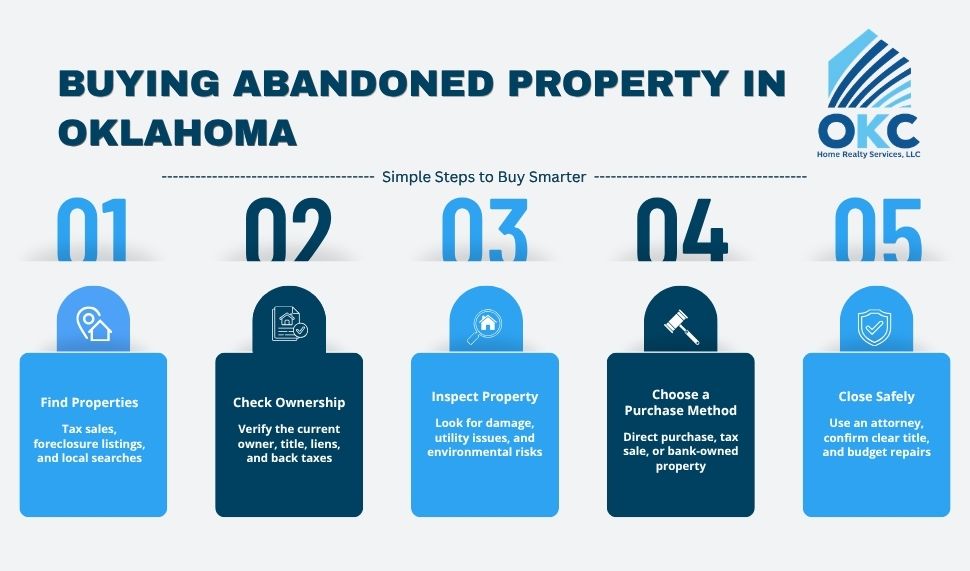
To buy an abandoned property in Oklahoma, follow basic steps: find abandoned properties, check ownership and title, inspect the property, choose a purchase method, and close safely. Before investing, confirm any liens, unpaid taxes, ownership disputes, title problems, and estimated repair costs.
Understand What “Abandoned” Means in Oklahoma
Abandoned properties in Oklahoma are often tax-delinquent, foreclosed, or unclaimed due to various reasons, such as:
- Death of the owner with no heirs stepping forward.
- Extended vacancy, where the owner has moved and stopped paying taxes or the mortgage.
- Natural disasters rendering the property uninhabitable.
- Neglect, including overgrown vegetation, broken windows, or lack of maintenance.
- No legal occupant has claimed ownership or paid taxes for years. Oklahoma does not have a strict statutory definition of abandonment. Instead, courts assess factors like the length of vacancy, unpaid taxes, utility disconnection, and visible neglect.
Keynote: Abandoned property isn’t always “free” or easy to claim. You must follow legal procedures to acquire ownership.
What is the difference between vacant and abandoned property?
| Property status | Meaning | Can an investor buy it? |
| Vacant | Unoccupied but still controlled by an owner | Only if the owner agrees to sell |
| Distressed | Has financial or physical problems | Possibly through the owner, lender, or sale |
| Foreclosed/REO | Lender or government has completed an authorized process | Through the entity controlling the property |
| Tax-delinquent | Property taxes remain unpaid | Not automatically available; it must reach an authorized sale |
| Apparently abandoned | Shows signs of prolonged vacancy or neglect | Ownership and availability must still be verified |
How to Find Abandoned Properties in Oklahoma?
Finding abandoned properties and abandoned buildings can be a great opportunity for real estate investment, whether in rural areas like Adair County or urban centers like Tulsa and Oklahoma City. Here are the best methods to locate them:
1. County Tax Sales & Delinquent Properties
- Annual Auctions: Oklahoma counties auction tax-delinquent properties every year.
- Where to Find Lists: Contact the county treasurer’s office or check their website.
- Example: Tulsa County holds online auctions via RealAuction.
- Redemption Period: Owners have two years to repay taxes with interest (up to 18%) before the buyer can claim the deed.
2. County Clerk & Probate Court
- Check the County Clerk’s Office for probate cases where heirs are unknown or unable to claim the property.
- You may be able to file a petition to purchase such properties through the court, especially in rural areas like McCurtain County.
3. Code Enforcement & City Planning Departments
- Cities like Oklahoma City publish lists of derelict properties that have been flagged for violations.
- Contact the Planning Department or Code Enforcement Office for details on properties that may be available.
4. Online Databases & Foreclosure Listings
- Oklahoma Tax Commission and RealtyTrac provide listings of tax-defaulted or foreclosed homes.
- Zillow Foreclosure Center lists bank-owned (REO) properties.
- Search MLS and listing sites for phrases like “must sell” or “priced below market value” — these often flag distressed sellers open to abandoned or neglected properties.
5. Driving Around & Identifying Neglected Homes
- Physically survey neighborhoods for signs of abandonment, such as overgrown yards, broken windows, or uncollected mail.
- This works well in both urban hubs like Tulsa and small towns across Oklahoma.
6. Unclaimed Property Databases
While not directly listing real estate, the Oklahoma State Treasurer’s Unclaimed Property database may help locate property owners or heirs who have abandoned assets.
Work with a Real Estate Agent: A local real estate agent who specializes in distressed properties can flag abandoned homes before they hit public listings and help you gauge fair market value.
Pro Tip: Focus on cities like Oklahoma City or Tulsa, where urban renewal programs may offer incentives to buyers.
How to Verify Ownership & Liens Before Buying an Abandoned Property?
Before making an offer on an abandoned property, it’s essential to verify ownership and uncover any legal or financial hurdles. Following these steps can ensure a clear purchase:
1. Conduct a Title Search
- Visit the county clerk’s office (e.g., Cleveland County) to trace the deed history and confirm legal ownership. A clean title search confirms the seller is the rightful owner before you spend another dollar on the deal.
- Look for:
- Mortgages (unpaid home loans)
- IRS Liens (debts over $10,000 can block your purchase)
- Judgments (e.g., unpaid contractor bills)
- Cost: Typically $50–$200, depending on the county.
2. Check for Back Taxes
- Oklahoma allows counties to auction tax-delinquent properties.
- Visit the county treasurer’s website to verify any outstanding property taxes before making an offer.
3. Check for Surviving Heirs
- If the previous owner has passed away, unclaimed heirs may have legal rights to the property.
- Use Ancestry.com or hire a skip tracer to locate potential relatives.
4. Hire a Real Estate Attorney
- Hiring a real estate attorney can help uncover hidden claims or legal complications, especially if someone says they own your property, ensuring a smooth transaction.
- They can also assist with clearing title defects and resolving ownership disputes.
5. Inspect for Environmental Hazards
- Abandoned properties may have asbestos, mold, or meth contamination, especially in neglected Oklahoma homes.
- Consider testing before purchasing to avoid costly remediation.
6. Secure Financing
- Many lenders hesitate to finance homes in poor condition, so investors often turn to hard money loans or cash purchases instead.
- Getting pre-approved for financing before making an offer strengthens your bid and speeds up closing.
Contacting the Owner & Understanding Adverse Possession in Oklahoma
If you locate an abandoned property, the first step is to determine whether the owner can be contacted. If possible, follow these steps:
1. Contact the Owner (If Reachable)
- Negotiate directly—some owners may be willing to sell at a low price to avoid tax burdens or maintenance costs.
- If the owner is unresponsive, explore legal options such as tax lien sales or, in rare cases, adverse possession (squatter’s rights).
2. Understanding Adverse Possession in Oklahoma
While uncommon, you may be able to claim ownership of an abandoned property through adverse possession, but strict requirements apply:
Requirements:
- Uninterrupted, open, and hostile possession for 15 consecutive years.
- You must live on the property, maintain it, and pay property taxes during this period.
- The occupation must be without the owner’s permission (this makes the claim “hostile”).
Limitations:
- Adverse possession cannot be used against government-owned land.
- It’s more difficult in urban areas (e.g., Tulsa or Oklahoma City) because owners are more likely to monitor and reclaim properties.
While adverse possession is a long and challenging process, negotiating with the owner or participating in tax lien sales is usually a faster and more reliable path to ownership.
How to Bid at Tax Sales in Oklahoma?
Oklahoma holds annual tax lien auctions, typically in August or September, offering a way to invest in real estate at a lower cost. Understanding the difference between tax lien sales and tax deed sales is crucial before bidding.
1. Tax Lien Sales
- You bid on a tax lien certificate, which gives you the right to collect the owed debt + interest (up to 18%).
- If the owner doesn’t pay within 2–3 years, you can petition for a deed and take ownership.
2. Tax Deed Sales
- Instead of a lien, you buy the property outright at auction.
- Example: In an Oklahoma County tax deed auction:
- The minimum bid equals unpaid taxes + fees.
- The winning bidder gets the deed immediately (no redemption period).
3. Key Considerations Before Bidding
Research the property thoroughly; some may have:
- Major repair needs
- Environmental hazards (e.g., asbestos, foundation issues)
- Existing liens or legal complications
Pro Tip: Attend a few tax sales as an observer before bidding to learn strategies and avoid costly mistakes.
Purchasing an Abandoned Property Through a Quiet Title Action
If ownership of an abandoned property is unclear—such as when heirs cannot be found—you may need to file a quiet title lawsuit to legally establish ownership.
1. What is a Quiet Title Action?
A quiet title lawsuit is a legal process that removes any disputes over property ownership, allowing you to obtain a clear title.
2. Steps to File a Quiet Title Lawsuit
1. File a Petition
- Submit a quiet title lawsuit to the district court in the county where the property is located.
2. Notify Potential Heirs
- Publish a notice in local newspapers (e.g., The Oklahoman) for three consecutive weeks to inform any possible heirs or claimants.
3. Court Hearing
- If no one contests the claim, the judge will grant you legal ownership of the property.
3. Costs & Considerations
- Legal fees typically range from $1,500–$5,000, depending on the complexity of the case.
- This process is especially useful for abandoned properties with unclear ownership, ensuring a clean title for future resale or development.
In some cases, a quiet title action is necessary after someone has paid off delinquent property taxes and is seeking ownership, which is a legal gray area in Oklahoma. Go through the article if you’re wondering whether paying someone else’s taxes gives you the right to take their property.
By using a quiet title action, you can eliminate disputes and secure full ownership, making it a valuable legal tool for real estate investors.
Buying Foreclosed & REO Properties from Banks
Abandoned homes in foreclosure can often be purchased at a discount by negotiating directly with banks. Here are the best ways to secure a deal:
1. Find Foreclosed & REO Properties
- REO (Real Estate Owned) Listings: Banks sell foreclosed properties below market value after they fail to sell at auction.
- Short Sales: If a homeowner owes more than the property’s value, you may be able to negotiate with the lender to buy it at a discount.
- Where to Search:
- Bank websites (e.g., Bank of Oklahoma).
- MLS listings and foreclosure platforms.
2. Negotiation Strategies for REO Properties
Offer Strategy:
- Banks often accept 70–80% of market value for a quick sale.
- Competitive offers with few contingencies are more likely to be accepted.
Key Considerations:
- Properties are sold “as-is”—banks typically won’t cover repairs.
- Conduct a thorough inspection to assess potential costs before making an offer.
By understanding bank-owned property sales, you can negotiate great deals while minimizing risks.
Inspecting & Renovating an Abandoned Property in Oklahoma
Before purchasing an abandoned property, a thorough inspection is essential to avoid unexpected costs and legal issues.
1. Key Areas to Assess
- Structural Integrity: Check the roof, foundation, and walls for major damage.
- Utility Connections: Ensure access to water, electricity, and gas.
- Zoning Restrictions: Rural properties may require septic tanks or wells, so check local regulations.
- Renovation Costs: Budget for repairs; Oklahoma’s average rehab expense is $20–$50 per square foot.
2. Renovation & Resale Considerations
- Permits: Major repairs (e.g., structural changes) require permits from the local Building Services Department.
- Grants & Assistance: Some cities, like Lawton, offer rehab grants for historic homes.
3. Common Repair Costs in Oklahoma
- Roof Replacement: $8,000–$15,000
- HVAC System: $5,000–$10,000
By thoroughly inspecting a property and budgeting for renovations, you can make informed decisions and maximize your investment potential.
Common Pitfalls When Buying Abandoned Properties
Investing in abandoned properties can be rewarding, but there are several risks and challenges to consider. Here’s how to avoid common pitfalls:
1. Hidden Liens & Back Taxes
- Risk: Unpaid HOA fees or IRS liens may transfer to you after purchase. Municipal code violations tied to the property can also carry fines that transfer to the new owner if left unresolved.
- Solution: Always verify property taxes using the Oklahoma Tax Commission’s Ad Valorem Tax Lookup to check for any outstanding balances.
- Title Insurance: Consider purchasing title insurance to protect against any future undiscovered liens or claims.
2. Squatters & Eviction
- Risk: If there are squatters on the property, evicting them can take 3–30 days depending on the situation in Oklahoma.
- Solution: File an unlawful detainer lawsuit to legally remove squatters.
Related Article: How to remove and avoid serial squatters?
3. Market Volatility & Appreciation
- Risk: Rural properties may experience slower market appreciation, making resale more difficult.
- Solution: Carefully research the local market trends before purchasing in less-developed areas.
By being aware of these risks and taking preventative steps, you can safeguard your investment and avoid costly mistakes.
4. Insurance & Vandalism Risk
- Risk: Vacant homes are more prone to vandalism and fire damage, which is exactly why standard home insurance is hard to secure until the property is renovated and occupied.
- Solution: Look into vacant-property or builder’s risk policies as a bridge, and consider basic security (boarding windows, motion lighting) while the property sits empty.
Why Invest in Abandoned Properties in Oklahoma?
Oklahoma offers affordable real estate and investor-friendly laws, making it an attractive market for flippers, landlords, and homesteaders. Here’s why:
1. Low Property Prices & High Potential
- Median Home Value: $198,000 (as of 2023), significantly lower than the national average.
- Abandoned properties can be acquired below market value, creating opportunities for flipping or long-term investment.
2. Low Competition & Rural Opportunities
- Rural areas like Enid and Altus have cheaper properties with less buyer competition.
- These areas can offer high ROI for patient investors willing to wait for market appreciation.
3. Growth Markets: OKC & Tulsa
Oklahoma City and Tulsa are experiencing economic growth, leading to higher demand for flipped homes and rentals.
[Learn more about real estate investing in Oklahoma City before purchasing your next investment property.]
4. Landowner-Friendly Laws
- No state property tax—only county taxes, which average 0.87% of property value.
- Easier property ownership regulations compared to other states.
By staying diligent, working with professionals, and verifying property details, investors can capitalize on Oklahoma’s real estate opportunities while minimizing risks.
Conclusion: Should You Buy Abandoned Property in Oklahoma?
Buying abandoned property in Oklahoma can offer opportunities for real-estate investors, house flippers, land investors, and first-time buyers, but a low purchase price does not automatically make a property profitable. Before making an offer or auction bid, confirm the legal owner, title condition, liens, occupancy, access, zoning, utilities, insurance, and complete rehabilitation cost.
Use a lawful purchase route and work with an Oklahoma real estate attorney, title professional, inspector, and contractor when necessary. If the property has a manageable title, realistic repair budget, and sufficient value after all expenses, it may be worth pursuing. If the deal depends on uncertain ownership or unrealistic returns, be prepared to walk away.
If you plan to convert the property into an Oklahoma City rental, OKC Home Realty Services can help evaluate its rent-ready condition, potential rental income, and ongoing management needs.
1. Can You Buy Abandoned Property by Paying the Property Taxes in Oklahoma?
No. Paying another owner’s property taxes does not transfer the deed or automatically create ownership. The property must be acquired from the legal owner or through an authorized process, such as a qualifying county tax resale. Confirm the current county procedure and obtain title advice before paying or bidding.
2. How Do You Find the Owner of an Abandoned Property?
Start with the county assessor’s parcel database to identify the listed owner and tax-mailing address. Then review county clerk land records for the latest deed, mortgages, and recorded claims. If the owner is deceased, an entity, or difficult to locate, ask a title company or Oklahoma real estate attorney to investigate.
3. Are Abandoned Houses Free to Claim?
Generally, no. An abandoned-looking house normally still belongs to an individual, estate, lender, company, or government entity. Vacancy, unpaid taxes, or visible neglect does not make it free. You need a valid transfer from someone authorized to sell the property or must purchase it through a legally authorized sale process.
4. Can You Enter an Abandoned Property Before Buying It?
Do not enter merely because the property appears vacant. Obtain permission from the record owner, estate representative, lender, government seller, or another party with legal authority. Without permission, entering the building or crossing secured areas may constitute trespass and could expose you to physical hazards and legal liability.
5. What Happens if the Owner of an Abandoned Property Has Died?
Ownership does not disappear when the owner dies. The property may pass through a trust, joint ownership, or an Oklahoma probate proceeding. A court-appointed personal representative may receive authority to sell estate property. Confirm who can legally sign the deed before negotiating, paying money, or beginning title work.
6. Does an Oklahoma Tax-Resale Deed Provide Marketable Title?
Not necessarily. The Oklahoma County Treasurer describes tax resales as buyer-beware sales and states that a tax deed is not a warranty deed or a county guarantee of title. Buyers may need additional title examination or a quiet-title action before a title company, lender, or future purchaser considers the title marketable.
7. Can You Get a Mortgage for an Abandoned House?
Possibly, but severely neglected or uninhabitable properties may not qualify for an ordinary mortgage because of condition, appraisal, title, or insurance problems. Renovation financing may be available; for example, Fannie Mae says a HomeStyle Renovation property need not be habitable at closing. Eligibility, occupancy, and loan terms remain lender-specific.
8. What if Someone Is Living in the Property?
First, determine whether the occupant is an owner, tenant, guest, or unauthorized occupant. Do not change locks, remove belongings, or shut off utilities yourself. After acquiring legal ownership, consult an Oklahoma attorney about the correct notice and court process. Oklahoma law provides remedies for tenants who are wrongfully excluded.
9. Can Adverse Possession Be Used to Obtain an Abandoned Property?
Adverse possession is not a practical shortcut for purchasing abandoned property. Oklahoma generally requires actual, exclusive, continuous, open, notorious, and hostile possession for the applicable statutory period, commonly 15 years. A claimant must prove every element and usually pursue court action, so investors should obtain property-specific legal advice.
10. How Much Should a Landlord Budget for Unexpected Repairs?
Start with a detailed inspection and contractor estimate, then add a contingency reserve. A 10%–20% reserve is a useful starting benchmark; HUD’s rehabilitation materials use that range for certain contingencies. Increase it when utilities are off or access is limited, and separately budget for title, security, insurance, holding, and environmental costs.